
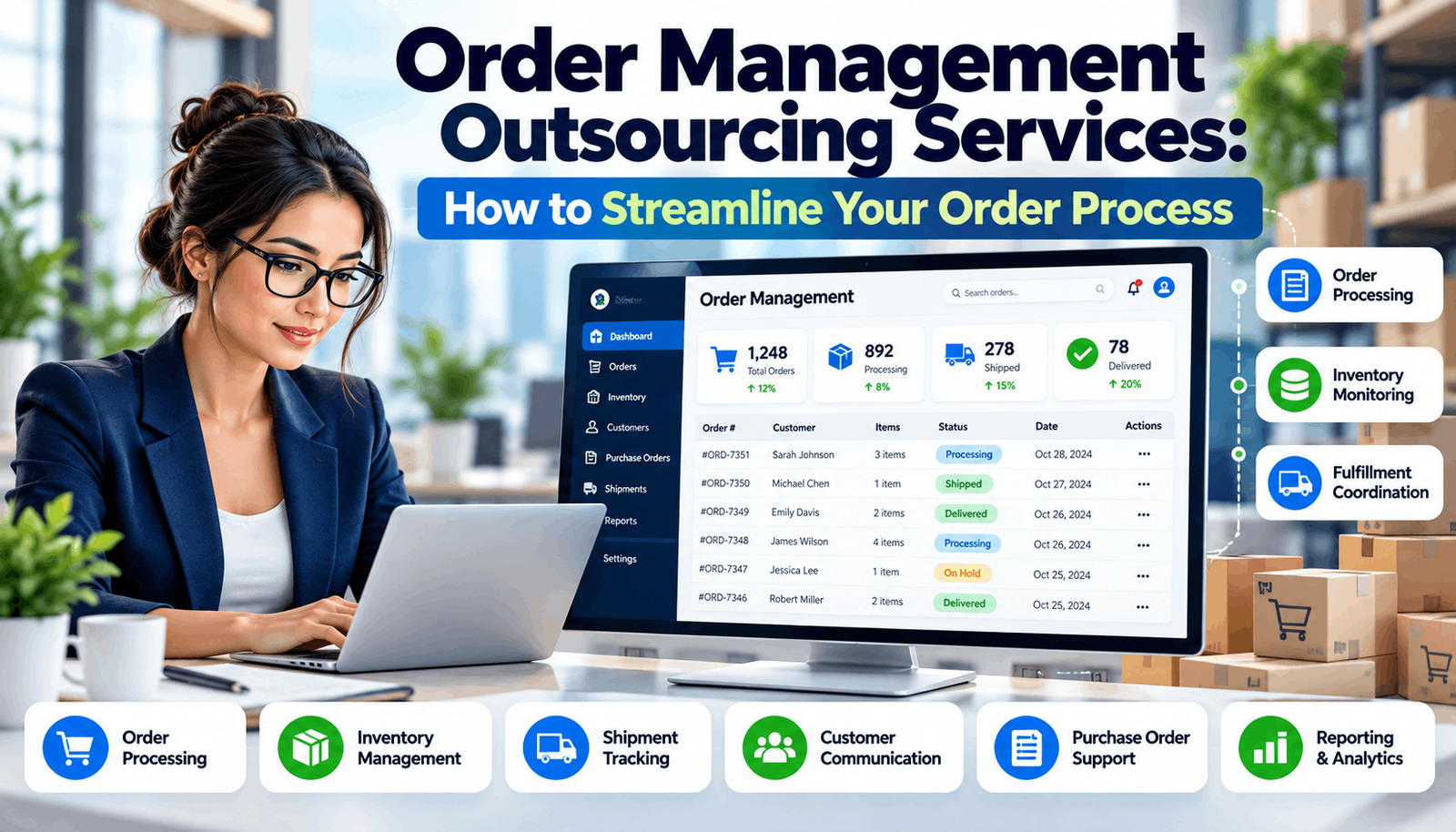
Order Management Outsourcing Services: How to Streamline Your Order Process
Order management outsourcing services help businesses handle routine order processing, maintain accurate records, coordinate fulfillment, and manage customer communication without overwhelming their internal teams.
For growing U.S. businesses, managing orders becomes more demanding as sales increase. More orders bring additional responsibilities, including inventory updates, shipping coordination, customer inquiries, and order tracking.
Without an organized workflow, even simple tasks can create delays. Employees may spend hours updating records, checking order statuses, or answering repetitive questions.
However, businesses do not need to manage every administrative responsibility internally.
By outsourcing selected order-management tasks, companies can create more consistent processes, reduce routine workloads, and allow their internal teams to focus on business growth.
The key is understanding which responsibilities to delegate, how to maintain control, and how to build a workflow that supports daily operations.
What Are Order Management Outsourcing Services?
Order management outsourcing services involve assigning selected order-processing and administrative responsibilities to external professionals or remote teams.
These responsibilities may include order entry, inventory monitoring, shipment tracking, customer communication, purchase order administration, and routine reporting.
The exact services depend on the company’s needs.
For example, an ecommerce business may need assistance processing customer orders and monitoring deliveries. Meanwhile, a wholesale company may require help organizing purchase orders and coordinating supplier communication.
Order management outsourcing does not necessarily mean transferring complete operational control to an outside provider.
Instead, businesses can delegate repeatable administrative work while keeping important financial decisions, purchasing approvals, and operational authority within their organization.
This approach helps establish clear responsibilities across the order-management process.
Why Order Processing Becomes Difficult as Businesses Grow
Order management may seem straightforward when a company handles only a small number of daily transactions.
However, business growth introduces additional complexity.
Each new order requires accurate customer information, product details, inventory availability, and fulfillment coordination.
Furthermore, customers expect clear communication about their purchases.
When employees handle these responsibilities manually, small mistakes can create larger operational problems.
For example, an incorrect shipping address may delay delivery. Similarly, outdated inventory information could cause an order to remain unfulfilled.
Customer inquiries can also accumulate when employees lack time to monitor order updates.
As a result, businesses need reliable processes that help teams manage information consistently.
Outsourcing selected administrative responsibilities can provide additional support without requiring business owners or managers to handle every order personally.
What Order Management Outsourcing Services Can Handle
Businesses can delegate different responsibilities depending on their operations, systems, and staffing requirements.
However, the most suitable tasks usually follow clear procedures and require limited independent decision-making.
Order Entry, Inventory, and Verification
Order entry is one of the most important administrative activities in the order-management process.
Employees must record customer details, product information, quantities, delivery addresses, and order instructions accurately.
A remote professional may help enter information, update order records, check required fields, and identify missing details.
For example, an assistant could review incoming orders and flag incomplete shipping information before the fulfillment team begins processing.
Inventory monitoring is another potential responsibility.
A remote assistant may review approved inventory records, identify low-stock items, and notify the appropriate employee when product availability changes.
However, businesses should maintain clear approval procedures for inventory adjustments, purchasing decisions, and unusual order exceptions.
Fulfillment Tracking and Customer Communication
After a customer places an order, the business must coordinate the next steps.
Depending on the company’s workflow, a remote professional may help monitor fulfillment statuses, organize shipping information, and track delivery updates.
For example, an assistant could identify orders that remain pending beyond the expected processing period.
The assistant can then notify the responsible warehouse, supplier, or operations manager.
Customer communication also plays an important role.
Customers frequently ask about shipping dates, tracking numbers, delayed deliveries, and order changes.
With approved procedures, remote professionals may answer routine questions and escalate complicated cases.
UpSource Media lists ecommerce administration, order processing, inventory support, and customer inquiries among its published virtual-assistance capabilities.
Businesses can learn more through UpSource Media’s ecommerce support guide.
Returns, Reporting, and Exceptions
Returns and order exceptions often require additional administrative attention.
A customer may request a return, report a damaged product, or ask about an incorrect shipment.
An outsourced assistant can help organize requests, update records, gather supporting information, and communicate approved next steps.
However, refund authorization and financial decisions should follow the company’s established approval rules.
Reporting is another useful support function.
A remote professional may prepare routine summaries showing pending orders, delayed shipments, unresolved customer issues, and other operational information.
Consequently, managers can review organized information rather than manually collecting updates from several systems.
How Order Management Outsourcing Services Improve Workflows
A streamlined order process depends on more than completing tasks quickly.
Businesses also need accurate information, clear responsibilities, and consistent communication.
Consider a growing online retailer.
Initially, the owner handles customer orders, inventory updates, shipping questions, and supplier communication.
As the company grows, these responsibilities consume more time.
The owner may spend several hours each day checking order statuses instead of focusing on product development, customer relationships, or business strategy.
By delegating suitable administrative tasks, the company can establish a more organized workflow.
For example, a remote professional could monitor incoming orders, maintain records, track routine fulfillment updates, and organize customer inquiries.
Meanwhile, the owner could continue managing supplier relationships, approving important changes, and making operational decisions.
This separation creates several potential benefits.
More consistent administration: Assigned professionals can follow documented procedures for recurring tasks.
Clearer order visibility: Updated records help employees identify orders requiring attention.
Better workload distribution: Internal employees can focus on responsibilities that require their expertise.
Improved communication: Defined processes help customer service, fulfillment, and management teams exchange information.
Greater operational flexibility: Businesses can evaluate additional remote support as workloads change.
However, these benefits depend on proper training, oversight, and communication.
Outsourcing an unclear process does not automatically make it efficient.
Purchase Order Management Outsourcing: Key Differences
Customer order processing and purchase order management are related, but they serve different purposes.
A customer order records a purchase made by a customer.
A purchase order generally documents a business’s request to buy products or services from a supplier.
Therefore, purchase order management outsourcing focuses more on procurement-related administration.
Depending on the role, a remote professional may help with:
- Preparing purchase order information
- Organizing supplier records
- Updating purchase order statuses
- Monitoring expected delivery dates
- Maintaining supporting documentation
- Coordinating routine supplier communication
- Preparing purchase order reports
For example, a distributor may need help tracking outstanding purchase orders across multiple suppliers.
A remote assistant could organize records and flag delayed deliveries for review.
However, supplier selection, contract negotiations, spending approvals, and purchasing authority should remain with designated company personnel.
Businesses should also confirm that a prospective remote professional has the experience required for procurement-related work.
Signs Your Business Needs More Order Support
Not every business needs outsourced order administration.
However, several operational challenges may indicate that additional support could be useful.
Consider reviewing your workflow when:
- Employees spend too much time updating order records.
- Customer inquiries regularly accumulate.
- Order-status information becomes difficult to track.
- Shipping follow-ups consume management time.
- Inventory records require frequent manual updates.
- Order documentation becomes inconsistent.
- Routine administrative tasks delay other responsibilities.
- Growing order volume creates recurring backlogs.
The important question is not simply whether your business is busy.
Instead, identify which tasks consume employee time without requiring specialized expertise or management authority.
For example, an operations manager may need to resolve fulfillment problems but may not need to personally update every tracking record.
Delegating appropriate administrative work can create a clearer division of responsibilities.
How to Start With Order Management Outsourcing Services
Successful outsourcing begins with preparation.
Before hiring remote support, businesses should review their existing processes and establish clear expectations.
Define Workflows and Approval Rules
Start by documenting how orders move through your business.
Identify what happens when an order arrives, how employees verify information, who checks inventory, and how the fulfillment team receives instructions.
Next, determine which responsibilities can move to a remote professional.
For example, routine order updates may follow a standard procedure. However, pricing changes, refunds, and unusual purchasing decisions may require approval.
Create simple standard operating procedures that explain:
- What starts each task.
- Which systems employees should use.
- What information they must check.
- How to complete the task.
- When to notify another department.
- Which situations require management approval.
Clear instructions reduce confusion and support consistent performance.
Protect Data and Review Performance
Remote order support may require access to customer records, ecommerce platforms, inventory dashboards, and order-management software.
Therefore, businesses should provide only the permissions necessary for assigned responsibilities.
Use individual accounts where possible, enable multifactor authentication, and review access regularly.
The Federal Trade Commission’s cybersecurity guidance for small businesses provides useful recommendations for protecting business information and managing third-party access.
Once the company establishes appropriate controls, begin with a limited set of responsibilities.
For example, start with order-status monitoring and routine customer communication.
Then review accuracy, task completion, communication quality, and escalation procedures.
As the workflow becomes more consistent, the business can consider expanding the role.
Choosing Order Management Outsourcing Services for Your Business
Selecting an outsourcing provider requires more than comparing hourly rates.
The provider should understand your business model, administrative requirements, and existing systems.
Before making a decision, consider several questions.
Does the provider understand your industry?
An ecommerce retailer may need different support from a wholesale distributor.
Can the remote professional use your existing systems?
The person should be comfortable learning or working within your order-management platform, inventory software, and communication tools.
How will responsibilities be defined?
A clear role description should explain which tasks the professional handles and which decisions remain internal.
What communication procedures will the team follow?
Remote professionals need reliable ways to contact managers, fulfillment teams, and customer service employees.
How will performance be evaluated?
Establish expectations for accuracy, turnaround time, documentation, and appropriate escalation.
What security measures are required?
Confirm how the company will manage credentials, customer information, system permissions, and access removal.
The right provider should fit your workflow rather than force your business into an unsuitable process.
How UpSource Media Supports Order Processing
UpSource Media provides virtual staffing and remote business support for companies seeking additional operational capacity.
Its published service areas include ecommerce support, customer support and relations, administrative assistance, and other virtual business functions.
Within ecommerce support, UpSource Media identifies activities such as online-store management, product-listing updates, order processing, inventory-related administration, and customer inquiries.
These capabilities are relevant to businesses evaluating remote order-processing support.
For example, an ecommerce company may need assistance maintaining product information, organizing customer orders, and responding to routine purchase-related questions.
Meanwhile, another business may require broader administrative assistance to support its internal operations team.
UpSource Media also discusses ecommerce administration and order processing in its back office support services guide.
Businesses can explore the company’s available services or learn more about its remote staffing approach through Why UpSource.
The best starting point is to identify your company’s specific workload and determine which responsibilities can be handled effectively by a remote professional.
Frequently Asked Questions
Can Order Management Outsourcing Services Work for Small Businesses?
Yes. Small businesses can outsource suitable order-processing responsibilities when they have clear procedures and appropriate oversight.
For example, an online retailer may delegate routine order updates, shipment tracking, and customer inquiries while retaining control over pricing, refunds, and purchasing decisions.
The decision should depend on workload and business requirements rather than company size alone.
Does Outsourcing Replace Order Management Software?
No. Order management software and outsourced administrative support serve different purposes.
Software helps businesses record, organize, and track order information.
Remote professionals can use those systems to maintain records, monitor exceptions, coordinate communication, and complete assigned administrative tasks.
Therefore, businesses may benefit from combining suitable software with trained remote support.
What Is the Difference Between Order Processing and Fulfillment?
Order processing focuses on receiving, verifying, recording, and coordinating customer orders.
Fulfillment involves preparing, packing, and shipping products to customers.
The two functions work together. However, outsourcing order administration does not automatically mean outsourcing physical warehousing or delivery operations.
Can a Remote Assistant Manage Purchase Orders?
A qualified remote assistant may support selected purchase order administration tasks.
These responsibilities could include preparing records, monitoring order statuses, organizing supplier information, and tracking expected deliveries.
However, companies should retain appropriate control over purchasing approvals, supplier agreements, and financial authority.
How Can Businesses Measure Outsourced Order Support?
Performance should reflect the responsibilities assigned to the professional.
Useful measures may include order-entry accuracy, administrative turnaround time, record completeness, customer response times, and appropriate escalation.
For example, an assistant responsible for tracking shipments should be evaluated on accurate monitoring and communication rather than delays caused by shipping carriers.
Build an Order Process That Scales
Order management outsourcing services can help businesses organize recurring administrative tasks, maintain clearer order records, and create more consistent communication across their operations.
However, successful outsourcing requires a defined workflow.
Start by identifying repetitive responsibilities. Next, document your procedures, establish approval rules, and provide appropriate system access.
Then evaluate how remote professionals can support your existing team.
The objective is not simply to move work outside your company. Instead, it is to build an order-management process that remains organized as business demands change.
For U.S. companies exploring remote support for ecommerce administration, customer communication, inventory-related tasks, and other recurring operations, UpSource Media offers virtual staffing solutions worth considering.
Ready to streamline your order-related administrative workload?
Contact UpSource Media to discuss your business requirements and explore suitable remote staffing support.