
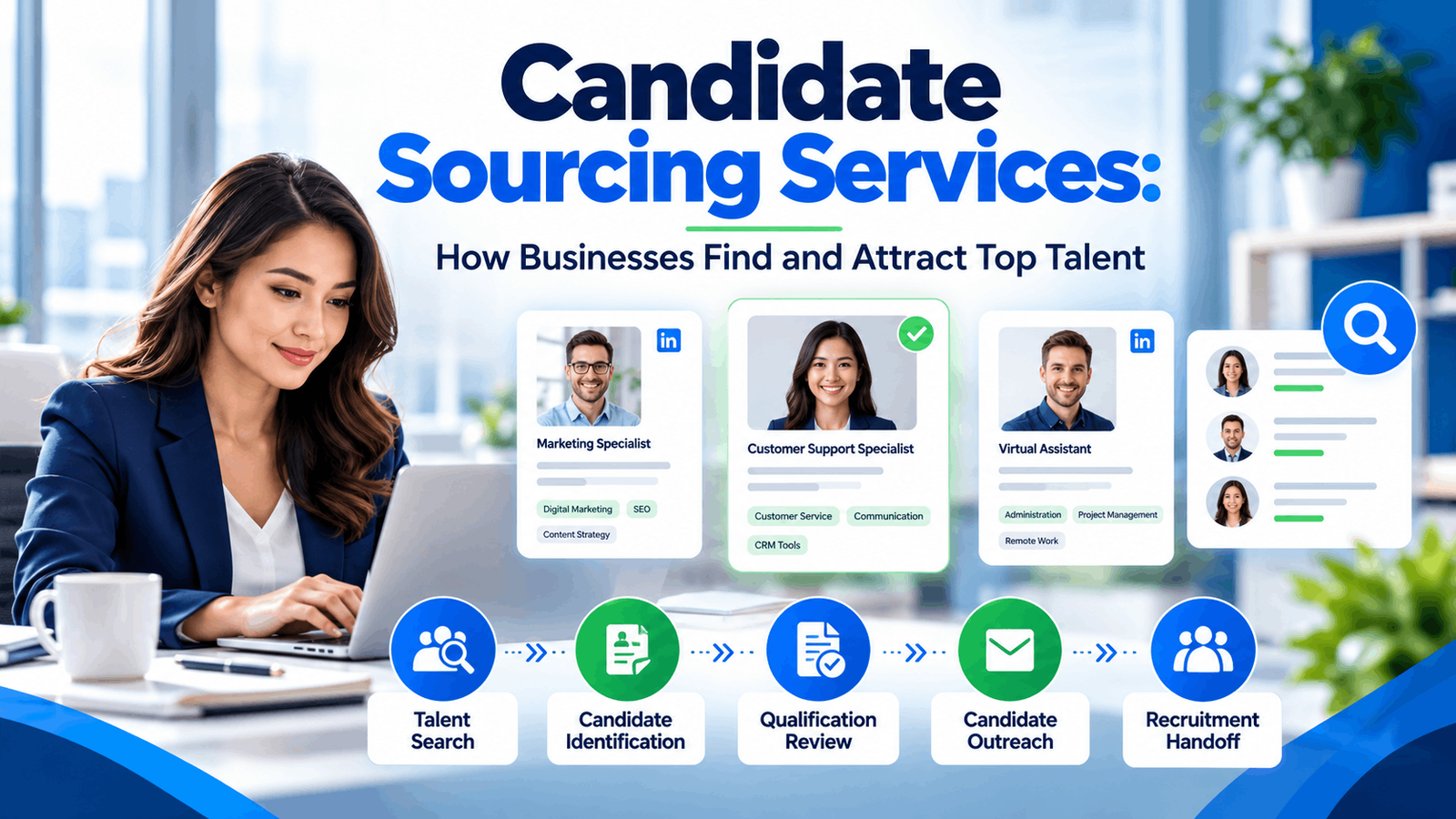
Candidate Sourcing Services: How Businesses Find and Attract Top Talent
Candidate sourcing services help U.S. businesses identify and connect with professionals who may be a good match for open roles. Rather than waiting for applications alone, employers can search for relevant experience, make thoughtful contact, and organize potential candidates for review.
A growing company might need a customer support lead, an operations coordinator, and a bookkeeper at the same time. Finding people with the right skills takes planning, especially when managers are already responsible for daily operations. As a result, a structured sourcing process can make that work more manageable without replacing interviews or hiring decisions.
This guide explains how sourcing works, where businesses find potential employees, and what to consider before outsourcing part of the process.
What Are Candidate Sourcing Services?
Candidate sourcing services cover the early work of finding prospective employees, comparing available qualifications with a job profile, and making initial contact when appropriate. The result is an organized pool of people for recruiters or hiring managers to evaluate.
Posting a vacancy invites interested applicants to come to the employer. Sourcing takes a different route by looking for professionals who may not have applied or may not be actively seeking a new position. In practice, both approaches can work together.
Importantly, finding a promising profile does not establish that the person is available, interested, or qualified for employment. Instead, those details still need to be confirmed through the employer’s recruitment process.
Candidate Sourcing Services vs. Recruiting: Key Differences
Sourcing concentrates on identifying potential candidates and starting relevant conversations. By comparison, recruiting covers a wider process that can include screening, interviews, assessments, offers, and onboarding coordination.
For example, a sourcing specialist might locate an experienced executive assistant, document relevant experience, and send an approved introduction. From there, a recruiter could confirm the person’s interest, arrange interviews, and support the employer’s selection process.
Smaller organizations may assign both functions to one person. However, separating the responsibilities can help growing teams understand who owns each step.
How Candidate Sourcing Services Work
A useful sourcing process begins before anyone searches for names. For that reason, clear requirements, appropriate outreach, and reliable records matter more than the size of a candidate list.
Step 1: Define the Ideal Candidate Profile
Start with the work the new employee will actually perform. Identify essential skills, relevant experience, schedule expectations, and any qualifications that are genuinely necessary.
For a remote customer support role, requirements might include experience handling customer inquiries, familiarity with a help desk platform, and availability during defined U.S. business hours. Then distinguish those essentials from preferences so the search does not become unnecessarily narrow.
Step 2: Find Candidates Through Relevant Channels
Choose sources that match the role instead of searching every platform indiscriminately. Professional networks, industry groups, employee referrals, job boards, and approved recruitment databases may all be useful.
An administrative position may attract suitable applicants through general professional networks. By contrast, a specialized technical role may require outreach within a more focused industry community.
Step 3: Review Qualifications Before Outreach
Compare each potential candidate’s available information with the documented requirements. Look for relevant experience and skills, but avoid treating an online profile as proof of credentials or work eligibility.
Where details are missing, mark them as unconfirmed. Later, recruiters can verify important information through appropriate screening steps.
Step 4: Contact Candidates Professionally
An effective first message explains the opportunity without overwhelming the recipient. Mention the role, the main responsibilities, the working arrangement, and a clear way to express interest.
Personalized outreach should be accurate and respectful. Also follow the communication rules of the platform being used, as well as applicable privacy requirements.
Step 5: Record Responses and Hand Off Candidates
Keep approved candidate information in an applicant tracking system or another secure recruitment tool. For consistency, record the position, source, outreach date, response, and next action so team members do not duplicate work.
Once a person confirms interest, prepare a concise handoff for the recruiter or hiring manager. That summary can distinguish verified facts from information still requiring confirmation.
Where Businesses Find Qualified Candidates
The best sourcing channel depends on the position, location, and experience required. Combining a few relevant sources often makes more sense than relying on a single website.
Professional Networks and Industry Communities
Professional networking platforms can help teams identify people with experience in particular roles. In addition, industry associations and specialized communities may offer context for technical or niche positions.
However, profile details can become outdated. Instead, treat them as starting points for a conversation, not as final evidence of qualifications.
Employee Referrals and Previous Applicants
Current employees may know people who would be interested in an opening. Meanwhile, a company’s existing applicant records may contain individuals who previously expressed interest in similar work.
Use those records only when renewed contact and data handling are appropriate. Although referrals can add useful leads, employers should also use other channels to avoid limiting the candidate pool.
Benefits of Outsourced Candidate Sourcing Services
Outsourced candidate sourcing services allow a business to delegate defined research, outreach, and coordination tasks to an external team. For example, this arrangement can help when hiring managers need more capacity but want to retain control over interviews and employment decisions.
How Candidate Sourcing Services Support Internal Teams
Searching profiles, updating records, and coordinating initial communication all take time. With clear task ownership, internal recruiters can spend more attention on candidate conversations, assessments, and decisions.
A More Organized Talent Pipeline
Consistent documentation makes it easier to see who has been contacted and what should happen next. A smaller, well-researched list can be more useful than a large spreadsheet of loosely matched profiles.
Flexible Support as Hiring Needs Change
Recruitment demands can rise during an expansion or a seasonal hiring period. Depending on the provider’s service model, businesses may be able to adjust the scope of sourcing support without assigning every task to an existing employee.
Before agreeing to an arrangement, confirm deliverables, communication expectations, and pricing. Above all, external sourcing should complement the company’s recruitment process rather than create confusion about responsibilities.
Remote Work Candidate Sourcing Services
Remote work candidate sourcing services focus on identifying professionals for roles that can be performed away from a traditional office. Although a wider geographic search can be useful, remote availability alone does not establish suitability.
Consider whether a candidate has the skills to work independently, communicate clearly, and use the tools required by the position. In addition, schedule overlap, access to appropriate equipment, and the ability to handle sensitive information may matter.
For example, a remote scheduling coordinator who answers live calls may need dependable coverage during U.S. business hours. By comparison, an analyst producing weekly research reports might have more flexibility, provided deadlines and collaboration expectations are clear.
Employers should also confirm relevant work authorization, employment classification, and legal requirements for the proposed arrangement. Therefore, these issues should not be left to assumptions about where a candidate lives.
Candidate Sourcing Example: Hiring for Two Roles
Imagine a U.S. property management company looking for a remote administrative coordinator and an on-site leasing specialist. Although both positions support the same business, they require different sourcing strategies.
The coordinator’s profile emphasizes scheduling, document organization, communication, and remote collaboration. By contrast, the leasing position requires location-specific availability and experience with tenant-facing responsibilities.
A sourcing team can search suitable channels for each role, document relevant qualifications, and contact promising professionals with accurate position details. Afterward, interested candidates move to the employer’s screening and interview process.
This approach does not guarantee a hire. Instead, it gives the company a clearer way to compare candidates and manage the early stages of recruitment.
How to Choose Candidate Sourcing Services
A sourcing provider should understand the roles you need to fill and explain exactly which tasks it will perform. Ask practical questions before comparing prices.
Ask About Candidate Identification and Screening
Find out how the provider develops search criteria and checks preliminary qualifications. Also clarify whether its work stops at identifying prospects or includes outreach, screening, and interview scheduling.
Confirm Reporting, Data Protection, and Ownership
Request a sample candidate report and ask how often progress updates will arrive. Additionally, discuss who can access candidate information, where it will be stored, and how records will be handled when the engagement ends.
Review Pricing and Service Expectations
Compare proposals using the same scope of work. For example, a lower quoted fee may not include the same research, outreach, or reporting responsibilities as another provider’s offer.
Set realistic review points rather than expecting an immediate list of perfect candidates. Specialized positions and narrow requirements may need more research.
Measuring Candidate Sourcing Results
The number of names collected is only one part of performance. Instead, useful measures show whether sourcing activity produces relevant, well-documented candidates.
Track the proportion of sourced profiles that match the essential job requirements. In addition, review outreach responses, qualified handoffs to recruiters, record accuracy, and the time required to assemble an initial candidate shortlist.
Equally important, recruiter feedback adds context. If most profiles are rejected for the same missing skill, the search criteria or qualification review may need to change.
Avoid judging a sourcing specialist solely by completed hires. Compensation, interview outcomes, candidate decisions, and final offers are often controlled by other parts of the hiring process.
Common Candidate Sourcing Mistakes
Even an active search can underperform when the process lacks clear direction. Several avoidable problems deserve attention.
Unclear Job Requirements
Vague descriptions lead to inconsistent candidate selection. First, write down the skills and responsibilities that matter before searching, then update the profile when the hiring manager clarifies a requirement.
Volume Without Relevance
A long list may look productive while offering few suitable people. Instead, prioritize verified, job-related information and explain why each candidate appears relevant.
Poor Communication or Follow-Up
Generic messages can leave candidates uncertain about the opportunity. Use clear introductions, respect responses, and keep accurate notes so people are not contacted repeatedly without a reason.
U.S. Hiring Compliance and Candidate Outreach
Sourcing criteria should reflect legitimate job requirements. The U.S. Equal Employment Opportunity Commission explains how federal employment discrimination rules apply to recruitment, advertising, and hiring.
For small employers, the EEOC also provides recruiting and hiring guidance. Together, these resources can help teams understand why consistent, job-related criteria matter.
Privacy, accessibility, recordkeeping, and state-specific employment requirements may also affect the process. Employers should establish appropriate procedures and seek qualified legal guidance when necessary, particularly for cross-border or remote arrangements.
UpSource Media and Remote Staffing Support
UpSource Media focuses on virtual employment and remote staffing support for businesses. Its services overview covers several operational areas, while the Why UpSource page describes the company’s staffing approach.
Businesses exploring recruitment support can also read UpSource Media’s article about virtual staffing services. It offers additional context for planning roles and building remote teams.
Because sourcing, screening, and recruitment coordination are not identical services, confirm which activities UpSource Media can provide for your specific hiring needs. Ultimately, a clear discussion of responsibilities and expectations is the best starting point.
Candidate Sourcing Services: Frequently Asked Questions
Can Small Businesses Use Candidate Sourcing Services?
Yes. A small company may benefit from help identifying candidates when its managers lack time for a sustained search. Still, the decision should depend on hiring needs, budget, and the tasks included in the service.
Do Candidate Sourcing Services Handle Interviews and Hiring?
Not necessarily. For example, some providers focus on research and initial outreach, while others offer additional recruitment support. Therefore, confirm the scope in writing before work begins.
How Long Does Candidate Sourcing Take?
Timelines vary with the role, location, required skills, and responsiveness of potential candidates. Instead, agree on milestones for research, outreach, and shortlist reviews rather than assuming every position follows the same schedule.
How Are Remote Candidates Evaluated?
Employers should assess job-related experience, communication, schedule compatibility, and ability to use required tools. Interviews, work samples, and any necessary credential checks can help confirm details that sourcing alone cannot establish.
What Makes Candidate Sourcing Services Effective?
Clear job criteria, relevant search channels, respectful outreach, accurate records, and timely recruiter feedback all contribute. Over time, results can improve when the sourcing team and hiring manager regularly review what works and what needs adjustment.
Build a Better Hiring Pipeline
Candidate sourcing services give businesses a structured way to look beyond incoming applications and connect with people who may fit their open roles. The strongest process emphasizes relevance, candidate experience, reliable documentation, and responsible hiring practices.
For U.S. employers considering remote staffing, the next step is to define the positions and decide which sourcing or recruitment tasks need outside support. Contact UpSource Media to discuss your staffing requirements and confirm which services are available for your team.