
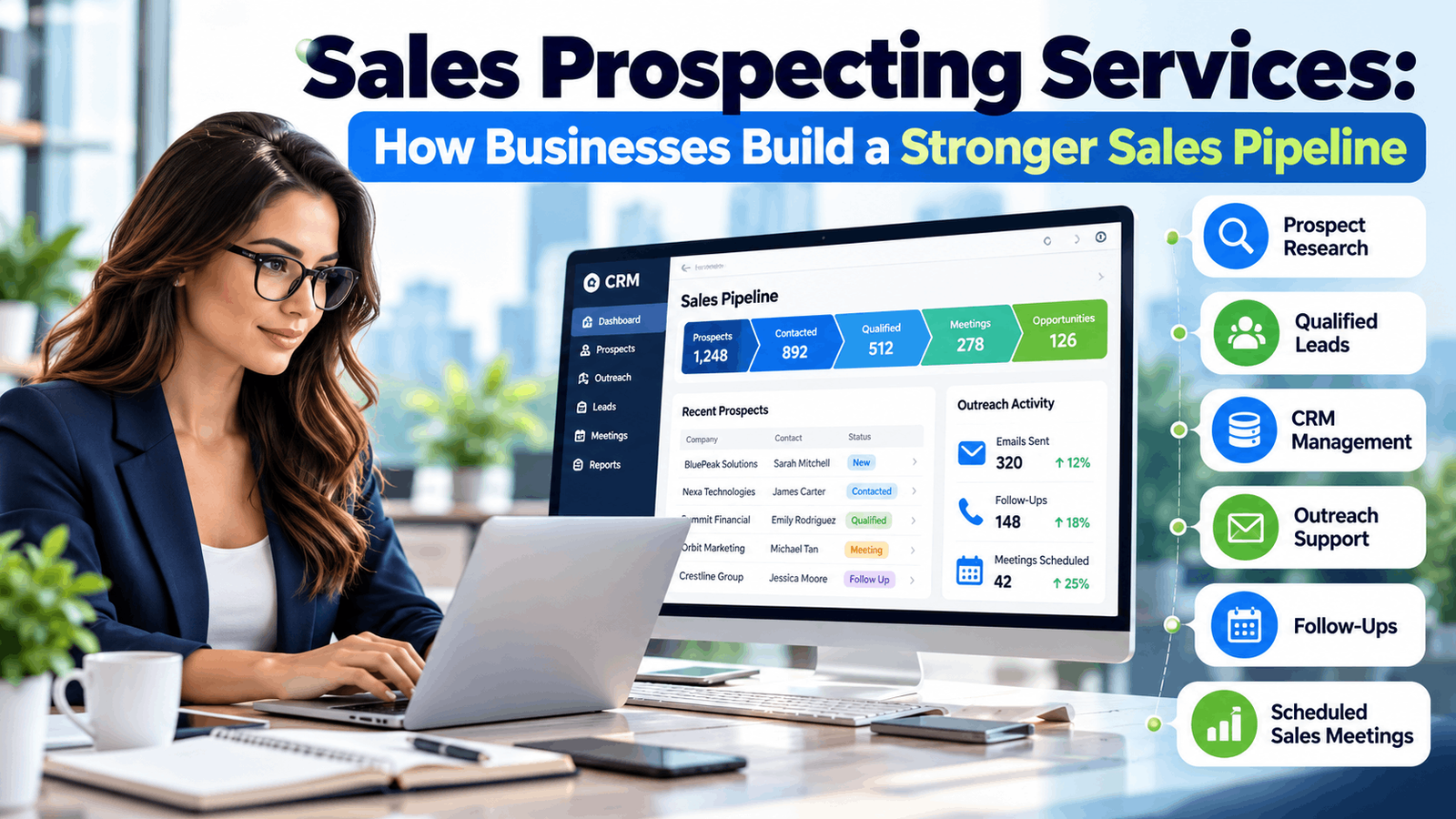
Sales Prospecting Services: How Businesses Build a Stronger Sales Pipeline
Sales prospecting services help businesses identify potential customers, organize prospect data, support outreach, maintain CRM records, and keep early-stage sales activity moving consistently. For growing U.S. companies, this work can become increasingly important as sales goals expand and internal teams have less time for repetitive prospect research and follow-up.
A strong sales pipeline does not begin with the sales call. It starts much earlier.
Someone must define the target market, find relevant companies, identify the right contacts, verify information, organize records, prepare outreach, document activity, and make sure promising prospects do not disappear because nobody followed up.
Sales representatives can handle these tasks themselves. However, every hour spent researching contact information or cleaning CRM records is an hour they cannot spend talking with qualified prospects, developing relationships, preparing proposals, or advancing active opportunities.
That is why businesses often look for ways to separate prospecting support from the higher-value parts of the sales process.
What Are Sales Prospecting Services?
Sales prospecting services support the activities that happen before and around the first meaningful sales conversation.
The exact scope varies by company. A business may need help researching target accounts, identifying decision-makers, maintaining prospect records, supporting approved outreach, scheduling appointments, or organizing follow-up activity.
In other cases, the role may focus heavily on research and CRM administration while internal sales representatives handle all direct communication.
The objective is not simply to create the largest possible contact list.
Instead, effective prospecting should help a business build an organized pool of potential customers who match defined targeting criteria and can move through a structured sales process.
UpSource Media’s published content identifies lead generation, prospect research, CRM updates, lead organization, appointment scheduling, and follow-up activities as examples of work that remote professionals can support. UpSource Media
Businesses can explore UpSource Media’s services to understand its broader remote staffing capabilities.
Why Prospecting Becomes a Sales Bottleneck
Prospecting requires consistency.
A salesperson may have a productive week filled with prospect research and outreach. Then several active opportunities demand attention. Research slows down, follow-ups become inconsistent, and fewer new prospects enter the pipeline.
The effect may not be obvious immediately.
Existing opportunities can keep the sales team busy for a while. However, if prospecting activity repeatedly stops whenever sales representatives become occupied, the top of the pipeline can become inconsistent.
This creates a capacity problem rather than simply a motivation problem.
Sales professionals need time for conversations, discovery, relationship development, proposals, negotiations, and closing activities. Meanwhile, prospecting also requires regular attention.
Separating appropriate support tasks can help both areas receive the attention they need.
How Sales Prospecting Services Strengthen the Pipeline
A stronger pipeline starts with a repeatable process.
Instead of researching prospects only when the sales team has spare time, businesses can establish clear responsibilities for identifying, organizing, and preparing potential opportunities.
For example, a remote prospecting professional might research companies that match approved criteria. Next, that person could identify relevant contacts, organize the information in the CRM, and flag records that require review.
The sales team then begins with better-organized information.
This does not guarantee that a prospect will become a customer. However, it can create a more structured foundation for sales activity.
The difference is important.
Prospecting support should improve the process behind pipeline development rather than promise sales outcomes that no provider can guarantee.
What B2B Sales Prospecting Services Can Support
B2B sales prospecting services can cover several recurring activities, depending on the company’s sales model and the provider’s capabilities.
The following tasks are common areas businesses may evaluate for delegation.
1. Ideal Customer Profile Research
Good prospecting starts by defining who the business wants to reach.
Before asking someone to build a list, clarify the characteristics of a suitable prospect.
Those criteria might include:
- Industry
- Company size
- Geographic market
- Business model
- Relevant job titles
- Organizational characteristics
- Products or services used
- Specific business needs
- Other qualification criteria
A prospecting professional can then research companies according to those standards.
Without clear criteria, teams may create large databases filled with companies that have little connection to the actual offer.
Therefore, quality begins with targeting.
2. Prospect Research
Once the target market is clear, research can begin.
This work may involve finding companies that match the approved profile, reviewing publicly available business information, identifying relevant contacts, and organizing useful details for the sales team.
Research should serve a specific sales purpose.
For example, knowing that a company operates in the right industry may not be enough. The sales team may also need to understand its size, location, business model, or which role is likely to influence the purchasing decision.
A documented research process helps maintain consistency across prospect records.
3. Contact and Decision-Maker Research
Finding a company is only the first step.
The sales team also needs to know who may be relevant to the conversation.
Depending on the product or service, that person could work in operations, marketing, finance, technology, human resources, procurement, or executive leadership.
Prospecting support can help identify appropriate roles and organize publicly available business contact information according to the company’s procedures.
However, businesses should establish standards for data sourcing and outreach compliance before building large contact databases.
Accurate targeting is more useful than simply collecting as many names as possible.
4. CRM Data Management
A CRM becomes less useful when prospect information is incomplete, duplicated, outdated, or inconsistently formatted.
Unfortunately, maintaining clean records requires ongoing attention.
A sales prospecting professional may support tasks such as:
- Adding approved prospect records
- Updating contact information
- Organizing companies and contacts
- Applying approved tags or stages
- Recording prospecting activity
- Identifying duplicate records
- Updating notes
- Maintaining required CRM fields
- Flagging incomplete information
- Preparing prospect lists for sales representatives
Consistent CRM administration gives the sales team a clearer view of prospecting activity.
Furthermore, it reduces the need for sales representatives to spend valuable selling time performing routine data entry.
5. Lead Qualification Support
Not every prospect deserves the same level of attention.
Businesses can establish qualification criteria that help the team prioritize opportunities.
For example, a company may decide that prospects need to meet specific industry, company-size, geographic, or operational requirements before moving to the next stage.
A prospecting professional can help review available information against those criteria.
However, qualification rules should come from the business.
The support professional follows the process; sales leadership determines what makes a prospect valuable.
6. Outreach Preparation
Prospecting support can also help prepare approved outreach activity.
Depending on the company’s workflow, this may include organizing contact lists, preparing approved templates, researching personalization details, maintaining outreach records, and ensuring follow-up tasks appear in the correct system.
Businesses should avoid treating outreach as a volume contest.
Sending more messages does not automatically create better opportunities.
Instead, outreach should align with the target audience, the company’s positioning, and applicable communication requirements.
For commercial email in the United States, the FTC explains that the CAN-SPAM Act establishes requirements for commercial messages and applies to business-to-business email as well. Businesses remain responsible for compliance even when another company handles email marketing on their behalf. Federal Trade Commission
Companies using email prospecting should review the FTC’s CAN-SPAM compliance guide before establishing outreach procedures.
7. Follow-Up Administration
Prospects rarely move through a sales process because of one administrative action.
Follow-up requires organization.
A remote professional may help track approved follow-up schedules, update CRM activity, prepare reminders, organize responses, and flag prospects that require attention from a sales representative.
The key is establishing clear ownership.
If everyone assumes someone else will follow up, promising conversations can become inactive.
Therefore, businesses should define who owns each stage of the prospecting and sales process.
8. Appointment Coordination
Once a prospect expresses interest, scheduling can create another layer of administrative work.
Someone may need to provide available times, confirm the meeting, update calendars, record the appointment in the CRM, and ensure the sales representative has relevant information before the conversation.
These steps are straightforward, but they still require time.
Delegating appointment coordination can help sales professionals focus more attention on preparing for and conducting the actual conversation.
Sales Prospecting Services vs. Lead Generation
Sales prospecting and lead generation are closely related, but businesses may use the terms differently.
Lead generation often refers broadly to attracting or identifying potential customers through activities such as marketing, referrals, advertising, content, events, or outbound campaigns.
Sales prospecting usually focuses more directly on identifying potential buyers and initiating or supporting the early stages of sales engagement.
In practice, the two functions can overlap.
For example, a remote professional might research prospects, organize lead data, maintain CRM records, support approved outreach, and coordinate appointments. Those responsibilities could reasonably support both lead generation and sales prospecting.
The terminology matters less than the workflow.
Before hiring, define exactly which responsibilities the role will own.
Keep Salespeople Focused on Selling
One reason businesses explore prospecting support is simple: sales professionals have limited time.
Consider a salesperson responsible for researching accounts, finding contacts, checking data, updating the CRM, sending approved outreach, following up, scheduling meetings, running discovery calls, creating proposals, and negotiating opportunities.
Every responsibility may be important.
However, they do not all require the same skill set.
Prospect research and CRM maintenance may follow repeatable processes. Discovery conversations and negotiations require different abilities.
Separating these responsibilities can create clearer roles.
A prospecting support professional can help maintain early-stage activity, while experienced sales representatives focus more of their attention on conversations and opportunities that require sales expertise.
Build a Repeatable Prospecting Workflow
Outsourcing works better when the process already has structure.
Start by mapping the journey from identifying a potential company to handing a qualified opportunity to a salesperson.
A simple workflow could look like this:
- Define target-account criteria.
- Research matching companies.
- Identify relevant contacts.
- Verify required information.
- Add approved records to the CRM.
- Apply qualification criteria.
- Complete approved outreach activities.
- Record responses and activity.
- Schedule follow-up.
- Escalate interested prospects to the appropriate salesperson.
Your workflow may look different.
What matters is that each stage has a clear owner, expected output, and escalation procedure.
Without that structure, adding another person may simply add more activity without improving the pipeline.
Define What Makes a Qualified Prospect
Businesses should not ask a remote team to “find good leads” without defining what “good” means.
Instead, establish objective criteria.
For example, the business could define target industries, company sizes, locations, relevant job functions, and specific characteristics that make an account worth researching.
The company may also identify clear exclusions.
Perhaps certain industries do not fit the offer. Maybe the service only works for companies above a particular operational size. Alternatively, the business may serve only selected U.S. markets.
Document those rules.
As a result, prospecting professionals can make more consistent decisions and salespeople receive records that better reflect the company’s actual market.
Measure Quality, Not Just Prospect Volume
Large numbers can look impressive on a report.
However, a database containing thousands of poorly matched companies does not necessarily create a useful sales pipeline.
Therefore, performance measures should reflect quality as well as activity.
Depending on the role, businesses might evaluate:
- Accuracy of prospect records
- Match with targeting criteria
- Completeness of required CRM fields
- Duplicate-record rates
- Follow-up completion
- Research quality
- Appointment coordination
- Appropriate escalation
- CRM consistency
- Sales-team feedback on prospect relevance
The right metrics depend on the responsibilities assigned.
For example, a researcher should not be evaluated solely on closed revenue if that person has no responsibility for sales conversations or closing.
Connect performance measures to work the professional can actually influence.
Use CRM Stages Consistently
Pipeline reporting becomes difficult when team members use CRM stages differently.
One person may label a newly researched account as a lead. Another may reserve that stage for someone who has responded to outreach.
Those inconsistencies can make reports misleading.
Before expanding prospecting activity, define what each stage means.
For example, a business might use stages such as:
Researched → Approved → Outreach Started → Responded → Qualified → Meeting Scheduled → Sales Opportunity
The exact terminology is not important.
Consistency is.
Everyone involved in the process should understand what must happen before a record moves to the next stage.
When Should a Business Outsource Sales Prospecting?
There is no universal point when a company should outsource prospecting.
Instead, examine how your sales team currently spends its time.
Prospecting support may be worth considering when:
- Sales representatives spend substantial time researching contacts
- CRM administration regularly falls behind
- Prospecting stops when active opportunities become busy
- Follow-ups are inconsistent
- Salespeople spend too much time on data entry
- Target-account research lacks a clear owner
- New markets require additional research
- Growth requires more prospecting capacity
- Managers repeatedly handle basic sales administration
These signals do not automatically mean outsourcing is the answer.
However, they indicate that the current process deserves review.
How to Outsource B2B Sales Prospecting Services
Businesses researching how to outsource B2B sales prospecting services should begin with the process, not the provider.
First, identify the specific bottleneck.
Does the team need prospect research? CRM support? Contact identification? Follow-up administration? Appointment coordination? A combination of several functions?
Next, document how those tasks should work.
Define targeting criteria, required data, communication standards, CRM stages, approval procedures, escalation rules, and performance expectations.
Then determine which responsibilities remain internal.
For example, your remote team may research and organize prospects while internal sales representatives handle discovery calls and proposals.
Finally, evaluate providers or candidates based on their ability to work within that structure.
This approach creates a defined role instead of simply telling someone to “generate leads.”
How to Choose the Best Sales Prospecting Services
Businesses searching for the best sales prospecting services should avoid choosing a provider based solely on the number of contacts promised.
Instead, evaluate how the provider approaches the work.
Ask questions such as:
- How do you research prospects?
- How do you work with targeting criteria?
- Can you work inside our existing CRM?
- How do you maintain data quality?
- How do you handle duplicate records?
- Can responsibilities be customized?
- How is performance measured?
- How do you communicate with our sales team?
- How are problems escalated?
- How do you approach data access and security?
- How do you support compliance with our approved outreach procedures?
A provider should understand your sales process before recommending a staffing solution.
The “best” service is therefore not necessarily the company promising the largest prospect list.
It is the one that fits your workflow, target market, systems, communication requirements, and business objectives.
Protect Prospect and CRM Data
Prospecting teams may need access to CRM platforms, contact databases, email systems, scheduling tools, and other business applications.
Access should match the role.
A researcher who only needs to update prospect records may not need administrator-level permissions across the entire CRM.
Similarly, businesses should use individual accounts where possible and review access when responsibilities change.
Clear access controls improve accountability and reduce unnecessary exposure of business information.
In addition, document which sources team members can use for prospect data and how information should be stored.
Good prospecting depends on organized information, but that information should also be handled responsibly.
Keep Outreach Compliant
Compliance should be built into the prospecting process rather than addressed after outreach begins.
For U.S. commercial email, the FTC’s CAN-SPAM guidance explains requirements involving sender information, subject lines, identification of commercial messages, postal-address information, opt-out mechanisms, and honoring opt-out requests. Importantly, the FTC states that CAN-SPAM applies to B2B commercial email as well. Federal Trade Commission
The FTC also makes clear that hiring another company to handle marketing email does not remove the business’s legal responsibility. Federal Trade Commission
Therefore, companies outsourcing outreach should establish approved procedures and monitor activity performed on their behalf.
Other outreach channels can involve different federal, state, platform, and industry requirements. Businesses should obtain appropriate legal or compliance guidance when needed.
Integrate Prospecting Support With Your Sales Team
Prospecting should not become an isolated remote function.
The support team needs feedback from sales.
For example, sales representatives may discover that prospects from one industry consistently fit the offer better than those from another. They may also learn that a particular job title rarely has purchasing authority.
That information should return to the prospecting team.
As a result, targeting can improve over time.
Regular communication can include short pipeline reviews, feedback on prospect quality, targeting adjustments, CRM issues, and changes to qualification criteria.
This creates a feedback loop between research and real sales conversations.
Common Prospecting Outsourcing Mistakes
The first mistake is prioritizing quantity over relevance.
A huge prospect list offers little value when most records fall outside the target market.
Another mistake is failing to define the ideal customer.
Without clear criteria, researchers have to guess which companies belong in the pipeline.
Poor CRM discipline creates another problem.
Even strong research loses value when records are incomplete, duplicated, or difficult for sales representatives to understand.
Businesses should also avoid vague performance expectations.
If the remote professional owns research and CRM preparation but not sales calls, measuring performance only by closed deals creates a mismatch.
Finally, do not outsource an undefined process.
Document the workflow first. Then assign responsibilities.
How UpSource Media Can Support Sales Teams
UpSource Media provides remote workforce support for U.S. businesses across a range of operational functions. Its current service areas include customer support, executive and personal assistance, financial services, e-commerce, and other virtual-assistant functions. UpSource Media
In addition, UpSource Media’s published BPO and remote-staffing content identifies lead generation, prospect research, CRM updates, lead organization, appointment scheduling, and follow-up as functions that remote professionals can support. UpSource Media
Businesses considering this model can review UpSource Media’s services and its guide on choosing a business process outsourcing company.
UpSource Media also emphasizes access to remote talent, workforce flexibility, and recruitment support through its Why UpSource page. UpSource Media
The starting point should still be your sales process.
Identify the tasks slowing down your salespeople. Then decide which activities can move to a defined remote role while your internal team retains control over sales strategy, messaging, relationships, proposals, and closing decisions.
Frequently Asked Questions
What Are Sales Prospecting Services?
Sales prospecting services support the early stages of the sales process. Depending on the role, this may include target-account research, contact research, CRM management, qualification support, approved outreach activities, follow-up administration, and appointment coordination.
What Is the Difference Between Prospecting and Lead Generation?
Lead generation broadly focuses on creating or identifying potential customer interest. Sales prospecting often focuses more directly on researching potential buyers and supporting initial sales engagement. However, the responsibilities can overlap depending on the company’s process.
Can Sales Prospecting Be Outsourced?
Yes, businesses can outsource defined prospecting responsibilities when the work can follow documented processes. Companies should establish targeting criteria, CRM standards, outreach procedures, access controls, performance expectations, and escalation rules before delegating the work.
What Tasks Should a Business Outsource First?
Start with repeatable tasks that consume sales-team time without requiring advanced selling expertise. Prospect research, CRM updates, contact organization, follow-up administration, and appointment coordination may be useful areas to evaluate.
What Are the Best Sales Prospecting Services for B2B Companies?
The best fit depends on your sales process. Look for support that matches your target market, CRM, research requirements, communication standards, workflow, and performance expectations rather than choosing a provider based only on prospect volume.
How Should Businesses Measure Prospecting Performance?
Use metrics that match the responsibilities of the role. Research accuracy, prospect relevance, CRM completeness, follow-up completion, data quality, appointment coordination, and sales-team feedback may all provide useful information.
Do B2B Prospecting Emails Need to Follow CAN-SPAM?
Yes. The FTC states that the CAN-SPAM Act applies to commercial email and does not provide an exception for B2B email. Businesses using email prospecting should review current FTC requirements and ensure their processes comply. Federal Trade Commission
Build a Pipeline Process Your Team Can Maintain
Sales prospecting services can provide additional capacity at the top of the sales pipeline, but outsourcing alone does not create a strong sales process.
Start with the foundation.
Define your target customer. Establish qualification criteria. Document prospecting workflows. Keep CRM stages consistent. Set clear outreach procedures and decide exactly when a prospect should move to the sales team.
Then identify the recurring work that does not require your salespeople’s direct involvement.
When research, CRM administration, follow-up support, and appointment coordination have clear owners, sales representatives can spend more of their time where their expertise matters most: communicating with prospects and advancing real opportunities.
For U.S. businesses exploring remote support for recurring sales and operational work, review UpSource Media’s services. Businesses with a defined staffing requirement can also contact UpSource Media to discuss the role and support they need.