
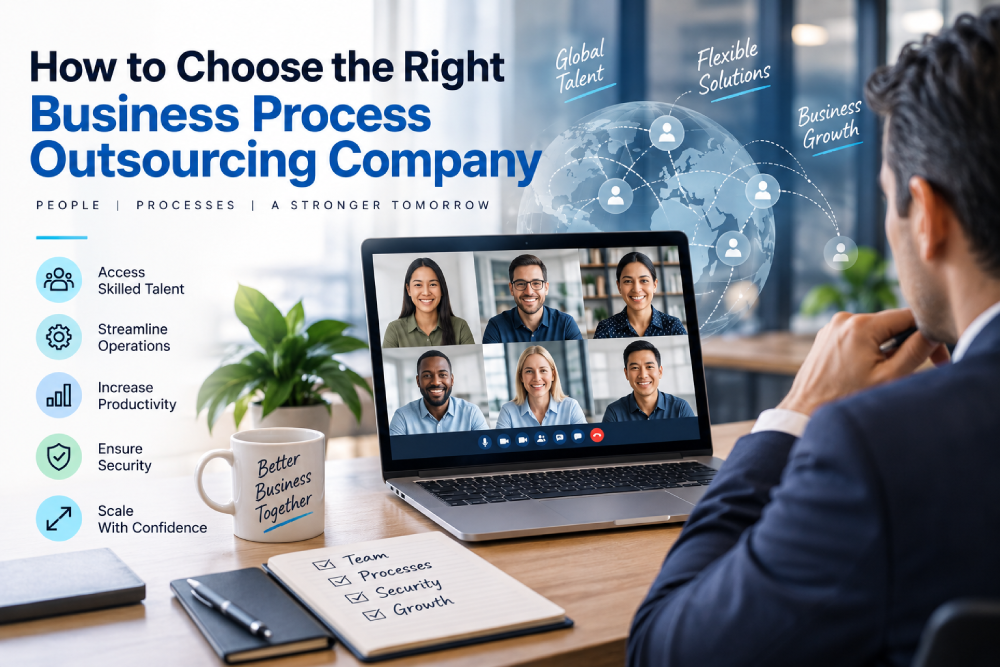
How to Choose the Right Business Process Outsourcing Company
Choosing the right business process outsourcing company can have a lasting impact on how efficiently your business operates. The right provider can support recurring business functions, expand workforce capacity, and give your internal team more time to focus on customers, strategy, and growth.
However, choosing a provider should involve more than comparing prices. Businesses need to evaluate talent quality, communication, service capabilities, flexibility, security, recruitment practices, and how well an outsourcing partner can fit into existing operations.
For U.S. businesses considering outsourcing, the goal is straightforward: find a partner that can provide dependable support without creating additional management problems.
This guide explains what to evaluate before making that decision.
What Does a Business Process Outsourcing Company Do?
A business process outsourcing company helps another organization manage specific business functions or processes that would otherwise be handled internally.
These responsibilities can vary depending on the company. For example, businesses may outsource:
- Customer support
- Administrative work
- Research
- Bookkeeping support
- E-commerce operations
- Website management
- Social media management
- Executive assistance
- Property management support
- Lead generation
- Other recurring operational tasks
Outsourcing does not have to mean transferring an entire department.
Instead, a company can identify specific processes that consume internal resources and determine whether an outside team could handle them effectively.
Start by Identifying What You Need to Outsource
Before comparing providers, define the problem you are trying to solve.
For example, are customer inquiries increasing faster than your internal team can manage them?
Are managers spending too much time on administrative work?
Perhaps your sales team needs additional support with lead generation and follow-up.
Alternatively, your company may need more operational capacity without limiting recruitment to the local labor market.
Start by separating your work into three categories:
Core responsibilities: Work that should remain under direct internal control.
Support responsibilities: Important recurring work that another qualified professional could manage.
Specialized responsibilities: Tasks that require specific expertise your current team may not have.
As a result, you will have a clearer picture of the business process outsourcing solutions your company actually needs.
Look for Relevant Service Capabilities
A provider should have capabilities that match your requirements.
A long list of services does not automatically make one outsourcing provider better than another. Instead, focus on whether the company can support the specific functions you want to delegate.
For example, UpSource Media provides support across customer service, administrative functions, research, bookkeeping and accounting, e-commerce, website management, property management assistance, social media management, and other business functions.
Businesses can explore UpSource Media’s services to learn more about its remote staffing capabilities.
Most importantly, ask potential providers how they would approach your specific role rather than relying only on a generic service description.
Evaluate the Quality of the Talent
People ultimately determine whether outsourcing succeeds.
Therefore, candidate quality should be one of the most important factors when choosing a business process outsourcing company.
Depending on the role, evaluate candidates for:
- Relevant experience
- Communication skills
- Technical abilities
- Problem-solving
- Reliability
- Professionalism
- Industry knowledge
- Software experience
- Schedule compatibility
For example, someone managing customer service requires different strengths from someone supporting bookkeeping or website operations.
Consequently, the staffing provider should understand the difference and match candidates to the actual responsibilities of the role.
Do Not Choose a BPO Partner Based Only on Price
Cost is naturally part of an outsourcing decision. However, the lowest price does not always produce the best business outcome.
Imagine hiring a low-cost provider that regularly misses deadlines or requires constant supervision. Your company may then spend additional time correcting errors, retraining workers, and managing problems.
In that situation, the cheaper option can create more work rather than less.
Instead, consider overall value.
Ask whether the provider understands the role, communicates effectively, delivers dependable work, and can support your company as its needs change.
A strong outsourcing relationship should help reduce operational pressure rather than simply move it somewhere else.
Examine Recruitment and Candidate Matching
Recruitment is another important factor.
A provider may have access to many candidates, but access alone does not guarantee the right match.
Therefore, ask how the company selects professionals for specific clients.
A strong matching process should consider more than a résumé.
For example, a customer support professional may need excellent communication and patience. An executive assistant may require strong organization and discretion. Meanwhile, an e-commerce professional may need experience with specific platforms.
The recruitment process should reflect the actual role.
This is particularly important when evaluating business process outsourcing BPO services for ongoing operational support.
Business Process Outsourcing Solutions Should Fit Your Workflow
Your outsourcing provider should not operate in isolation from the rest of your company.
Instead, outsourced professionals may need to work with your existing:
- CRM
- Email systems
- Project management software
- Communication platforms
- E-commerce systems
- Customer support tools
- Reporting processes
- Standard operating procedures
Before selecting a provider, explain how your business currently operates.
Then, ask how the remote team would fit into those processes.
This conversation can reveal whether the provider understands operational integration or simply plans to assign someone without considering the larger workflow.
Ultimately, responsibilities, systems, communication, and accountability should be clear from the beginning.
Ask About Communication Before You Sign
Communication problems can quickly damage an outsourcing relationship.
Therefore, establish expectations early.
Ask:
- Who will be your primary contact?
- How often will progress be reviewed?
- How are urgent problems escalated?
- Which communication channels will be used?
- How quickly should messages receive a response?
- How will performance concerns be addressed?
In addition, determine how remote professionals will communicate with your internal employees.
For example, a company might use instant messaging for routine questions, project management software for assignments, and scheduled video meetings for progress reviews.
Clear communication reduces uncertainty for everyone involved.
Check Whether the Provider Can Scale With You
Your staffing requirements today may look very different several months from now.
Perhaps you initially need one administrative professional. Later, you may need customer support, lead generation, technical assistance, or additional operational support.
Therefore, flexibility should be part of your evaluation.
Ask potential providers:
- Can we expand the team?
- Can responsibilities change?
- Can you support additional business functions?
- What happens if our workload increases?
- Can support adapt as our company grows?
A flexible provider can be especially useful for growing businesses because workforce requirements rarely remain static.
You can learn more about UpSource Media’s approach to flexible staffing through Why UpSource.
Evaluate Relevant Experience
Experience matters. However, the number of years a provider has operated should not be your only consideration.
More useful questions include:
- Has the company supported similar business functions?
- Does it understand the work you need completed?
- Can it explain its process clearly?
- Does it understand the tools your team uses?
- Can it adapt to your workflows?
Relevant experience is more valuable than a generic claim of expertise.
Therefore, ask providers about experience that directly relates to the processes you plan to outsource.
Consider Data Security and Access
Outsourced professionals may need access to company systems, customer information, documents, or other business data.
As a result, security should be discussed before access is provided.
Businesses should consider controls such as:
- Multi-factor authentication
- Password managers
- Role-based permissions
- Secure cloud storage
- Approved software
- Regular access reviews
- Clear confidentiality expectations
Access should always match the responsibilities of the role.
For example, an employee managing appointment scheduling should not automatically receive access to unrelated financial systems.
Similarly, permissions should be reviewed whenever responsibilities change.
The Cybersecurity and Infrastructure Security Agency’s Secure Our World resources provide useful guidance on passwords, multi-factor authentication, phishing awareness, and software updates.
Define Performance Before Outsourcing
Do not wait until something goes wrong to decide what good performance looks like.
Instead, establish expectations before work begins.
For customer support, you might evaluate:
- Response time
- Resolution time
- Escalation accuracy
- Communication quality
For administrative support, you might measure:
- Task completion
- Scheduling accuracy
- CRM updates
- Reporting consistency
- Deadline performance
For lead generation, expectations might include:
- Research quality
- Prospect records
- Follow-up completion
- CRM accuracy
- Appointment coordination
Clear expectations create accountability for both your internal team and outsourced professionals.
Understand the Difference Between Tasks and Processes
There is an important difference between outsourcing individual tasks and outsourcing a repeatable business process.
A task may be:
“Update these 50 customer records.”
A process is broader:
“Maintain accurate customer records in the CRM according to our documented workflow.”
The second approach creates ongoing ownership.
For businesses evaluating business process outsourcing BPO services, this distinction matters.
A provider supporting an ongoing process needs to understand:
- The objective
- The workflow
- The tools
- The quality standard
- The escalation procedure
- The expected outcome
Once these elements are defined, businesses can delegate with greater confidence.
Look for Long-Term Integration
One important question is whether your company needs a simple vendor or a more integrated workforce partner.
A vendor may complete assigned tasks.
However, an integrated remote professional can learn your workflows, understand your customers, become familiar with your tools, and take greater ownership of recurring responsibilities.
For ongoing operations, that continuity can be valuable.
UpSource Media’s approach focuses on helping businesses access remote professionals for recurring operational functions rather than treating every assignment as an isolated project.
This approach can be useful for businesses seeking long-term workforce support.
Compare Providers Using the Same Criteria
Comparing outsourcing companies can become difficult when every sales conversation focuses on different features.
Instead, create a consistent evaluation framework.
Service Fit
Can the company support the processes you actually need?
Talent Quality
How does the provider find and evaluate professionals?
Communication
How will communication and escalation work?
Integration
Can professionals work within your existing systems?
Flexibility
Can the staffing model adapt as your requirements change?
Security
How will access and sensitive information be managed?
Accountability
How will performance be measured?
Long-Term Fit
Can the provider support an ongoing working relationship?
Using consistent criteria makes it easier to compare different providers objectively.
Questions to Ask a Business Process Outsourcing Company
Before making a final decision, prepare questions for every provider you are considering.
Ask:
- What business functions do you specialize in?
- How do you recruit and evaluate candidates?
- How do you match professionals to clients?
- Who manages the working relationship?
- How do you handle performance concerns?
- What communication systems do you use?
- How do you approach data access and security?
- Can the team scale if our needs increase?
- What happens if a professional is not the right fit?
- How will you integrate with our existing processes?
- What does onboarding involve?
- How do you support ongoing workforce relationships?
The answers should give you a clearer picture of what working with the provider will actually look like.
Warning Signs When Choosing a BPO Provider
Not every provider will be the right fit.
Therefore, pay attention to warning signs during the evaluation process.
Be cautious if a company:
- Cannot clearly explain its recruitment process
- Makes unrealistic guarantees
- Avoids questions about security
- Focuses entirely on low pricing
- Cannot explain how communication works
- Does not ask questions about your business
- Provides vague role descriptions
- Has no clear escalation process
- Pushes you to outsource processes that do not fit your needs
A professional provider should first understand your requirements before recommending a solution.
When Should a Business Consider BPO Services?
There is no single point when every company should begin outsourcing.
However, several situations may indicate that it is worth considering.
For example:
- Internal employees are overloaded
- Customer service volume is increasing
- Administrative work consumes leadership time
- Local recruitment is difficult
- Specialized skills are difficult to find
- Routine tasks are delaying higher-value projects
- Growth requires additional operational capacity
- Managers spend too much time recruiting
In these situations, business process outsourcing solutions can provide another way to structure your workforce.
However, outsourcing should solve a defined operational problem rather than simply follow a business trend.
How UpSource Media Supports Business Operations
UpSource Media provides virtual employment and remote workforce support for businesses seeking additional operational capacity.
Its service areas include functions such as customer support, administrative work, executive assistance, research, e-commerce, website management, social media, bookkeeping and accounting support, and property management assistance.
The objective is to help businesses access professionals who can support specific operational needs while becoming part of a more flexible workforce structure.
Businesses can explore UpSource Media to learn more.
If you already know which business processes require additional support, you can also contact UpSource Media to discuss your staffing requirements.
Frequently Asked Questions
What Is a Business Process Outsourcing Company?
A business process outsourcing company provides external support for business functions that an organization chooses not to manage entirely with its internal workforce.
These functions may include customer service, administration, research, bookkeeping support, e-commerce, and other recurring operations.
What Should I Look for in a BPO Company?
Look at service fit, candidate quality, recruitment practices, communication, security, flexibility, workflow integration, accountability, and the provider’s ability to support your business over time.
What Are Business Process Outsourcing Solutions?
Business process outsourcing solutions are services designed to move specific business processes or operational responsibilities to an external provider.
The exact solution depends on the company’s needs and may range from customer support to administrative and back-office functions.
Are BPO Services Only for Large Businesses?
No. Small and growing businesses can also outsource recurring functions when doing so fits their operational requirements.
How Do I Compare Business Process Outsourcing BPO Services?
Start by defining the processes you need help with.
Then, compare providers using consistent criteria such as relevant expertise, talent quality, communication, technology, security, scalability, management structure, and service fit.
Should Price Be the Main Factor When Choosing a BPO Provider?
Price matters, but it should not be the only factor.
Reliability, work quality, communication, management requirements, and long-term fit can significantly affect the overall value of an outsourcing relationship.
What Business Processes Can Be Outsourced?
Depending on the business, outsourcing may be appropriate for customer support, administration, research, e-commerce operations, bookkeeping support, website management, social media, executive assistance, lead generation, and other recurring digital functions.
Choose a BPO Partner That Fits Your Business
Choosing the right business process outsourcing company starts with understanding your own operational needs.
First, define what you want to outsource. Next, evaluate talent quality, relevant expertise, communication, security, scalability, integration, and accountability.
Most importantly, look beyond the initial sales pitch.
The provider you choose may eventually support important customer interactions and recurring business processes. Therefore, the relationship should be built around reliability, clear expectations, and long-term fit.
If your business needs additional operational capacity, UpSource Media can help you explore remote professionals for a range of business functions.
Contact UpSource Media to discuss your staffing requirements.
One thought on “Business Process Outsourcing Company: How to Choose”