
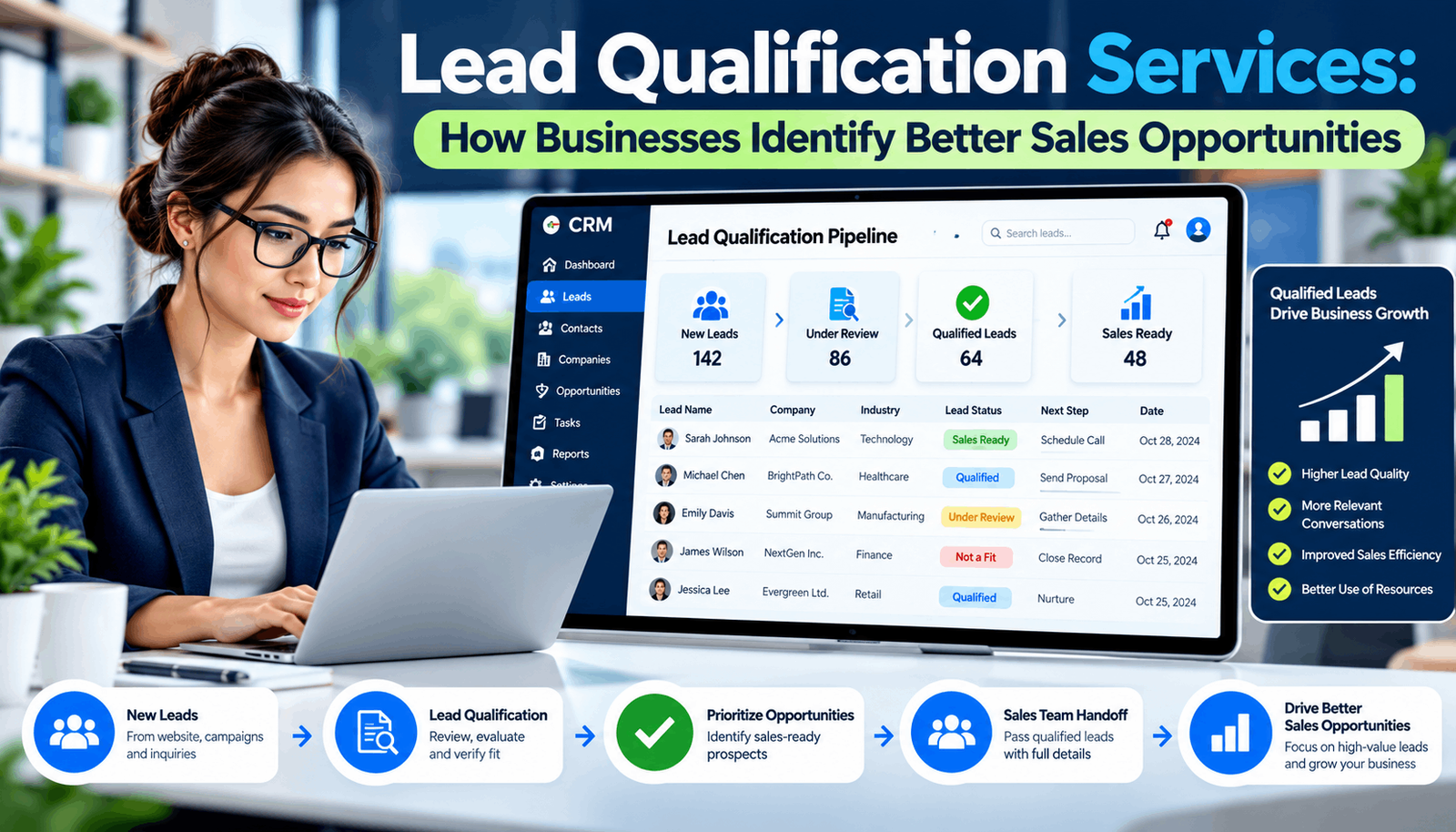
Lead Qualification Services: How Businesses Identify Better Sales Opportunities
Lead qualification services help businesses identify which prospects fit their ideal customer profile and deserve attention from the sales team. Instead of treating every website inquiry, referral, or marketing response as a sales opportunity, companies can evaluate each lead against clear criteria.
For U.S. businesses, that distinction matters. A full inbox does not necessarily mean a healthy pipeline. Some contacts are researching options, while others have an immediate need and the authority to make a purchasing decision. Without a consistent review process, sales representatives may spend too much time sorting inquiries and too little time speaking with suitable prospects.
A practical qualification system creates a clearer path from initial interest to a useful sales conversation. Here’s how it works, what businesses should measure, and when remote support may help.
What Are Lead Qualification Services?
Lead qualification is the process of evaluating potential customers to determine whether they match a business’s target market and are appropriate for further sales engagement.
Depending on the organization, lead qualification services may include reviewing contact details, checking customer fit, gathering missing information, recording business needs, updating CRM records, and routing suitable prospects to sales representatives.
Consider a company that provides bookkeeping support to small businesses. Its website may attract business owners seeking ongoing assistance, students researching bookkeeping, and individuals looking for personal tax advice. All three groups might submit a form, but only some match the company’s offering.
Qualification helps the company identify that difference without assuming every inquiry is ready to buy. Importantly, a lead that is not sales-ready today may still be worth revisiting later.
Why Better Lead Qualification Creates Better Sales Opportunities
More leads do not automatically produce more relevant sales conversations. Quality depends on how closely a prospect’s needs match the company’s services.
Imagine two fictional teams. The first receives 200 inquiries, many from people outside its target market. Meanwhile, the second receives 60 inquiries, most from businesses that meet its customer criteria. Although the first team has more contacts, the second may have a more useful starting point for sales outreach.
These numbers illustrate a concept, not a performance benchmark.
A structured qualification process can help a business:
- Identify prospects that match its target customers.
- Separate immediate opportunities from future possibilities.
- Give sales representatives clearer information before a call.
- Reduce repeated questions during handoffs.
- Keep CRM records organized and useful.
- Apply consistent standards across incoming inquiries.
However, qualification does not guarantee a sale. Pricing, competition, timing, service fit, and the sales conversation still influence the final outcome.
What B2B Lead Qualification Services Typically Include
B2B lead qualification services focus on the details that help one business evaluate another as a potential customer. The exact tasks depend on the company’s industry, sales cycle, and approved workflow.
Reviewing and Completing Lead Records
A prospect may provide a name and email address but leave out the company size, location, or service requirement. Before a sales handoff, a support professional can review the available record and identify what information is missing.
For example, a commercial cleaning company may need to know whether an inquiry concerns an office, a retail location, or a residential property. That detail can determine which team should respond.
Accurate records also make it easier to avoid duplicate entries and track earlier conversations.
Checking Customer Fit
An ideal customer profile describes the organizations most likely to benefit from a company’s offering. It may include industry, location, business size, service needs, and other relevant characteristics.
Qualification staff can compare each inquiry with those documented criteria. Still, the business should define what qualifies as a good fit; support staff should not invent the rules.
Understanding Needs and Timing
A suitable company may be exploring options rather than actively buying. Therefore, a useful review asks what the prospect needs and when the solution might be required.
For instance, a retailer planning to launch an online store next month may require faster follow-up than one gathering ideas for next year. Both contacts may deserve attention, but their next steps will differ.
Clarifying the Contact’s Role
In B2B sales, the person who submits a form is not always the person who approves a purchase. A coordinator may research options for an owner, while a department manager may influence the final decision.
Understanding that role helps the sales team prepare an appropriate conversation. It should not automatically disqualify contacts who contribute to the buying process.
Updating the CRM and Preparing Handoffs
Once a lead has been reviewed, its status and supporting notes should be easy to understand. Useful fields may include the stated need, customer-fit criteria, timing, contact role, assigned representative, and next action.
For additional background on this type of administrative work, see UpSource Media’s article about CRM management with a virtual assistant.
How to Decide Whether a Lead Is Qualified
There is no universal definition of a qualified lead. A local service business, a software company, and an industrial supplier may evaluate prospects differently.
Still, most businesses can begin with five practical questions:
- Customer fit: Does this person or organization match our target market?
- Business need: Have they described a problem our service can address?
- Decision-making role: Are they an approver, influencer, or researcher?
- Timing: Are they looking for help now or planning for a later date?
- Next step: Is there enough information to arrange a relevant sales conversation?
Use the answers to create clear categories such as sales-ready, needs more information, future opportunity, and not a fit.
Avoid treating these categories as permanent judgments. A future opportunity can become sales-ready when circumstances change.
A Realistic Lead Qualification Example
Suppose a U.S. managed IT provider serves organizations with 20 to 200 employees. Its team receives three inquiries during the same week.
First inquiry: An operations director at a 75-person company requests help with network management and wants a consultation within two weeks.
Second inquiry: A student downloads a general cybersecurity resource for a class project.
Third inquiry: A 100-person business asks about IT support but expects to review vendors in six months.
Each contact has shown some interest, yet the sales priority is different.
The first inquiry appears to match the provider’s customer profile and includes an active requirement. By contrast, the second does not indicate a current business purchasing need. Meanwhile, the third may be a suitable future opportunity that deserves an agreed follow-up date.
The lesson is simple: qualification considers context, not just form submissions or email activity.
How to Build a Reliable Lead Qualification Process
A repeatable process helps employees make similar decisions about similar inquiries. It also gives managers a way to review the quality of the work.
Step 1: Define Your Ideal Customer
Start with the types of customers your business is equipped to serve. Document the relevant industries, locations, company sizes, common problems, and situations that fall outside your offering.
Clear boundaries prevent the qualification team from relying on guesswork.
Step 2: Choose a Short Set of Questions
Ask only for information that supports the next decision. Useful questions might cover the requested service, the prospect’s business challenge, expected timeline, and role in the purchasing process.
Long questionnaires can create unnecessary friction. Instead, make the initial review focused and easy to complete.
Step 3: Establish Lead Status Rules
Define what qualifies a lead for immediate sales follow-up. Also specify when a record needs more information, when to schedule future contact, and when to close an unsuitable inquiry.
Written rules make it easier to train team members and resolve uncertain cases.
Step 4: Set CRM Documentation Standards
Choose the fields employees must complete before moving a lead to the next stage. Include a concise summary of the prospect’s needs and the agreed next action.
Consistent documentation helps the receiving sales representative continue the conversation without starting from zero.
Step 5: Assign Ownership and Response Expectations
Decide who reviews incoming leads, who contacts prospects, and who handles sales-ready opportunities. Set practical response expectations for urgent requests and routine inquiries.
Without clear ownership, even a well-qualified lead can remain untouched.
Step 6: Review Feedback From Sales
Ask sales representatives whether the leads they receive meet the agreed criteria. When patterns emerge, adjust the questions, categories, or handoff rules.
Over time, that feedback can make the process more relevant to real customer conversations.
Inbound Lead Qualification Services and New Customer Inquiries
Inbound lead qualification services focus on people who contact a business through its website, phone, email, referrals, or marketing activity. These prospects have initiated an interaction, but their level of buying interest can vary widely.
For example, a pricing request may deserve a different response from a general newsletter signup. Likewise, a consultation request with a clear business need may be more time-sensitive than an informational download.
An inbound workflow should explain how to review each inquiry, identify missing details, record the result, and route the contact. Where communication is required, employees should follow the company’s approved procedures.
Fast responses can be useful, but speed should not replace accurate qualification. A rushed handoff with no context may create extra work for the sales team.
Lead Scoring vs. Lead Qualification: What’s the Difference?
Lead scoring assigns points to selected characteristics or actions. A business might give a higher score to contacts from its target industry or to people who request a consultation.
Lead qualification is broader. It evaluates whether the prospect represents an appropriate sales opportunity using available information and business-defined criteria.
For instance, a person could visit a website repeatedly and receive a high engagement score without having a business need. A qualification review would consider that missing context before passing the contact to sales.
Scoring can support prioritization. Nevertheless, it should not replace a thoughtful review of fit and readiness.
When Outsourcing Lead Qualification Services Makes Sense
Outsourcing lead qualification services may be useful when incoming inquiries are growing faster than the internal team can review them. Businesses may also need help maintaining CRM records or preparing consistent sales handoffs.
Common signs include incomplete lead profiles, unclear ownership, missed follow-up tasks, and sales representatives spending too much time sorting basic inquiries.
Before assigning these tasks to a remote professional, establish the process internally. The company should provide qualification rules, CRM access requirements, approved communication scripts, escalation procedures, and performance expectations.
Start with a manageable set of responsibilities. After the workflow becomes consistent, consider whether additional tasks should be delegated.
Remote support can help organize lead-related operations. However, business leaders should retain ownership of customer criteria, sales strategy, and final decisions.
Choosing Lead Qualification Services in the US Market
When evaluating lead qualification services in the US, businesses should consider whether a provider or remote professional can support their customers and existing workflow. Location alone does not determine service quality.
Ask practical questions before committing:
- Can the professional follow our customer-fit rules?
- Which CRM systems have they worked with?
- How will missing or uncertain information be handled?
- What hours of coverage do we actually need?
- Who approves changes to qualification criteria?
- How will access to customer information be restricted?
- What happens when a prospect needs an urgent response?
- How will sales staff provide feedback on lead quality?
The answers should translate into documented responsibilities, not vague promises about generating more sales.
Protect Customer Data and Follow Outreach Rules
Lead qualification often involves personal contact details and business information. Give staff only the access needed for their assigned tasks, and establish procedures for handling records securely.
If the role includes commercial email, review the Federal Trade Commission’s CAN-SPAM compliance guide. The FTC explains that the law also applies to business-to-business commercial email and that companies remain responsible for compliance when they hire others to send messages.
Phone outreach and other communication channels may have additional legal requirements. As a result, businesses should use approved procedures and obtain professional guidance when necessary.
How to Measure Lead Qualification Performance
A qualification program should be judged by the usefulness of its output, not simply by the number of records marked qualified.
Track measures that match the team’s actual responsibilities:
- Qualification accuracy: Do leads meet the documented customer criteria?
- CRM completeness: Are required details and notes present?
- Response time: How quickly are assigned inquiries reviewed?
- Sales acceptance: Do representatives agree that handed-off leads are appropriate?
- Follow-up completion: Are assigned next steps completed on schedule?
- Handoff quality: Can sales representatives act without repeating basic questions?
Review the measures together. For example, a high qualification count means little if sales representatives repeatedly return leads because key details are missing.
Do not hold qualification staff solely responsible for closed revenue when they do not control proposals, pricing, or purchasing decisions.
Common Mistakes That Weaken Lead Qualification
Even a detailed process can underperform when teams overlook the basics.
Treating all inquiries equally. A newsletter signup and a request for a sales consultation may require different actions.
Using vague criteria. Without a clear ideal customer profile, employees cannot make consistent decisions.
Collecting too much information. Excessive questions can slow the process without helping the sales team.
Leaving CRM records incomplete. Missing notes force employees to repeat work and ask the prospect the same questions.
Failing to assign the next step. A suitable lead still needs an owner and a follow-up plan.
Ignoring sales feedback. Qualification rules can become outdated when teams never review which handoffs were useful.
Regular coaching, documented procedures, and simple quality checks can help address these issues.
How UpSource Media Fits Into Lead-Related Support
UpSource Media provides virtual employment and remote staffing support for U.S. businesses. Its published services include customer support, executive and personal assistance, financial services support, and other administrative functions.
Those capabilities may be relevant when a business needs help organizing inquiries, maintaining CRM records, coordinating appointments, or handling approved customer communication. However, companies should confirm the exact duties, experience requirements, and scope of any proposed role rather than assuming a dedicated lead qualification package is available.
For more information about the company’s staffing approach, explore Why UpSource.
A useful first step is to list the tasks your sales team spends time on before a prospect reaches a meaningful conversation. From there, you can decide which activities require a salesperson and which could be handled through structured administrative support.
Frequently Asked Questions About Lead Qualification Services
What do lead qualification services do?
They help businesses review potential customers, check fit against established criteria, gather relevant details, and prepare suitable prospects for sales follow-up. Specific responsibilities vary by business and provider.
How is lead qualification different from lead generation?
Lead generation attracts or identifies potential customers. Qualification evaluates those contacts to determine whether they are appropriate for further sales engagement.
What makes a lead sales-ready?
A sales-ready lead typically matches the company’s target customer profile and has a relevant business need. Depending on the sales process, timing, contact role, and willingness to discuss next steps may also matter.
Can small businesses outsource lead qualification?
Yes. A small business can delegate selected review, CRM, and follow-up coordination tasks when it has clear instructions and appropriate oversight. Sales strategy and qualification criteria should remain under the company’s control.
Are inbound leads automatically qualified?
No. Submitting a form or requesting information shows interest, but it does not confirm customer fit or purchasing readiness. Inbound contacts still need appropriate evaluation.
What is the difference between an MQL and an SQL?
An MQL, or marketing-qualified lead, meets criteria defined by marketing. An SQL, or sales-qualified lead, meets the company’s criteria for sales engagement. Teams should agree on their definitions because the labels vary across businesses.
How can businesses improve qualification accuracy?
Begin with documented customer criteria and a small set of useful questions. Then standardize CRM notes, establish handoff rules, and review feedback from sales representatives.
Turn More Inquiries Into Relevant Sales Conversations
Lead qualification services give businesses a practical way to identify customer fit, prioritize timely opportunities, and prepare useful sales handoffs. The strongest results come from clear criteria, reliable records, and consistent communication between the people reviewing leads and the team responsible for selling.
If your company needs additional help with lead-related administration, CRM organization, appointment coordination, or customer communication, explore the remote staffing options available through UpSource Media.
Contact UpSource Media to discuss your workflow and the kind of support your business needs.