
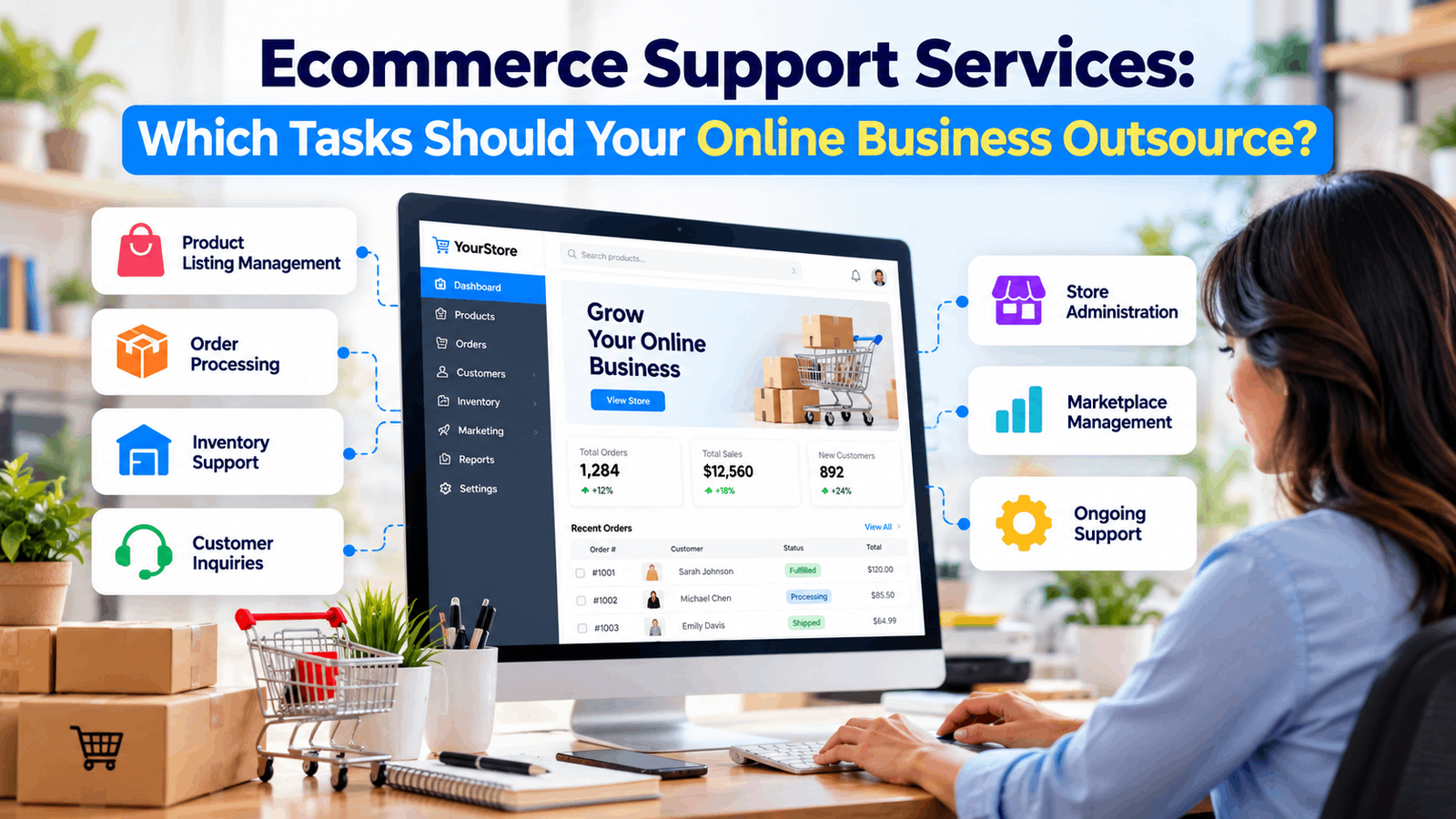
Ecommerce Support Services: Which Tasks Should Your Online Business Outsource?
Ecommerce support services help online businesses manage recurring operational tasks such as product listings, order processing, store administration, inventory-related work, and customer inquiries. As an online store grows, these responsibilities can consume time that owners and key employees could spend on marketing, merchandising, supplier relationships, strategy, and growth.
Running an ecommerce business involves much more than attracting customers and generating sales. Every order creates operational work. Products need accurate information, customers ask questions, inventory changes, and store records require attention.
As a result, founders and managers can quickly become responsible for dozens of routine tasks.
Outsourcing selected ecommerce responsibilities can create additional capacity. However, the goal should not be to hand over every part of the business. Instead, identify repeatable, process-driven tasks that remote professionals can manage effectively while your internal team retains control over strategy and important decisions.
What Are Ecommerce Support Services?
Ecommerce support services cover the recurring tasks that help an online store operate efficiently.
The exact responsibilities depend on the business model, sales channels, products, systems, and customer experience.
For example, a smaller direct-to-consumer store may need help updating products and processing orders. In contrast, a larger operation may require ongoing assistance with product data, customer inquiries, inventory records, marketplaces, and routine store administration.
UpSource Media provides remote assistance for ecommerce businesses. Its ecommerce support capabilities include managing online stores, updating product listings, processing orders, and handling customer inquiries related to online purchases.
Businesses can also explore UpSource Media’s services to see how ecommerce support fits within its broader remote staffing capabilities.
Which Ecommerce Tasks Should You Outsource?
Not every ecommerce responsibility should move outside your internal team.
Start with work that follows a repeatable process, occurs frequently, and does not require executive-level decision-making every time someone completes it.
A useful question is:
Does this task require the business owner’s judgment, or does it require a reliable process and consistent execution?
That distinction can reveal strong outsourcing opportunities.
For many online businesses, the following areas are worth evaluating.
1. Product Listing Management
Product listings directly affect how customers understand what they are buying.
However, maintaining those listings can involve substantial repetitive work.
A remote ecommerce professional may help with:
- Adding new products
- Updating approved product descriptions
- Uploading product images
- Updating SKUs and product information
- Organizing categories
- Checking listing consistency
- Updating approved pricing information
- Adding product specifications
- Maintaining variations such as size or color
- Removing outdated information
Before delegating these responsibilities, create clear standards.
For example, establish guidelines for product titles, descriptions, image requirements, categories, formatting, and approval procedures. Clear documentation makes consistent execution easier.
UpSource Media specifically includes product-listing updates within its ecommerce support capabilities.
2. Order Processing and Administration
Every new order creates administrative work.
Depending on the store’s systems and fulfillment model, someone may need to review order information, update records, coordinate routine processing, identify exceptions, or communicate issues.
When order volume increases, these small tasks can become a significant daily workload.
Delegating defined order-processing responsibilities can prevent owners and senior employees from reviewing every routine transaction personally.
However, businesses should establish clear boundaries.
A remote professional may manage normal orders according to documented procedures. Unusual transactions, payment disputes, suspected fraud, high-value exceptions, or other sensitive cases may require internal review.
3. Inventory-Related Support
Inventory requires accurate and timely information.
Online businesses may need to update stock records, review product availability, identify discrepancies, coordinate routine information across sales channels, or flag products that require attention.
Remote support can assist with defined inventory-related administrative work when the business has a reliable system in place.
The important word is defined.
A remote professional should know which records to review, where information comes from, how frequently updates occur, and what to do when information does not match.
Strategic purchasing decisions can remain with internal management. Meanwhile, recurring inventory administration can move to a support role.
4. Customer Order Inquiries
Customers frequently contact ecommerce businesses with questions related to purchases.
Common inquiries may involve:
- Order status
- Product information
- Shipping questions
- Delivery issues
- Returns
- Exchanges
- Product availability
- Account questions
- Order changes
- Store policies
Many of these interactions follow predictable patterns.
A trained remote professional can handle appropriate recurring inquiries when the company provides accurate information, clear policies, approved procedures, and escalation rules.
Customer service should also remain connected to ecommerce operations. Representatives need access to appropriate order information and must know when a situation requires additional authority.
Businesses experiencing growing support volumes can also read UpSource Media’s guide to customer service outsourcing.
5. Routine Online Store Administration
An ecommerce store constantly changes.
New products appear. Old products disappear. Promotions begin and end. Product information changes, while store content may require regular attention.
Consequently, routine store administration can become another useful area for delegation.
A remote professional might help maintain approved store information, update content, organize product data, review routine store tasks, and coordinate changes with the appropriate internal employee.
More complex technical changes should follow a different process.
Custom development, serious technical problems, cybersecurity incidents, or major platform modifications may require developers or other qualified specialists.
Separating routine administration from specialized technical work helps businesses assign the right people to the right responsibilities.
6. Marketplace Administration
Businesses selling through several online channels can face additional administrative work.
Each marketplace may require product information, images, availability details, order monitoring, customer communication, and other routine updates.
Managing these activities across multiple channels becomes more difficult as the product catalog expands.
Remote ecommerce support can help businesses maintain approved information and recurring marketplace workflows.
Before delegating this work, document each platform’s procedures.
Clear instructions should explain what the team member can change independently, what requires approval, and where problems should be escalated.
7. Product Data and Catalog Organization
A growing product catalog creates a large amount of information.
Names, SKUs, categories, descriptions, variations, pricing information, images, and other product details require consistent organization.
Small inconsistencies become more difficult to manage as the catalog expands.
For example, one product may use a different naming convention from similar items. Another listing might contain outdated information. Elsewhere, an image could be missing or assigned incorrectly.
A defined catalog-management workflow helps businesses address these issues systematically.
Remote support can assist with reviewing and updating approved product data while internal employees retain control over merchandising strategy and major catalog decisions.
8. Returns and Exchange Administration
Returns and exchanges create both customer communication and operational work.
Someone needs to review the request, follow company policies, provide appropriate instructions, update records, and escalate exceptions.
Many standard requests can follow documented procedures.
For instance, a company can define eligibility requirements, required information, communication templates, and escalation rules.
Sensitive situations should still receive appropriate internal attention.
The goal is not to eliminate human judgment. Instead, businesses can create repeatable workflows for common situations while reserving unusual cases for authorized employees.
9. Customer Feedback Organization
Customers provide useful information through support conversations, reviews, returns, and product questions.
However, that information has limited value when nobody organizes it.
An ecommerce support professional can help categorize recurring customer comments and identify patterns for the internal team.
Suppose several customers repeatedly ask the same product question. That pattern may indicate that the product page needs clearer information.
Likewise, frequent complaints about a specific process could reveal operational friction.
The remote support professional does not need to make strategic decisions based on that information. Instead, the person can organize and report useful patterns so management can determine what action to take.
What Should Stay With Your Internal Team?
Outsourcing works best when businesses know what not to delegate.
Some responsibilities require strategic authority, specialized expertise, sensitive access, or executive judgment.
Depending on the company, these responsibilities may include:
- Overall ecommerce strategy
- Brand positioning
- Major pricing decisions
- Supplier negotiations
- High-level merchandising decisions
- Sensitive financial approvals
- Major customer disputes
- Legal or compliance decisions
- Cybersecurity incidents
- High-risk account permissions
- Major platform changes
The exact boundaries will vary from one company to another.
What matters is defining those boundaries before the remote team starts working.
When Should You Outsource Ecommerce Support Services?
Businesses often begin exploring outsourcing after the workload has already become difficult to manage.
A better approach is to watch for operational signals.
Perhaps the owner spends several hours each week updating products. Customer questions may interrupt marketing work, while order administration consumes an operations manager’s morning.
Meanwhile, important product updates may remain unfinished because nobody owns the task.
Those situations suggest that the business should review how work is distributed.
When businesses outsource ecommerce support services, they should start with clearly defined responsibilities rather than transferring an entire operation at once.
Choose a manageable group of recurring tasks. Then document the workflow, establish expectations, and evaluate the process before expanding the role.
Ongoing Ecommerce Support Services vs. One-Time Projects
Not every ecommerce task requires an ongoing role.
A business may occasionally need help uploading a large product catalog or completing a short-term store cleanup. Those activities can function as projects.
Daily ecommerce operations are different.
Orders continue arriving. Customers continue asking questions. Products change, inventory requires attention, and store information needs updates.
In these situations, ongoing ecommerce support services can become part of the normal operational workflow.
Continuity also creates familiarity.
Over time, a remote professional can learn the company’s products, procedures, systems, escalation rules, and expectations. That knowledge can make recurring work easier to organize than repeatedly explaining the same processes to different short-term workers.
Build Processes Before You Outsource
Outsourcing a disorganized process rarely makes it organized automatically.
Before delegating a responsibility, document how your company currently handles it.
Start with five questions:
- What triggers the task?
- What information does the person need?
- Which steps should they follow?
- What requires approval?
- When should they escalate the issue?
Consider order administration as an example.
A process might explain how to review a standard order, identify missing information, document completed work, handle common exceptions, and notify an internal employee when something falls outside normal procedures.
Documentation does not need to become complicated.
A checklist, written procedure, screen recording, or step-by-step guide may be enough for many recurring tasks.
Give Remote Ecommerce Professionals the Right Access
Online-store support may require access to important business systems.
Therefore, companies should manage permissions carefully.
Avoid automatically giving every remote worker full administrative access. Instead, match system permissions to actual job responsibilities.
Individual user accounts can also improve accountability when platforms support them.
In addition, businesses should use appropriate security practices for remote access. The U.S. Cybersecurity and Infrastructure Security Agency provides practical guidance through its Secure Our World resources, including recommendations related to multifactor authentication, strong passwords, phishing awareness, and software updates.
Security procedures should form part of onboarding rather than becoming an afterthought.
Connect Ecommerce Support With Customer Service
Store operations and customer service should not function as completely separate systems.
A customer may contact support because an order has not arrived. Another shopper may ask whether an item will return to stock. Someone else might notice incorrect information on a product page.
These conversations can reveal operational problems.
Create a process that allows ecommerce support professionals to share recurring customer issues with the internal team.
For example, repeated questions about product sizing may signal that a listing needs more detail. Multiple order inquiries could reveal a communication gap elsewhere in the customer journey.
This feedback loop helps the business address the source of recurring questions rather than repeatedly treating only the symptoms.
How to Measure Ecommerce Support Performance
Performance should reflect the responsibilities assigned to the role.
Avoid judging someone only by the number of tasks completed.
Speed matters, but accuracy and consistency matter too.
Depending on the position, businesses might review:
- Accuracy of product updates
- Order-processing quality
- Completion of assigned tasks
- Customer-response handling
- Escalation accuracy
- Documentation quality
- Catalog consistency
- Adherence to procedures
- Communication with internal employees
- Unresolved workload
Choose measures that reflect the actual job.
For instance, a product-listing specialist should not have the same performance criteria as a customer-support professional.
Common Ecommerce Outsourcing Mistakes
One common mistake is outsourcing before defining the work.
A vague instruction such as “manage our ecommerce store” can create confusion because it does not explain responsibilities, authority, or priorities.
Another problem involves weak onboarding.
Even an experienced ecommerce professional does not automatically know your products, customers, policies, systems, or internal processes.
Giving too much access creates unnecessary risk as well.
Permissions should match the role rather than convenience.
Finally, avoid delegating a broken process without first understanding why it fails. Additional people cannot automatically solve unclear policies, inaccurate product data, poor documentation, or inconsistent workflows.
Improve the process first. Then determine which parts can be delegated.
How to Choose an Ecommerce Support Provider
Start with your workload rather than a provider’s sales pitch.
Write down the responsibilities you want to delegate. Next, identify the platforms, working hours, experience, communication skills, and system knowledge required.
Ask potential providers how they approach recruitment, onboarding, communication, scalability, and ongoing support.
The provider should also understand where routine ecommerce support ends and specialized work begins.
Most importantly, consider how the remote professional will fit into your existing operation.
The goal should be a working relationship built around clearly defined responsibilities rather than simply moving random tasks outside the company.
Businesses evaluating a broader remote staffing model can also review UpSource Media’s guide to virtual staffing services.
What Are the Best Ecommerce Support Services for a Growing Business?
If you’re asking what are the best ecommerce support services, there is no universal package that fits every online store.
The best responsibilities to outsource are the ones creating real operational pressure in your business.
For one company, product listings may consume the most time. Another store may struggle with order administration and customer inquiries. A business with a large catalog might need more help maintaining product information.
Start by reviewing where your internal team spends its time.
Then separate strategic work from recurring execution.
That analysis provides a much stronger basis for outsourcing than choosing a generic service package.
How UpSource Media Supports Ecommerce Businesses
UpSource Media provides remote assistance for ecommerce businesses as part of its broader virtual staffing services.
Its current ecommerce support capabilities include managing online stores, updating product listings, processing orders, and handling customer inquiries related to online purchases.
UpSource Media also provides broader support across areas such as customer service, administration, website management, research, bookkeeping and accounting support, property management assistance, and social media management.
Businesses interested specifically in ecommerce operations can read UpSource Media’s guide to E-Commerce Support with Virtual Assistants.
The company’s Why UpSource page also explains its broader approach to remote talent, recruitment support, workforce flexibility, and ongoing assistance.
The right starting point is to identify the ecommerce tasks consuming your team’s time and determine which responsibilities can follow clear, repeatable processes.
Frequently Asked Questions
What Are Ecommerce Support Services?
Ecommerce support services help online businesses manage selected operational responsibilities. Depending on the business and provider, those tasks may include online-store administration, product listings, order processing, inventory-related work, customer inquiries, and other recurring ecommerce activities.
What Ecommerce Tasks Can I Outsource?
Businesses can consider outsourcing repeatable tasks such as product updates, catalog administration, routine order processing, customer inquiries, marketplace administration, and inventory-related support. Strategic and high-authority decisions may remain with internal leadership.
Should a Small Ecommerce Business Outsource?
Company size alone should not determine the decision. A smaller business may benefit when owners or core employees spend too much time on repetitive ecommerce administration that another trained professional could manage through documented processes.
Can I Outsource Only Part of My Ecommerce Operations?
Yes. In many cases, starting with a defined group of recurring tasks makes more sense than outsourcing an entire operation. Businesses can expand the role later when the workflow performs well.
Are Ongoing Ecommerce Support Services Better Than Project-Based Help?
It depends on the workload. A one-time catalog update may work well as a project. Recurring responsibilities such as orders, product updates, inventory administration, and customer inquiries may benefit from ongoing support.
How Do I Prepare Before Outsourcing Ecommerce Work?
Document responsibilities, establish approval rules, define escalation procedures, determine required system access, create communication standards, and identify how you will evaluate performance.
What Should I Look for in an Ecommerce Support Provider?
Look for relevant experience, clear communication, appropriate recruitment processes, defined responsibilities, security awareness, scalability, and the ability to work with your existing ecommerce systems and procedures.
Outsource the Work, Not the Strategy
Ecommerce support services can help online businesses create more operational capacity, but successful outsourcing begins with choosing the right tasks.
Start with repeatable work.
Product listings, order administration, inventory-related tasks, customer inquiries, catalog maintenance, and routine store operations may all be candidates when clear processes already exist.
Keep strategic decisions where they belong. Document workflows, establish permissions, create escalation procedures, and measure performance according to the responsibilities assigned.
The objective is not to outsource as much as possible. Instead, build an ecommerce operation where the right people handle the right work.
For U.S. businesses exploring remote ecommerce support, explore UpSource Media’s services to learn more about available remote staffing capabilities.
When you’re ready to discuss your specific ecommerce staffing needs, contact UpSource Media.