
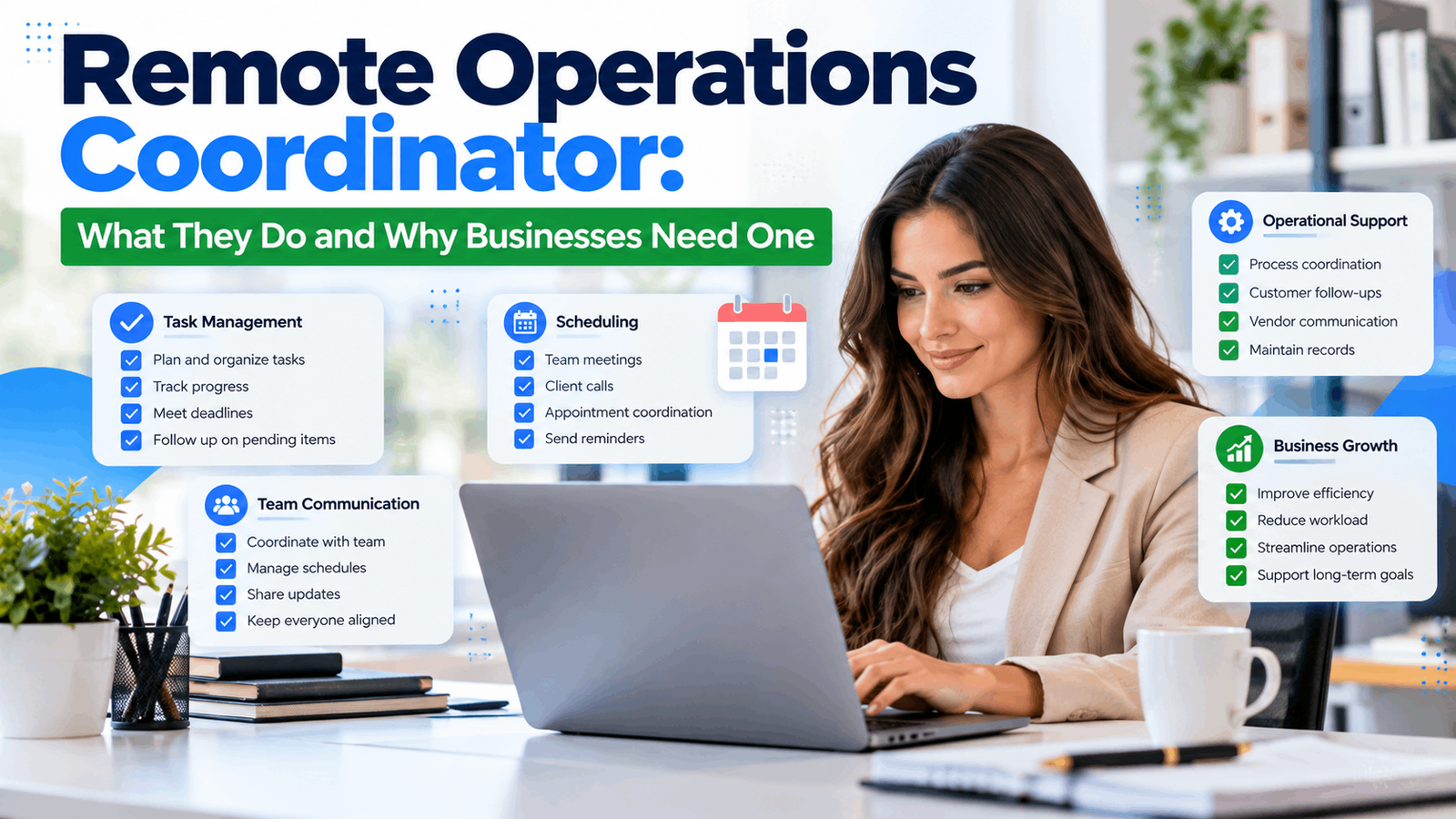
Remote Operations Coordinator: What They Do and Why Businesses Need One
A remote operations coordinator helps a business keep everyday work moving without requiring everyone to be in the same office. From following up on pending requests to updating task boards and organizing schedules, this role brings structure to the details that can otherwise slow a team down.
For U.S. business owners, the challenge often isn’t a lack of ideas or customers. It’s the time spent finding missing information, checking whether work was completed, and reminding different people about the next step. A capable coordinator can take ownership of those follow-ups while managers retain control of priorities and important decisions.
But what does the position actually involve, and when is it worth hiring? This guide covers the responsibilities, skills, practical benefits, hiring process, and ways to measure success.
What Is a Remote Operations Coordinator?
A remote operations coordinator is a professional who organizes recurring processes and keeps people, tasks, and information connected from a remote location. The position is typically focused on coordination and execution, rather than setting company strategy or managing an entire department.
Depending on the business, the work may involve tracking project deadlines, maintaining records, coordinating customer requests, or communicating with vendors. The coordinator often acts as the person who notices when a handoff is missing and makes sure the appropriate owner knows about it.
Remote does not mean unsupervised. Clear responsibilities, shared systems, and regular check-ins are still essential, especially when the team works across locations or time zones.
What Does a Remote Operations Coordinator Do Each Day?
The exact schedule varies by industry, but most work centers on making sure routine activities happen on time and information reaches the right person.
Workflow and Task Tracking
A coordinator may update a project board, confirm that assigned tasks have owners, and flag deadlines at risk. Instead of allowing an unfinished step to disappear in a message thread, the coordinator records its status and follows up through an agreed process.
For example, a small marketing agency might need someone to track when a client approves a draft, when revisions are due, and when the finished work is ready to publish. The coordinator keeps the process visible without making creative or account-management decisions.
Scheduling and Team Communication
Meetings, handoffs, and availability changes can affect an entire workflow. A remote coordinator can organize calendars, circulate agendas, capture action items, and remind participants of agreed next steps.
This support is particularly useful when staff, contractors, or clients work in different U.S. time zones. However, the team should still define the hours during which the coordinator is expected to respond.
Customer and Vendor Follow-Ups
A missed supplier update or unanswered customer request can create extra work later. Coordinators may request status updates, route questions to the correct employee, and keep communication records current.
Sensitive decisions, such as approving refunds, changing contracts, or committing company funds, should remain with authorized staff unless a specific delegation policy says otherwise.
Reporting and Process Documentation
Operations depend on accurate information. A coordinator can maintain trackers, prepare routine summaries, and update step-by-step instructions when an approved process changes.
For instance, a weekly report might show pending orders, overdue approvals, and open customer issues. These reports help managers identify problems without asking every employee for separate updates.
Remote Operations Coordinator Responsibilities: Who Owns What?
The most useful remote operations coordinator responsibilities are clearly defined. Without boundaries, the position can become a catchall for unrelated tasks, making performance difficult to evaluate.
| Work Area | Coordinator May Handle | Manager or Specialist Retains |
|---|---|---|
| Task management | Updating status, reminders, and handoff records | Setting priorities and resolving major conflicts |
| Customer requests | Logging inquiries and routing routine follow-ups | Handling escalations and policy exceptions |
| Vendor coordination | Collecting quotes or delivery updates | Approving contracts and spending |
| Documentation | Maintaining checklists and shared files | Approving policy or process changes |
| Reporting | Compiling operational metrics and exceptions | Interpreting results and deciding what to change |
These boundaries should reflect the company’s systems, industry requirements, and the coordinator’s actual experience. In regulated or specialized environments, some activities may require additional training, supervision, or credentials.
Remote Operations Coordinator Job Description: What to Include
A clear remote operations coordinator job description helps applicants understand the work and gives employers a fair way to compare candidates. Rather than asking for someone who can “do everything,” describe the processes that need reliable ownership.
Core Duties and Expected Outcomes
A practical description might include coordinating daily task assignments, updating CRM or project records, scheduling internal meetings, following up on open requests, and preparing weekly status reports. It should also identify the person who supervises the role and the decisions that require approval.
Be specific about success. For example, “maintain an accurate open-requests tracker and escalate overdue items each day” is easier to assess than “keep the office organized.”
Skills and Tools for a Remote Operations Coordinator
Useful skills include written communication, attention to detail, prioritization, spreadsheet literacy, and comfort with digital collaboration. Familiarity with tools such as Microsoft 365, Google Workspace, CRM systems, or project boards may help, depending on what the company already uses.
Software experience should match the actual assignment. A candidate who learns processes carefully and communicates problems early may be a better fit than someone who lists many tools but has limited coordination experience.
Why Businesses Need a Remote Operations Coordinator
The value of the role comes from making work easier to follow and less dependent on constant reminders from the owner. That improvement is possible when the coordinator has defined processes and the authority to request updates.
Fewer Interruptions for Business Owners
Consider a service business whose owner repeatedly checks appointment confirmations, outstanding invoices, and project schedules. Each question may take only a few minutes, yet the interruptions break up the day.
A coordinator can collect updates in one place and flag only items that require a decision. Consequently, the owner spends less time searching for status information and more time serving customers or planning upcoming work.
Clearer Accountability Across Teams
When several people contribute to a process, tasks can fall between departments. A shared tracker and a designated coordinator make it easier to see who owns the next action.
The coordinator does not replace individual accountability. Instead, the role helps the team maintain a reliable record of commitments, deadlines, and unresolved questions.
More Consistent Customer Communication
Customers often care about knowing what happens next. Timely appointment confirmations, order updates, and follow-up messages can make interactions easier to manage.
With approved templates and escalation rules, a coordinator can support communication consistency. Still, quality depends on accurate information and the team’s ability to resolve the underlying issue.
Better Support as Workloads Change
Growth can introduce more requests, more handoffs, and more opportunities for confusion. Before adding layers of management, a business may benefit from someone dedicated to coordinating existing processes.
That does not guarantee faster growth or lower costs. Rather, it creates a structure that can make an expanding workload easier to monitor.
When Should You Hire a Remote Operations Coordinator?
Look for recurring coordination problems, not simply a busy calendar. A strong signal is that important work stalls because nobody follows up on the next step.
Other signs include duplicate updates across spreadsheets, frequent questions about task ownership, overdue customer responses, or managers spending much of their week gathering status reports.
Before opening a position, write down the processes affected, the number of handoffs involved, and the outcomes you want to improve. If the work is mostly scheduling and inbox support, a general virtual assistant might be enough. However, when multiple people and workflows need ongoing coordination, a more operations-focused role may fit better.
Remote Operations Coordinator vs. Virtual Assistant vs. Operations Manager
These roles can overlap, but their primary responsibilities are different. Choosing the right one prevents a business from hiring for a title that does not match its needs.
| Role | Main Focus | Typical Scope |
|---|---|---|
| Virtual assistant | Administrative or specialized task support | Calendars, inboxes, data entry, customer communication |
| Remote operations coordinator | Keeping workflows and handoffs organized | Task tracking, cross-team follow-ups, reporting, process coordination |
| Operations manager | Directing operational performance and decisions | Staffing, budgets, priorities, process changes, team management |
A small company may combine some of these duties in one position. Even so, decision-making authority and expectations should be explicit from the start.
Which U.S. Businesses Benefit From Remote Operations Support?
Different industries use coordination in different ways. The following scenarios are examples of possible responsibilities, not claims about any particular staffing package.
Professional services firms: Track client onboarding steps, organize documents, and coordinate meeting follow-ups.
Ecommerce businesses: Monitor order exceptions, update product or fulfillment trackers, and route customer questions.
Real estate and property teams: Coordinate maintenance requests, appointment schedules, and communications between approved parties.
Marketing agencies: Track deliverables, approval deadlines, and handoffs between account managers and production teams.
Home service companies: Organize service requests, technician schedules, and post-visit follow-ups, while dispatch and technical decisions stay with authorized personnel.
In each case, the strongest fit depends on how repetitive the work is, how clearly it can be documented, and whether it can be performed securely from a remote location.
How to Hire a Remote Operations Coordinator
To hire a remote operations coordinator, begin with the workflow rather than the job title. The right candidate needs to understand what must happen, who is involved, and when to escalate a problem.
1. Map the Processes That Need Support
Select two or three workflows that repeatedly create delays. Record the trigger, required steps, person responsible for each approval, and expected turnaround time.
For example, a client onboarding process may begin when a contract is signed and end when the delivery team receives complete information. The coordinator’s responsibility could be to track that handoff and flag missing details.
2. Set Availability and Communication Expectations
Decide whether you need overlap with Eastern, Central, Mountain, or Pacific business hours. Then specify communication channels, expected response windows, and how urgent issues should be escalated.
A remote role does not automatically provide round-the-clock coverage. Confirm the actual schedule before hiring.
3. Assess Candidates With a Realistic Scenario
Ask how an applicant would respond if three tasks were overdue, a customer requested an update, and the assigned manager was unavailable. Look for sensible prioritization, accurate recordkeeping, and appropriate escalation rather than unsupported promises.
Where practical, use a short paid work sample based on non-sensitive, fictional information. This can help reveal how the person organizes details and communicates uncertainty.
4. Compare Hiring Models and Total Costs
Direct recruitment, employment arrangements, and virtual staffing services involve different responsibilities. Review candidate sourcing, training, supervision, replacement terms, software access, and ongoing fees before deciding.
For U.S. employers, worker classification deserves particular attention. The IRS explains that employee-versus-contractor status depends on the facts of the working relationship, not simply the title or remote location. Applicable state rules may also matter.
Onboarding a Remote Operations Coordinator: The First 30 Days
A structured first month gives the new team member a fair chance to learn the business. It also helps managers notice unclear processes before they become recurring mistakes.
Week 1: Understand the workflow. Introduce key contacts, explain the business priorities, and walk through approved procedures. Assign a limited set of tasks with clear examples.
Week 2: Own routine updates. Let the coordinator maintain selected trackers and handle agreed follow-ups. Review accuracy and clarify escalation rules each day.
Week 3: Coordinate a complete process. Expand responsibility to one workflow from initial request through final handoff. Keep approvals and exceptions with the appropriate manager.
Week 4: Review and improve. Compare results with the starting baseline, identify repeated obstacles, and decide whether additional tasks can be delegated safely.
Secure Access for Remote Operations Work
Use individual accounts, role-based permissions, and multi-factor authentication where available. Avoid sharing passwords or giving access to financial and customer records that the coordinator does not need.
The Federal Trade Commission’s cybersecurity guidance for small businesses recommends limiting access, training staff, and setting security expectations for vendors. These precautions are especially relevant when team members work outside the office.
How to Measure a Remote Coordinator’s Performance
Activity alone is not a useful measure of operational support. Instead, choose a few indicators connected to the problems you hired the person to address.
- On-time follow-ups: Were requests handled or escalated by the agreed deadline?
- Record accuracy: Are task statuses, contact details, and handoff notes reliable?
- Open exceptions: How many items are waiting for a decision, and how long have they been open?
- Manager involvement: Is the owner still chasing routine updates, or receiving useful summaries?
- Process consistency: Are the agreed checklists followed without repeated corrections?
Compare performance with a realistic baseline and review the reasons behind missed targets. A coordinator cannot resolve delays caused by decisions or information outside their authority, so evaluation should account for those dependencies.
Common Mistakes Businesses Should Avoid
Hiring before defining the work. A vague role often turns into a collection of unrelated requests. Start with documented workflows and a manageable scope.
Confusing coordination with management. Following up on a delayed task is different from deciding which department receives more resources. Keep authority boundaries clear.
Adding too many tools. Multiple overlapping trackers can create more confusion than they solve. Choose a primary system of record and agree on how updates are made.
Skipping security training. Remote access still involves company and customer information. Provide secure credentials, approved procedures, and a clear incident-reporting contact.
Expecting instant results. Initial onboarding requires explanations and feedback. Judge improvement over an appropriate period rather than expecting a new hire to fix every process immediately.
How UpSource Media Can Help With Remote Business Support
UpSource Media provides virtual employment and remote staffing solutions for businesses in the United States. Its published service areas include administrative and executive assistance, customer support, ecommerce, financial services, and professional services.
Those areas can overlap with tasks that an operations coordinator handles, such as scheduling, documentation, client communication, and project follow-ups. However, a dedicated remote operations coordinator position and its exact scope should be discussed with the company rather than assumed to be a predefined service package.
Businesses can explore UpSource Media’s staffing approach or use the virtual assistant inquiry page to explain their workflow needs. A clear description of the responsibilities, required tools, and U.S. time-zone coverage will make that conversation more productive.
Frequently Asked Questions About Remote Operations Coordinators
Is a Remote Operations Coordinator the Same as a Project Manager?
Not necessarily. A coordinator usually tracks tasks, handoffs, and updates, while a project manager may be responsible for project planning, budgets, scope, and delivery decisions. The division varies by company, so the written job description matters more than the title.
Can a Remote Operations Coordinator Work U.S. Business Hours?
Yes, if the agreed schedule includes the hours your team needs. Availability should be confirmed during recruitment, especially when customers and employees work across different time zones.
How Much Does a Remote Operations Coordinator Cost?
Costs vary with experience, duties, schedule, employment arrangement, and staffing provider terms. Ask for a clear explanation of rates, fees, supervision, and onboarding responsibilities instead of relying on a generic price estimate.
What Should a Business Delegate First?
Start with one repeatable workflow that has clear steps and measurable results. Task-status updates, appointment coordination, and routine follow-ups are often easier to transfer than decisions involving budgets, contracts, or policy exceptions.
Make Daily Operations Easier to Manage
A remote operations coordinator can help bring order to the small but important activities that keep a business running. By tracking handoffs, maintaining accurate records, and making follow-ups more consistent, the role gives managers a clearer view of work in progress.
The right decision starts with understanding where coordination breaks down in your company. If remote staffing could help, contact UpSource Media to discuss the responsibilities, schedule, and support your team needs.