
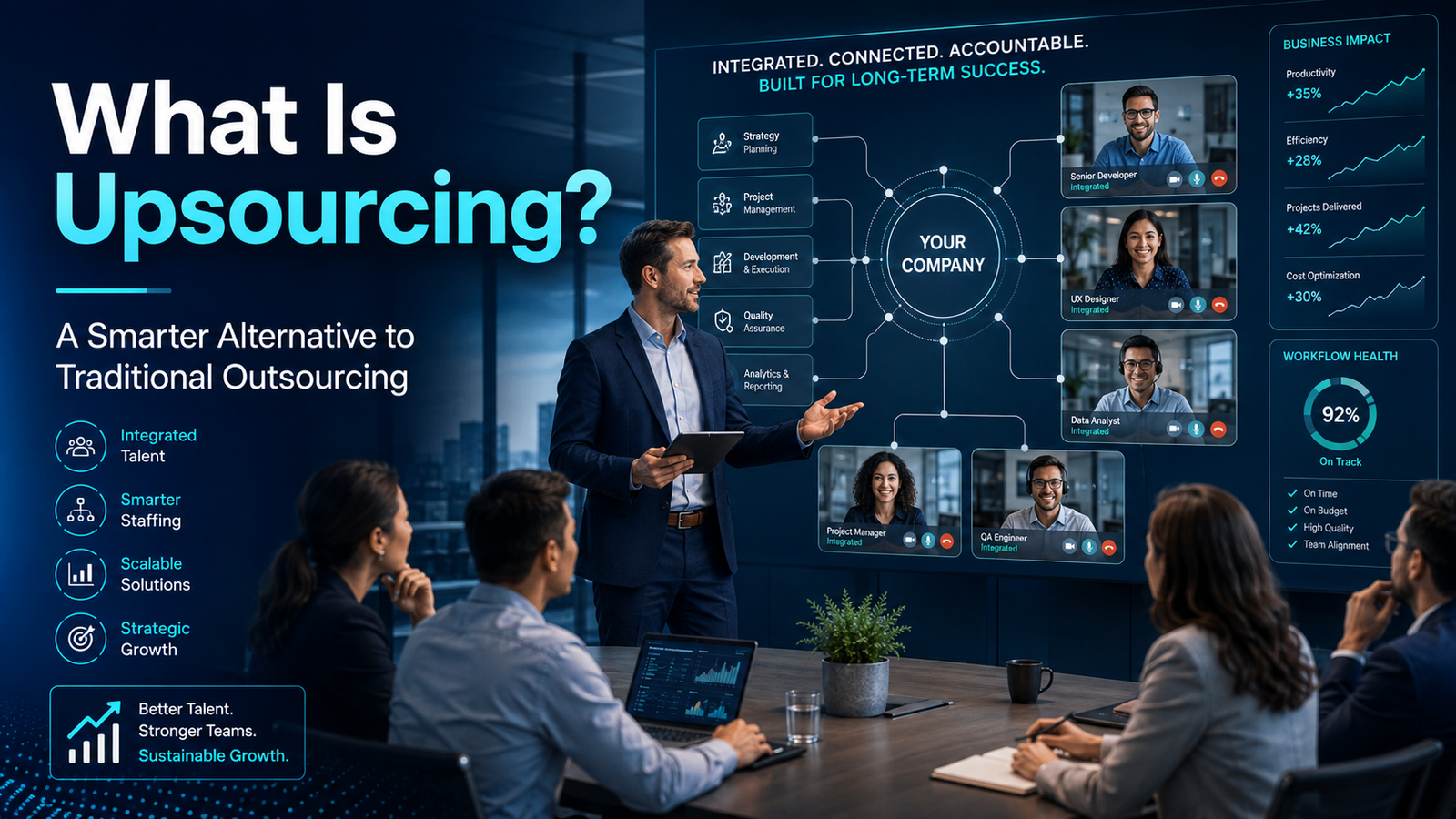
What is upsourcing? For growing businesses, upsourcing is a strategic approach to building workforce capacity by connecting companies with skilled remote professionals who can become part of their ongoing operations. Rather than simply sending isolated tasks to an outside vendor, upsourcing focuses on finding qualified talent, integrating that talent into business workflows, and creating dependable long-term support.
This approach can be especially valuable for businesses facing hiring shortages, rising labor costs, overloaded internal teams, or difficulty finding specialized talent locally.
Traditional outsourcing still has an important place in business. However, organizations that need consistent operational support may benefit from a model that focuses more heavily on talent quality, integration, accountability, and long-term workforce growth.
What Is Upsourcing and How Does It Work?
To understand what is upsourcing, it helps to begin with the way many companies traditionally think about outsourcing.
In a conventional outsourcing arrangement, a company may transfer a particular task, project, or business function to an outside provider. The vendor performs the work and delivers the result.
Upsourcing takes a more workforce-focused approach.
Instead of thinking only about which tasks can be transferred outside the company, businesses ask:
Which responsibilities could be handled by skilled remote professionals who work consistently with our organization?
That difference changes the relationship.
A remote professional may learn the company’s systems, processes, communication style, customers, tools, and expectations. Over time, that individual can become increasingly valuable because they understand how the business actually operates.
Upsourcing may support functions such as:
- Administrative support
- Executive assistance
- Customer service
- Research
- Bookkeeping support
- Financial operations
- E-commerce management
- Website administration
- Property management support
- Social media management
- CRM administration
- Data management
Businesses can explore these types of support through Upsource Media’s services.
Why Businesses Are Looking Beyond Traditional Hiring
Hiring locally remains important for many roles, but it can also create limitations.
Businesses may struggle with:
- Limited local candidate pools
- Rising wage expectations
- Long recruiting cycles
- Employee turnover
- High competition for skilled professionals
- Expensive employee benefits
- Office and equipment costs
- Difficulty scaling quickly
When an organization grows, these challenges become more significant.
A company may have enough customers and revenue opportunities to expand but still lack the workforce capacity required to support that growth.
This can cause internal employees to absorb additional responsibilities.
Eventually, managers, executives, and owners may begin spending time on tasks that should be handled by dedicated support professionals.
Upsourcing gives businesses another option by expanding the available talent pool beyond the local market.
What Is Upsourcing Compared With Outsourcing?
The terms may sound similar, but the business objectives can be different.
Traditional Outsourcing
Traditional outsourcing often focuses on assigning a specific function or project to an outside company.
Examples may include:
- Website development
- Payroll processing
- One-time design work
- Specialized IT projects
- Marketing campaigns
The company typically cares primarily about the result being delivered.
Upsourcing
Upsourcing focuses more on building consistent workforce support through skilled remote professionals.
The professional may work with the company on an ongoing basis and become familiar with internal processes, tools, team members, and operational expectations.
The objective is not simply:
“Complete this project.”
Instead, it may be:
“Become responsible for this function and help us operate more efficiently over time.”
That distinction is important for companies that need ongoing operational capacity.
Upsourcing vs Outsourcing: The Key Differences
Understanding upsourcing vs outsourcing can help businesses choose the right staffing model.
Relationship
Outsourcing can be project-focused.
Upsourcing is often relationship-focused.
Integration
An outsourced vendor may operate separately from the business.
An upsourced professional can become more closely integrated into daily operations.
Knowledge
Project vendors may only need information related to one assignment.
Long-term remote professionals can develop deeper knowledge of the company’s systems and processes.
Accountability
Upsourcing can create clearly defined ongoing responsibilities for specific operational areas.
Scalability
Businesses can expand remote support as operational requirements grow.
Continuity
Working with the same professionals can reduce the need to repeatedly explain systems, expectations, and processes to new freelancers or vendors.
Both models can be useful. The right choice depends on what the business is trying to accomplish.
What Is Upsourcing Designed to Solve?
Businesses usually do not look for staffing alternatives without a reason.
Common challenges include:
Hiring Shortages
A company may have difficulty finding qualified candidates locally.
Rising Labor Costs
Traditional employment involves more than salary. Businesses may also need to consider benefits, payroll costs, recruiting, equipment, training, office space, and management resources.
The U.S. Bureau of Labor Statistics publishes employer compensation data that can help businesses better understand broader employment-cost trends.
Employee Overload
When businesses are understaffed, existing employees are often expected to absorb additional responsibilities.
Leadership Performing Administrative Work
Executives and owners may spend valuable time handling scheduling, email organization, data entry, reporting, and other operational tasks.
Difficulty Scaling
A business may be ready to grow but lack the workforce capacity needed to support additional customers.
Limited Access to Specialized Talent
Some skills may simply be difficult to find within the company’s immediate geographic market.
These challenges are why businesses increasingly explore remote staffing and global talent strategies.
Access Global Talent Without Being Limited by Geography
One of the biggest advantages of modern staffing is that many business functions no longer require employees to work from the same physical office.
Cloud software, video conferencing, project management systems, CRM platforms, and digital communication tools make distributed work increasingly practical.
Businesses can therefore recruit based on:
- Experience
- Skills
- Communication
- Reliability
- Industry knowledge
- Software expertise
- Work quality
rather than primarily based on location.
A broader talent market can be especially valuable for small and mid-sized businesses competing with larger employers for skilled workers.
What Is Upsourcing for Administrative Support?
Administrative work is one of the clearest examples of how upsourcing can create business value.
Many companies have experienced employees spending significant time on repetitive responsibilities.
These may include:
- Calendar management
- Email organization
- Appointment scheduling
- CRM updates
- Data entry
- Document preparation
- Reporting
- Research
- Customer follow-up
- File organization
These tasks are necessary, but they may not require a senior employee to perform them.
A qualified remote professional can take ownership of recurring administrative functions, allowing internal employees to focus on responsibilities that require their expertise.
Executive Assistance Through Upsourcing
Business owners and senior executives often experience a different staffing problem.
Their calendars become full.
Their inboxes become difficult to manage.
Administrative responsibilities accumulate.
Important follow-ups are delayed.
Instead of hiring another local full-time employee immediately, companies can consider remote executive support.
An upsourced executive assistant may help with:
- Calendar management
- Meeting coordination
- Travel arrangements
- Research
- Email organization
- Follow-up
- Document preparation
- CRM management
- Scheduling
- Administrative reporting
The value comes from giving leadership more time to focus on strategy, revenue, customers, partnerships, and growth.
Customer Support and Global Staffing Solutions
Customer experience can deteriorate quickly when a company does not have enough people to respond to customers.
Long response times can lead to frustration.
Remote customer support professionals can help businesses manage:
- Email inquiries
- Phone support
- Live chat
- Customer follow-up
- Support tickets
- Order questions
- Appointment coordination
Global staffing can also provide greater flexibility when businesses need coverage outside traditional office hours.
This does not mean every organization needs a 24-hour support team. It means companies have more options when designing customer-service schedules.
Upsourcing for E-Commerce Operations
E-commerce businesses can experience rapid workload growth.
More sales often mean more:
- Orders
- Customer questions
- Product listings
- Inventory updates
- Returns
- Store updates
- Reports
- Marketplace administration
Founders can quickly become overwhelmed if they continue managing every operational responsibility themselves.
Remote professionals can help manage recurring e-commerce tasks while owners focus on product development, marketing, partnerships, and business growth.
This is where remote staffing solutions can become an important part of a scalable e-commerce operation.
Upsourcing for Real Estate and Property Management
Real estate businesses often manage a large volume of recurring communication and administrative work.
Remote professionals may support areas such as:
- Tenant communication
- Guest communication
- Maintenance coordination
- Appointment scheduling
- Property records
- Document organization
- Research
- CRM updates
- Administrative follow-up
As property portfolios grow, these responsibilities increase.
Strategic staffing can help companies increase operational capacity without requiring owners and senior managers to personally handle every recurring task.
Financial and Bookkeeping Support
Businesses also use remote professionals to support recurring financial and bookkeeping workflows.
Depending on the role and business requirements, this may include:
- Invoice organization
- Expense tracking
- Data entry
- Financial documentation
- Reconciliation support
- Reporting assistance
- Record organization
Clearly defined processes and appropriate access controls are especially important when remote professionals support financial operations.
Why Quality Matters More Than Finding the Cheapest Worker
One misunderstanding about global staffing is that the only objective is reducing labor costs.
That approach can create problems.
Selecting talent based exclusively on the lowest price may lead to:
- Poor communication
- Missed deadlines
- Inconsistent work
- High turnover
- Repeated training
- Customer complaints
- More management time
A stronger staffing strategy evaluates total value.
Businesses should consider:
Skills
Does the candidate understand the work?
Communication
Can the person communicate clearly with the team?
Reliability
Can the business depend on them?
Experience
Have they handled similar responsibilities before?
Accountability
Can performance be measured?
Long-Term Fit
Can this professional continue contributing as the business grows?
This quality-focused philosophy is central to the Why Upsource approach.
Upsourcing Can Protect High-Value Employee Time
A useful way to evaluate staffing is to look at where your highest-value employees spend their time.
Imagine a business owner spending 12 hours per week on:
- Scheduling
- Data entry
- Routine emails
- CRM administration
- Basic research
- Document organization
Those tasks may be important, but the owner’s time could potentially create more value elsewhere.
For example:
- Developing partnerships
- Closing new customers
- Improving products
- Building strategy
- Expanding services
- Strengthening client relationships
The purpose of upsourcing is not simply to add another person.
It is to create leverage.
When responsibilities are placed with the appropriate people, the productivity of the entire organization can improve.
Build Processes Before Building a Remote Workforce
Upsourcing works best when businesses have clear processes.
A remote professional cannot consistently perform a responsibility if the company itself does not know how the task should be completed.
Before assigning recurring work, create standard operating procedures.
Document:
- What should be completed
- Who owns the task
- Which software should be used
- What information is required
- When the task is due
- Who receives the final result
- How performance will be measured
Clear processes improve onboarding and reduce confusion.
They also make it easier to scale a remote workforce over time.
Communication Makes Remote Staffing Successful
A distributed team needs structured communication.
Companies should establish:
- Communication channels
- Meeting schedules
- Reporting expectations
- Response-time expectations
- Task-management systems
- Escalation procedures
- Performance metrics
Common collaboration tools may include project management software, video conferencing, team messaging, cloud storage, and CRM platforms.
The technology itself is not the most important factor.
Consistency is.
Remote professionals need to know where to communicate, where to find information, and how to report their work.
What Is Upsourcing for Small Businesses?
Small businesses can potentially gain significant value from upsourcing because they often operate with limited internal resources.
One employee may be responsible for several different functions.
The business owner may still be heavily involved in day-to-day administration.
Hiring a separate local employee for every business function may not be practical.
Remote staffing can help small businesses add targeted support where it creates the most value.
For example, a company could add:
- An administrative professional
- A customer support specialist
- An executive assistant
- An e-commerce support professional
- A bookkeeping support professional
without requiring every position to follow the same traditional local hiring model.
When Should a Business Consider Upsourcing?
There is no universal point when every company should change its staffing strategy.
However, several signs may indicate that additional support is needed.
Your Existing Team Is Constantly Overloaded
When employees are consistently working beyond capacity, productivity and quality may decline.
Important Tasks Are Being Delayed
Administrative backlogs often indicate insufficient workforce capacity.
Managers Are Performing Routine Work
Senior employees should not spend large portions of their day handling responsibilities that can be delegated.
Hiring Locally Takes Too Long
A broader talent pool may help companies find qualified professionals more efficiently.
Growth Is Creating Operational Bottlenecks
A business should not have to reject opportunities simply because internal employees cannot manage additional workload.
Labor Costs Are Restricting Expansion
Businesses may need a more flexible workforce structure.
These situations can make strategic remote staffing worth exploring.
How Upsource Media Approaches Upsourcing
Upsource Media helps businesses build remote workforce capacity through customized staffing solutions.
The approach focuses on connecting companies with professionals who can support recurring business functions rather than simply completing isolated tasks.
Organizations can use remote talent across areas such as:
- Administrative support
- Customer service
- Executive assistance
- Real estate
- Financial support
- E-commerce
- Website management
- Property management
- Research
- Social media
Businesses looking to expand their workforce can explore the Hire Virtual Assistant page.
Companies can also review the Upsource Media pricing approach to better understand how staffing solutions can be structured around individual business requirements.
What Is Upsourcing as a Long-Term Growth Strategy?
The most important part of understanding what is upsourcing is recognizing that it is not simply about finding someone to complete a list of tasks.
A strong upsourcing strategy can help a company design a workforce around long-term business needs.
That means asking:
- Which functions should remain internal?
- Which responsibilities can be handled remotely?
- Which employees are overloaded?
- Which skills are difficult to find locally?
- Which processes can be delegated?
- Where will the company need more capacity as it grows?
These questions help businesses create a workforce structure intentionally rather than waiting until staffing becomes an emergency.
Frequently Asked Questions
What is upsourcing?
What is upsourcing? Upsourcing is a strategic staffing approach in which businesses use skilled remote professionals to support ongoing operational functions. The goal is to create dependable workforce capacity rather than simply send individual projects to an outside vendor.
What is the difference between upsourcing and outsourcing?
Outsourcing often focuses on assigning projects or business processes to external providers. Upsourcing places greater emphasis on skilled professionals becoming integrated into recurring business operations and building longer-term working relationships.
Is upsourcing the same as hiring a freelancer?
Not necessarily. Freelancers are often hired for individual projects or specialized assignments. Upsourced professionals may work consistently with a company and take responsibility for recurring business functions.
Can small businesses use upsourcing?
Yes. Small businesses can use remote professionals to support administration, customer service, executive assistance, e-commerce, bookkeeping, research, website management, and other functions.
Can upsourcing help reduce hiring pressure?
Upsourcing can expand the available talent pool beyond a company’s immediate geographic market, giving businesses additional options when qualified local candidates are difficult to find.
What roles can be upsourced?
Many computer-based operational roles can be performed remotely, including administrative support, executive assistance, customer service, research, bookkeeping support, e-commerce operations, property management support, website administration, and social media management.
How should a company start upsourcing?
Begin by identifying recurring tasks that are consuming internal time. Document the responsibilities, required skills, tools, workflows, performance expectations, and communication requirements before selecting a remote professional.
Build a Smarter Workforce With Upsourcing
So, what is upsourcing in practical terms?
It is a way for businesses to expand their workforce beyond traditional geographic and hiring limitations while keeping quality, integration, and long-term operational value at the center of the staffing strategy.
The best approach is not to replace every traditional employee or outsource every responsibility.
Instead, businesses can determine which functions should remain internal and which can be supported by skilled remote professionals.
That creates a more flexible workforce built around the company’s actual needs.
For organizations facing hiring challenges, rising employment costs, overloaded employees, or operational bottlenecks, upsourcing can provide another path to growth.
Contact Upsource Media to discuss your staffing requirements and learn how a customized remote workforce can support your business.