
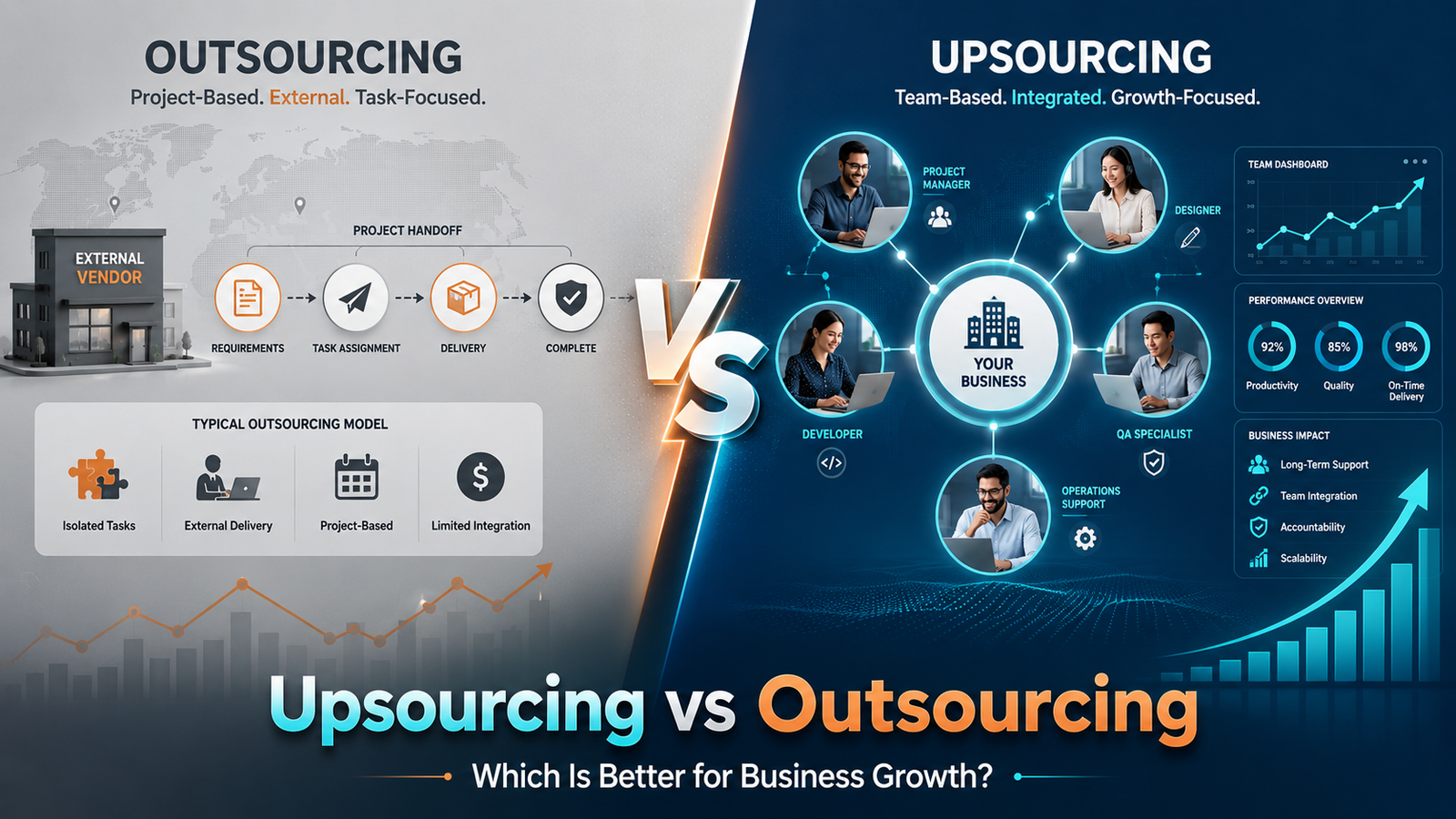
Upsourcing vs outsourcing is becoming an important comparison for businesses looking for better ways to access skilled talent, manage rising employment costs, and build scalable teams. While both models allow companies to use external resources, they are not always designed to achieve the same business outcome.
Traditional outsourcing often focuses on transferring specific tasks, projects, or functions to an external provider. Upsourcing takes a more integrated approach by connecting businesses with skilled remote professionals who can become part of ongoing operations.
For growing organizations, understanding the difference can help determine which staffing strategy best supports productivity, flexibility, customer service, and long-term growth.
Upsourcing vs Outsourcing: What Is the Main Difference?
The biggest difference between upsourcing vs outsourcing is how the external talent is used within the business.
Traditional outsourcing usually focuses on completing a specific project or function.
Examples may include:
- Website development
- Payroll processing
- Graphic design
- IT projects
- Marketing campaigns
- Data processing
- Technical support
A company hires an outside provider, defines the deliverable, and expects the provider to complete the work.
Upsourcing is often more focused on building ongoing workforce capacity.
Instead of only asking:
“Which project can we send outside the company?”
Businesses ask:
“Which responsibilities can a skilled remote professional consistently manage as part of our operations?”
That distinction can significantly change the working relationship.
What Is Traditional Outsourcing?
Outsourcing has been used by businesses for decades.
At its core, outsourcing involves transferring work to an external company, contractor, or service provider.
The business may outsource an entire process or simply one specialized project.
For example, a company could outsource:
- Website design
- Accounting
- IT management
- Marketing
- Customer service
- Payroll
- Manufacturing
- Data entry
Outsourcing can be extremely effective when a company needs specialized expertise but does not need to build an internal team for that function.
It can also help companies complete projects without hiring permanent employees.
However, traditional outsourcing may create more separation between the internal company and the external provider.
What Is Upsourcing?
Upsourcing focuses more heavily on integrating skilled remote professionals into ongoing business operations.
A remote professional may work consistently with the same company, learn its systems, understand its customers, become familiar with internal processes, and take responsibility for recurring tasks.
Examples include:
- Administrative support
- Executive assistance
- Customer service
- E-commerce management
- Bookkeeping support
- CRM administration
- Research
- Website management
- Property management support
- Social media management
Companies interested in building this type of remote workforce can explore Upsource Media’s staffing services.
The goal is not simply to complete a project.
The goal is to build operational capacity.
Upsourcing vs Outsourcing for Long-Term Staffing
One of the most important differences involves the length and depth of the relationship.
Outsourcing May Be Project-Based
A company may hire an outside provider to complete a specific assignment.
Once the project is finished, the relationship may end.
Upsourcing Can Be Ongoing
A remote professional may work with the company consistently and take ownership of recurring responsibilities.
Over time, this person can become more familiar with:
- Company procedures
- Customers
- Internal systems
- Team members
- Products
- Services
- Communication expectations
This continuity can reduce the time businesses spend repeatedly training new freelancers or vendors.
Why Businesses Are Reconsidering Traditional Hiring
The debate around upsourcing vs outsourcing is closely connected to broader workforce challenges.
Companies are dealing with:
- Rising labor costs
- Skills shortages
- Longer recruitment cycles
- Increased employee expectations
- Talent competition
- Employee turnover
- Growing operational workloads
Traditional hiring involves more than salary.
Businesses may also need to account for benefits, payroll taxes, recruitment, training, equipment, software, office space, and management costs.
The U.S. Bureau of Labor Statistics publishes employer compensation data that helps illustrate how wages and benefits contribute to total employment costs.
For growing companies, these pressures make workforce strategy increasingly important.
Upsourcing vs Outsourcing for Accessing Global Talent
Both models can help businesses access talent outside their local geographic area.
However, the way that talent is used may be different.
Traditional outsourcing typically gives businesses access to an external organization’s services.
Upsourcing can provide access to individual remote professionals who work more closely with the company’s existing team.
This can be particularly valuable when businesses need ongoing support in areas such as:
- Administration
- Customer service
- Financial support
- E-commerce
- Executive assistance
- Research
- Website management
- Social media
- Property operations
Global talent allows businesses to recruit based on skills rather than location.
This can expand the available candidate pool and make it easier to find professionals with relevant experience.
Which Model Offers More Workforce Integration?
Integration is one of the strongest differentiators in the upsourcing vs outsourcing discussion.
An outsourced provider may operate independently.
They receive instructions, complete the work, and return the result.
An upsourced professional may become integrated into daily workflows.
For example, they may:
- Attend regular team meetings
- Use company communication platforms
- Work inside the company’s CRM
- Follow internal standard operating procedures
- Coordinate directly with employees
- Manage recurring responsibilities
- Report performance to company managers
This can make the remote professional feel more like part of the operating team.
Upsourcing vs Outsourcing for Administrative Work
Administrative responsibilities are a strong example of where the two models can differ.
A company may outsource a one-time data-entry project.
That is traditional outsourcing.
However, if the organization needs someone every week to manage calendars, update CRM records, coordinate appointments, organize documents, and handle recurring reports, an upsourced administrative professional may be more appropriate.
Remote administrative support can help with:
- Email management
- Calendar organization
- Data entry
- Research
- Scheduling
- CRM updates
- Document preparation
- Customer follow-up
- Reporting
This gives internal employees more time to focus on higher-value responsibilities.
Executive Support Through Upsourcing
Business owners and senior executives frequently spend too much time on administrative responsibilities.
These may include:
- Scheduling meetings
- Organizing email
- Researching information
- Coordinating travel
- Preparing documents
- Managing follow-ups
- Updating records
An upsourced executive assistant can provide ongoing support in these areas.
The value is not simply the number of tasks completed.
The value comes from giving leadership more time for:
- Strategy
- Sales
- Partnerships
- Decision-making
- Customer relationships
- Business development
Upsourcing vs Outsourcing for Customer Support
Customer support can work under either model.
A large business may outsource its entire customer-service department to an external call center.
That may be an effective traditional outsourcing strategy.
A smaller or growing company may instead integrate remote customer-support professionals directly into its team.
These professionals can become familiar with:
- Products
- Customers
- Company policies
- CRM systems
- Internal escalation processes
- Brand communication standards
That deeper familiarity can create a more personalized support experience.
Remote customer-support professionals may handle:
- Phone
- Live chat
- Customer follow-up
- Support tickets
- Appointment coordination
- Order inquiries
E-Commerce: Upsourcing vs Outsourcing
E-commerce businesses often use both models.
They might outsource website development to a specialized agency while using upsourced remote professionals to manage ongoing store operations.
Remote e-commerce support can include:
- Product listings
- Order administration
- Customer inquiries
- Marketplace management
- Store updates
- Inventory coordination
- Reporting
- Customer follow-up
This demonstrates that businesses do not necessarily have to choose only one model.
They can use outsourcing for specialized projects and upsourcing for ongoing operational support.
Real Estate and Property Management Support
Real estate companies often need recurring administrative support as their portfolios grow.
Remote professionals may assist with:
- Tenant communication
- Guest communication
- Maintenance coordination
- Scheduling
- CRM management
- Documentation
- Property records
- Administrative follow-up
Rather than repeatedly outsourcing individual tasks, businesses can create an ongoing remote role responsible for these workflows.
That is where strategic upsourcing can become valuable.
Cost: Upsourcing vs Outsourcing
Cost is often one of the first questions businesses consider.
However, the cheapest model is not automatically the best.
Traditional outsourcing can be highly efficient for clearly defined projects.
For example, hiring an agency to complete a specialized technical project may be more cost-effective than hiring a permanent employee.
Upsourcing can be valuable when businesses need consistent support.
Rather than repeatedly hiring freelancers for recurring tasks, companies can build longer-term relationships with remote professionals.
Businesses should evaluate:
- Total cost
- Work quality
- Reliability
- Training requirements
- Productivity
- Management time
- Continuity
- Long-term value
The best staffing strategy should optimize business value rather than simply minimize hourly costs.
Why Quality Matters in Remote Staffing
The global talent market gives businesses many staffing options.
However, choosing candidates solely based on the lowest possible rate can create problems.
Poor staffing decisions may cause:
- Missed deadlines
- Inconsistent quality
- Customer complaints
- Communication problems
- Repeated training
- High turnover
- Management frustration
Strong remote staffing solutions should prioritize capability and reliability.
Companies should evaluate:
Experience
Does the professional understand the responsibilities?
Communication
Can they communicate clearly with the existing team?
Reliability
Can they consistently meet expectations?
Accountability
Can performance be measured?
Long-Term Fit
Can the professional grow with the company?
This quality-focused approach is central to Why Upsource Media.
Upsourcing Can Improve Workforce Scalability
Growth often creates operational pressure.
More customers mean more:
- Emails
- Orders
- Reports
- Appointments
- Documents
- Support requests
- Administrative tasks
If a business cannot increase workforce capacity, growth can eventually become a problem.
Employees become overloaded.
Customer response times increase.
Management spends more time solving operational problems.
Upsourcing can provide a flexible way to add capacity.
Companies can build remote teams around specific business requirements instead of relying only on local hiring.
When Traditional Outsourcing Makes Sense
Outsourcing is still an excellent strategy in many situations.
It may be the right choice when:
- The project is temporary
- Specialized expertise is required
- The task has a clear deliverable
- The company does not need ongoing support
- The provider can perform the work more efficiently
Examples include:
- Custom software projects
- Website development
- Specialized legal services
- Design projects
- Technical consulting
- One-time marketing campaigns
Businesses should not view traditional outsourcing as outdated.
It remains a powerful tool when used for the right type of work.
When Upsourcing Makes More Sense
Upsourcing may be a stronger choice when the company needs:
- Ongoing support
- Regular communication
- Process familiarity
- Team integration
- Consistent availability
- Recurring responsibilities
- Long-term staffing flexibility
This can be particularly useful for administration, customer service, executive support, e-commerce operations, property management, website administration, and other recurring functions.
Upsourcing vs Outsourcing for Small Businesses
Small businesses often need employees who can manage multiple responsibilities.
However, hiring a separate local employee for every function may not be practical.
Upsourcing can help small companies add support without requiring every new role to follow a traditional local hiring model.
For example, a growing company could bring in:
- A remote administrative professional
- An executive assistant
- A customer-support professional
- An e-commerce specialist
- A bookkeeping support professional
This creates targeted workforce capacity.
Traditional outsourcing can still be used for specialized projects outside the core operational team.
Build Clear Processes Before Using Remote Talent
Whether businesses choose upsourcing or outsourcing, clear processes are essential.
Companies should document:
- Responsibilities
- Required tools
- Communication expectations
- Deadlines
- Reporting procedures
- Performance standards
- Escalation procedures
Well-defined standard operating procedures help external professionals understand what successful work looks like.
They also make onboarding more efficient.
Use Technology to Manage Distributed Teams
Remote work is easier when businesses use the right technology.
Useful tools may include:
- Project management platforms
- CRM systems
- Video conferencing
- Team messaging
- Cloud storage
- Password management
- Reporting dashboards
- Workflow automation
The goal is not constant monitoring.
The goal is visibility and accountability.
Everyone should understand what work is being completed, who is responsible, and when results are expected.
Choosing Between Upsourcing vs Outsourcing
Businesses should consider several questions before choosing a model.
Is the work ongoing or temporary?
Temporary projects may be better suited to outsourcing.
Ongoing responsibilities may benefit from upsourcing.
Does the professional need to understand the business deeply?
If yes, integration becomes more important.
Will the work require daily communication?
Recurring collaboration may make upsourcing more appropriate.
Does the company need specialized expertise for one project?
Traditional outsourcing may provide faster access to specialized knowledge.
Is workforce scalability the goal?
Upsourcing may provide a stronger long-term staffing structure.
The best decision depends on the business’s operational needs.
How Upsource Media Supports Strategic Staffing
Upsource Media helps businesses build remote teams designed around recurring operational requirements.
Companies can access skilled professionals for functions including:
- Administrative support
- Executive assistance
- Customer service
- Financial support
- E-commerce
- Property management
- Research
- Website management
- Social media
Rather than relying only on traditional local recruitment or project-based outsourcing, companies can build flexible workforce capacity through remote professionals.
Businesses interested in adding remote talent can explore the Hire Virtual Assistant page.
You can also review the Upsource Media pricing approach to learn how staffing solutions can be structured around different business requirements.
Frequently Asked Questions
What is the difference between upsourcing and outsourcing?
The primary difference is integration. Outsourcing often transfers projects or business functions to an outside provider, while upsourcing focuses on integrating skilled remote professionals into recurring company operations.
Is upsourcing better than outsourcing?
Neither model is universally better. Outsourcing can work well for specialized or temporary projects, while upsourcing may be better for ongoing responsibilities and long-term workforce support.
Can businesses use both upsourcing and outsourcing?
Yes. Businesses can outsource specialized projects while using upsourced remote professionals for recurring operational responsibilities.
What jobs can be upsourced?
Administrative support, executive assistance, customer service, research, bookkeeping support, e-commerce, property management, website management, CRM administration, and social media are common examples.
Can upsourcing reduce staffing pressure?
Yes. Upsourcing expands access to remote professionals beyond the local labor market and can provide additional workforce capacity when internal teams are overloaded.
Is upsourcing suitable for small businesses?
Yes. Small businesses can use upsourcing to add targeted operational support while maintaining greater staffing flexibility.
How should businesses choose a staffing model?
Evaluate whether the work is temporary or ongoing, how closely the professional must work with the internal team, the required expertise, communication needs, budget, and long-term growth goals.
Choose the Staffing Strategy That Supports Your Growth
The upsourcing vs outsourcing decision should be based on business needs rather than trends.
Traditional outsourcing remains valuable when companies need specialized providers to complete defined projects.
Upsourcing provides another option for businesses that need ongoing workforce capacity, closer integration, consistent communication, and long-term operational support.
In many cases, the strongest strategy may involve both.
Businesses can outsource specialized projects while building a remote team to handle recurring functions.
The objective is to create a workforce structure that supports productivity, flexibility, and sustainable growth.
Contact Upsource Media to discuss your workforce requirements and learn how strategic remote staffing can support your business growth.