
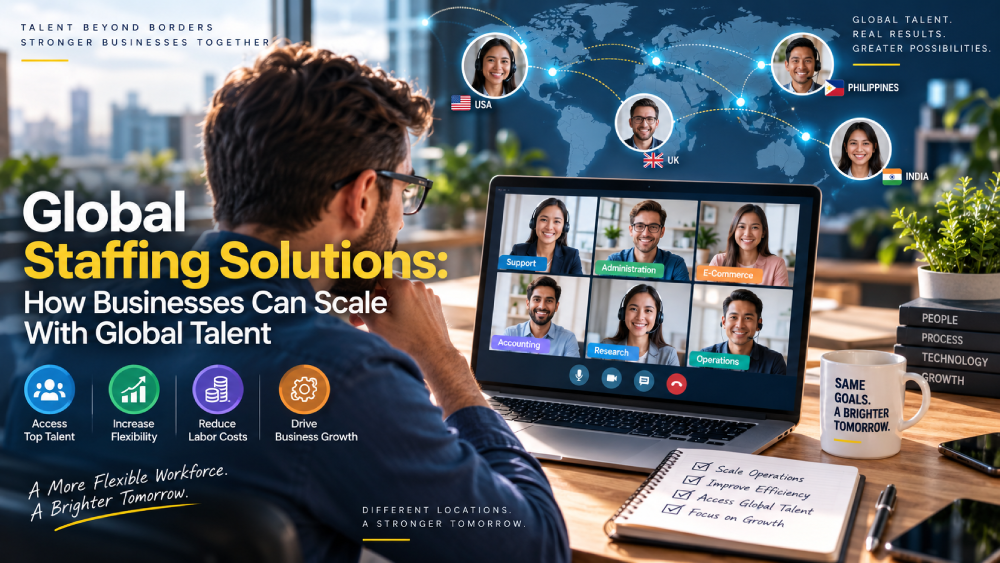
Global Staffing Solutions: How Businesses Can Scale With Global Talent
Global staffing solutions give businesses a practical way to expand their workforce beyond the limits of a local hiring market. Instead of searching only for professionals who live near an office, companies can access qualified talent across different regions and countries.
For growing U.S. businesses, this approach can create greater workforce flexibility. As a company grows, customer inquiries, administrative responsibilities, research, technical tasks, and other operational demands often increase as well. Therefore, businesses need a staffing strategy that can grow with them.
Global staffing is not simply about hiring people in different countries. Instead, an effective strategy focuses on finding the right talent, defining responsibilities clearly, building efficient workflows, and integrating remote professionals into the existing team.
What Are Global Staffing Solutions?
Global staffing solutions help businesses access professionals outside their immediate geographic hiring market.
Depending on the position and staffing model, professionals may work remotely from another state or country while supporting daily business operations. As a result, location becomes one consideration rather than the primary limitation when searching for talent.
This approach can be especially useful for digitally enabled positions that do not require someone to work inside a physical office.
For example, remote professionals may support areas such as:
- Administrative operations
- Customer support
- Technical assistance
- Lead generation
- Collections
- Accounts receivable
- Other defined remote business functions
UpSource Media helps businesses build remote teams and access global talent for a range of operational needs.
Why Businesses Are Looking Beyond Local Hiring
Traditional recruiting usually starts within a defined geographic area. That approach remains important for jobs requiring employees to be physically present.
However, many modern business responsibilities are performed through cloud platforms, email, phone systems, CRM software, and other digital tools. Consequently, businesses can consider a much broader talent pool for suitable positions.
Rather than focusing primarily on location, employers can evaluate candidates based on factors such as:
- Skills
- Experience
- Communication
- Availability
- Reliability
- Technology proficiency
- Language capabilities
- Role fit
Expanding the search can introduce businesses to professionals they may never find through local recruiting alone.
Still, global recruiting should not mean lowering hiring standards. Companies need structured recruiting, clear expectations, and careful candidate evaluation regardless of where a professional is located.
How Global Staffing Solutions Support Business Growth
Growth creates additional work.
As customer numbers increase, support requests may rise. Meanwhile, sales growth can create more administrative and financial responsibilities. New projects can also require additional coordination.
Eventually, existing employees may reach capacity.
At this stage, businesses can redistribute responsibilities, automate appropriate processes, hire locally, or expand their search for talent. Global staffing solutions provide another option.
For instance, a business could maintain its local leadership team while adding remote professionals to support customer service, lead generation, administrative operations, or accounts receivable.
Therefore, companies can build teams around actual operational requirements rather than relying on a single staffing model.
Start Your Global Staffing Strategy With the Work
A strong strategy for global staffing solutions should begin with the work that needs to be completed.
Before recruiting, businesses should identify where their current team is experiencing pressure.
Consider questions such as:
- Where is our team overloaded?
- Which responsibilities create recurring bottlenecks?
- What work requires physical presence?
- Which responsibilities can be handled remotely?
- Which skills are difficult to find locally?
- Where do we need additional coverage?
- Which functions will become more important as we grow?
These questions can reveal the actual staffing requirement.
For example, management may initially believe the company simply needs another general employee. After reviewing the workload, however, the business might discover that it specifically needs a customer support professional or an administrative specialist.
Clear roles make recruiting more focused and onboarding easier.
Which Roles Can Global Talent Support?
Not every position belongs in a global staffing model.
Jobs involving physical operations, field service, manufacturing, or other location-dependent responsibilities may require local employees. On the other hand, many digitally enabled functions can be performed remotely.
Administrative Support
Administrative professionals can help manage recurring operational responsibilities.
Depending on the position, this might include scheduling, data entry, document organization, CRM maintenance, and other defined administrative tasks.
As a result, managers can spend more time on responsibilities that specifically require their experience and authority.
Customer Support
Remote customer support professionals can assist customers through phone, email, chat, and other digital communication channels.
For this arrangement to work effectively, businesses should establish clear service standards. In addition, employees need defined escalation procedures for situations requiring management attention.
Lead Generation
Lead generation professionals can support prospect research, outreach, database management, and other defined activities within a company’s sales process.
However, businesses should establish clear targeting criteria and communication standards before delegating these responsibilities.
Technical Assistance
Certain technical support responsibilities can also be performed remotely.
In these roles, documented procedures become particularly important. Employees should understand which issues they can resolve independently and which problems require escalation.
Collections and Accounts Receivable
Remote professionals may also assist with defined collections and accounts receivable processes.
Because these responsibilities can involve sensitive business information, companies should carefully control system access and establish clear procedures.
How Global Staffing Solutions Reduce Labor Costs
Businesses researching how global staffing solutions reduce labor costs should look beyond wages alone.
Different labor markets can have different compensation structures. Furthermore, remote staffing may change some of the expenses associated with adding office-based positions.
Still, the lowest-cost candidate is not automatically the best choice.
A better question is:
What value will this professional add to the business?
When comparing staffing options, consider:
- Compensation
- Recruitment requirements
- Training
- Management time
- Technology
- Productivity
- Quality of work
- Reliability
- Communication
- Retention
- Required infrastructure
For example, a lower-cost professional who requires constant supervision may consume substantial management time. In contrast, an experienced professional who works independently may provide greater overall value.
Therefore, cost efficiency should come from designing a more effective workforce, not simply searching for the lowest possible rate.
Global Talent Can Create Greater Workforce Flexibility
Business requirements rarely remain the same forever.
A growing company may need more customer coverage today and additional administrative support six months later. Similarly, a sales team may eventually need lead generation assistance as its pipeline expands.
Global staffing allows businesses to approach these needs from a capability perspective.
Instead of asking only, “How many people should we hire?” management can ask, “Which capabilities does our business need next?”
For example, a company may need:
- Additional customer coverage
- Better administrative organization
- More consistent CRM maintenance
- Additional prospecting capacity
- Technical assistance
- Accounts receivable support
Once the need is clear, the business can define the appropriate position and begin recruiting.
Define Responsibilities Before Recruiting Globally
One of the most important steps in global staffing happens before the first interview.
Businesses should clearly define the role.
A vague request such as “we need a remote employee” does not explain what that person needs to accomplish. Therefore, management should document the position before recruiting.
A useful role description can include:
- Primary responsibilities
- Required skills
- Preferred experience
- Working hours
- Communication requirements
- Software knowledge
- Reporting structure
- Performance expectations
Suppose a business needs customer support.
Instead of simply advertising for a customer service professional, the company could specify the communication channels involved, required working hours, CRM responsibilities, and escalation procedures.
Consequently, both recruiters and candidates gain a clearer understanding of the position.
Evaluate Global Candidates Beyond Technical Skills
Technical ability matters. However, successful remote professionals also need to work effectively within a distributed team.
Businesses should evaluate several areas during recruitment.
Relevant Experience
First, determine whether the candidate has handled responsibilities similar to those required by the position.
Communication
Next, consider whether the candidate communicates clearly and professionally with managers, coworkers, prospects, or customers.
Technology Skills
Remote employees depend heavily on digital systems. Therefore, they should be comfortable using the technology required for their position.
Reliability
Businesses should also determine whether candidates can consistently meet agreed schedules, deadlines, and responsibilities.
Problem-Solving
Strong professionals should know how to handle routine decisions independently. At the same time, they should recognize when an issue requires escalation.
Long-Term Fit
Finally, consider whether the candidate can support the position as it exists today and potentially grow with the business over time.
Integrate Global Professionals Into Your Existing Team
Recruiting a talented professional is only the beginning.
New remote team members need to understand how the company operates. Therefore, businesses should create a structured onboarding process.
Onboarding can cover:
- Company goals
- Role responsibilities
- Team structure
- Communication channels
- Standard operating procedures
- Required software
- File organization
- Reporting expectations
- Security requirements
- Escalation procedures
In addition, managers should clearly explain who owns specific decisions.
Without this information, new employees may hesitate or repeatedly seek clarification. Clear onboarding, however, gives professionals a stronger foundation for independent work.
Build Clear Communication Across Global Teams
Distributed teams cannot depend on casual office conversations. Consequently, communication needs to be more intentional.
Businesses should establish:
- Primary communication platforms
- Working-hour expectations
- Response-time standards
- Meeting schedules
- Reporting procedures
- Emergency communication methods
- Escalation processes
At the same time, remote work does not require constant meetings.
Documented processes can actually reduce unnecessary communication. When professionals understand their responsibilities, they can complete more work without repeatedly asking managers what to do next.
Use Time Zones Strategically
Time-zone differences can create challenges when they are ignored. However, careful scheduling can turn them into a manageable part of workforce planning.
Some positions require significant overlap with U.S. business hours. Customer-facing roles, for instance, may need to be available when customers are active.
Other positions may allow greater scheduling flexibility.
Before recruiting, define:
- Required working hours
- Minimum schedule overlap
- Meeting expectations
- Customer coverage requirements
- Deadline standards
By establishing these expectations early, businesses can avoid scheduling conflicts after hiring.
Plan Global Staffing Solutions Payroll Carefully
Global staffing solutions payroll requires careful consideration because payroll, employment, and tax requirements can depend on several factors.
These may include worker location, classification, the structure of the working relationship, and applicable laws.
For U.S. businesses, worker classification is particularly important.
The IRS provides guidance on determining whether a worker is an employee or independent contractor. Its guidance considers factors involving behavioral control, financial control, and the nature of the relationship.
Therefore, businesses should not assume that someone is automatically an independent contractor simply because that person works remotely or lives in another country.
Companies developing international teams should obtain appropriate legal, tax, payroll, or employment guidance for their specific circumstances.
Protect Business Systems and Information
Remote professionals may need access to internal systems to perform their jobs.
For that reason, access management should be part of the staffing strategy from the beginning.
Businesses can consider practices such as:
- Individual user accounts
- Multi-factor authentication
- Role-based permissions
- Password management
- Approved communication tools
- Secure file sharing
- Device and software standards
- Periodic access reviews
- Documented offboarding
In addition, access should match the employee’s actual responsibilities.
For example, a customer support professional may require access to a CRM and support platform. However, that person may not need access to unrelated financial or administrative systems.
The Cybersecurity and Infrastructure Security Agency’s Secure Our World resources also provide practical cybersecurity guidance for businesses and individuals.
Measure Remote Performance Through Outcomes
Managers cannot rely on physical visibility when leading distributed teams.
Instead, businesses should establish clear performance expectations.
For an administrative role, measurements might include scheduling accuracy, CRM updates, task completion, and reporting.
Meanwhile, a customer support role could focus on response procedures, case documentation, communication quality, escalation accuracy, and assigned workload.
Lead generation positions may require a different set of expectations.
Ultimately, performance measures should reflect the responsibilities of each specific role.
Clear outcomes help both managers and remote professionals understand what successful performance looks like.
Common Global Staffing Mistakes to Avoid
Global staffing can provide significant flexibility. Nevertheless, poor planning can create unnecessary challenges.
Hiring Only for the Lowest Price
Cost is important. However, experience, reliability, communication, and work quality also affect the value of a hire.
Creating Vague Roles
Professionals need to understand what they own. Therefore, responsibilities should be documented before recruiting begins.
Ignoring Time Zones
Scheduling expectations should be discussed during recruitment rather than after hiring.
Skipping Onboarding
Even experienced professionals need to understand company-specific systems, processes, and expectations.
Failing to Document Processes
Without documented workflows, remote professionals may rely on assumptions. As a result, consistency can suffer.
Separating Remote Professionals From the Team
Global professionals still need context, communication, feedback, and accountability. They should understand how their work contributes to broader company objectives.
Ignoring Payroll and Classification Requirements
Finally, businesses should not make assumptions about employment classification or cross-border payroll. Appropriate professional guidance can help companies understand the requirements that apply to their specific staffing structure.
How to Choose a Global Staffing Partner
The right staffing partner should help a business identify professionals who match its actual workforce requirements.
Before selecting a provider, consider asking:
- How are candidates recruited?
- How are skills evaluated?
- Can our company interview candidates?
- Which roles can you help us staff?
- How do you evaluate communication skills?
- Can candidates work within our required schedule?
- How does onboarding work?
- What ongoing support is available?
- Can we expand our team as our needs change?
- How does your model support long-term staffing relationships?
These questions help businesses evaluate more than price.
In addition, companies can consider the provider’s understanding of remote workforce integration, communication, and operational requirements.
How UpSource Media Supports Global Staffing
UpSource Media helps businesses access remote professionals and build flexible teams around their operational needs.
Rather than restricting talent searches to one local market, businesses can explore professionals from a broader talent pool for suitable remote roles.
UpSource Media’s approach can support companies looking for assistance across areas such as virtual staffing, customer support, technical assistance, lead generation, collections, accounts receivable, and other remote business functions.
Businesses considering this approach can also learn more about why businesses choose UpSource Media.
The objective is not simply to add another person to payroll. Instead, businesses should identify the capability they need and build a staffing structure that supports sustainable operations.
Frequently Asked Questions About Global Staffing Solutions
What Are Global Staffing Solutions?
Global staffing solutions help businesses recruit or access professionals beyond their immediate geographic hiring market.
For suitable positions, this can allow companies to build distributed teams across different regions or countries.
Why Do Businesses Use Global Talent?
Businesses may use global talent to expand their candidate pool, access specific skills, increase workforce flexibility, or support growing operational requirements.
In addition, remote staffing can help companies consider professionals who would otherwise be unavailable through a local search.
How Do Global Staffing Solutions Reduce Labor Costs?
Different labor markets and staffing structures may create cost efficiencies. However, businesses should evaluate the total value of a staffing arrangement rather than comparing wages alone.
Recruitment, training, management, productivity, technology, and quality should all be considered.
Which Positions Can Be Staffed Globally?
Many digitally enabled positions can potentially be performed remotely.
Examples include administrative support, customer support, lead generation, technical assistance, collections, accounts receivable, and other computer-based business functions.
However, the appropriate model depends on the specific responsibilities of the position.
How Should Businesses Manage Global Professionals?
Start with clear responsibilities and documented processes.
Then, establish communication standards, working hours, performance expectations, reporting procedures, and appropriate system access. Regular feedback can further help remote professionals stay aligned with business goals.
How Does Global Staffing Solutions Payroll Work?
There is no single payroll structure for every global staffing arrangement.
Worker location, classification, employment structure, and applicable laws can affect payroll requirements. Therefore, businesses should review their specific situation with qualified payroll, legal, tax, or employment professionals.
Is Global Staffing Only for Large Companies?
No. Smaller and growing businesses can also consider global talent when a position can be performed remotely and the staffing structure fits their operational requirements.
Build Your Workforce Around the Talent You Need
Global staffing solutions allow businesses to approach workforce growth differently.
Rather than automatically limiting every candidate search to commuting distance, companies can first identify the work that needs to be completed. Next, they can determine which skills are required and whether physical location actually matters.
From there, businesses can create clearly defined roles, recruit qualified professionals, document workflows, establish communication standards, and measure performance through outcomes.
At the same time, payroll, worker classification, cybersecurity, and system access should remain part of the planning process.
Ultimately, global talent delivers the most value when it becomes part of a thoughtful workforce strategy rather than simply a way to hire somewhere else.
For businesses exploring a more flexible approach to building their workforce, UpSource Media can help connect operational needs with remote talent.