
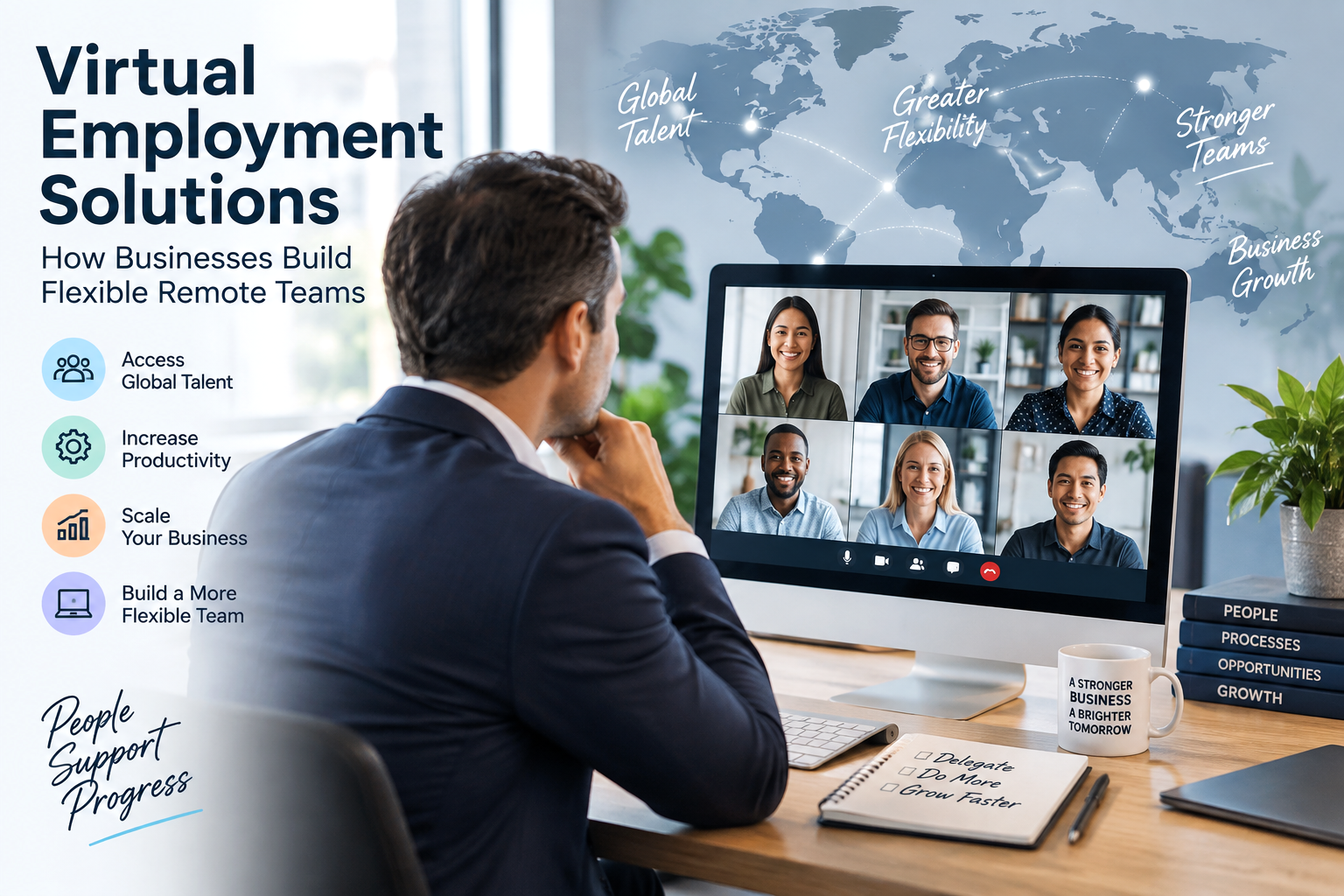
Virtual employment solutions give businesses a practical way to build flexible remote teams without limiting recruitment to one office, city, or local talent pool. For U.S. business owners, this approach can create more staffing options while making it easier to delegate recurring work and access skilled professionals.
However, building a strong virtual team involves more than hiring someone who works remotely. Businesses need clear roles, documented processes, reliable communication, secure systems, and measurable expectations.
When those foundations are in place, remote professionals can support important business functions while leadership stays focused on customers, strategy, and growth.
What Are Virtual Employment Solutions?
Virtual employment solutions allow businesses to add professionals who perform their responsibilities remotely while supporting ongoing company operations.
Depending on the role, these professionals may work from another city, state, or country. Even so, they can operate within the company’s normal workflows, communication systems, software, and performance standards.
For example, remote professionals can support functions such as:
- Administrative support
- Executive assistance
- Customer service
- Research
- E-commerce operations
- Website management
- Social media management
- Bookkeeping and accounting support
- Property management assistance
Rather than viewing remote talent as temporary help, businesses can build roles around recurring operational needs.
Explore UpSource Media’s remote staffing services to see the types of business functions that can be supported remotely.
Why Businesses Are Building Flexible Remote Teams
Business workloads rarely remain constant.
A new customer can create more service requests. Likewise, a successful marketing campaign may increase sales follow-up, administrative work, and customer communication.
As a result, existing employees may become overloaded even when the company is growing successfully.
Flexible remote teams give businesses another staffing option.
Instead of relying only on local recruitment, companies can determine which responsibilities require physical presence and which can be completed remotely.
That flexibility can be especially useful when businesses need support in a specific area but do not want senior employees handling every recurring task themselves.
Virtual Employment Solutions Expand the Talent Pool
Traditional recruitment often begins with geography.
A business may search for candidates who live close enough to commute to its office. Therefore, the available talent pool can become limited before the hiring process even begins.
Remote recruitment changes that.
Instead of asking, “Who lives close enough to work here?” a company can ask:
Who has the skills and experience required for this role?
Access to global talent can expand the range of candidates available for digital and operational positions.
However, location should never replace quality as a hiring standard.
Businesses should still evaluate candidates based on:
- Relevant experience
- Communication skills
- Reliability
- Technology knowledge
- Problem-solving ability
- Schedule compatibility
- Long-term role fit
Ultimately, the goal is to widen the search without lowering expectations.
Which Roles Work Well With Remote Staffing?
Not every position should become remote.
For example, jobs requiring physical equipment, local field work, in-person customer service, or location-specific responsibilities may still need local employees.
On the other hand, many digital business functions can be managed effectively from anywhere.
Administrative Support
Remote professionals can assist with:
- Email organization
- Calendar management
- Appointment scheduling
- Data entry
- CRM updates
- Document preparation
- Reporting
- Research
Because these tasks are largely digital, they can often be handled without requiring an employee to work inside the office.
Executive Assistance
Business owners and executives frequently spend valuable time managing routine administration.
A remote executive assistant can help organize calendars, meetings, research, travel, documents, and follow-ups.
Consequently, leadership can spend more time on higher-value work.
Customer Support
Remote customer service professionals can support:
- Email inquiries
- Live chat
- Phone calls
- Support tickets
- Appointment coordination
- Customer follow-up
A clear support process is essential. However, once those processes are documented, customer service can often be managed effectively by a distributed team.
E-Commerce Support
Online stores already rely heavily on digital systems.
Therefore, remote professionals may help with:
- Product listings
- Order administration
- Customer inquiries
- Store updates
- Marketplace management
- Inventory support
Website and Social Media Support
Routine website updates and social media administration can also be delegated.
For example, remote professionals may assist with content updates, page management, post scheduling, engagement monitoring, and reporting.
Virtual Employment Solutions vs. Traditional Hiring
Traditional hiring and virtual employment are not competing ideas.
In fact, many businesses benefit from using both.
Local employees may be the right choice when physical presence is important. Meanwhile, remote employees can support roles where location does not affect performance.
A traditional role may make sense when:
- Physical equipment is required
- Customers expect in-person service
- Field work is involved
- Local credentials are necessary
- The job depends on on-site operations
In contrast, remote staffing may be appropriate when:
- Work is primarily digital
- Performance can be measured clearly
- The role involves recurring computer-based tasks
- Local recruiting is difficult
- The company needs access to a broader talent pool
For many growing businesses, a blended workforce offers the best balance.
Build the Role Before Hiring Virtual Employees
A common mistake is hiring before defining the position.
For example, a business may decide it needs a “virtual assistant” without identifying what that person should actually own.
Instead, start with the work.
Ask:
- Which tasks need to be completed?
- How often do they occur?
- Which tools are required?
- Who will manage the role?
- How will successful performance be measured?
A clear role might include responsibilities such as:
- Updating CRM records
- Managing customer follow-ups
- Coordinating appointments
- Preparing weekly reports
- Conducting research
- Organizing documents
Because expectations are specific, both hiring and management become easier.
How Virtual Employment Services Improve Delegation
Good delegation is not simply transferring random tasks to someone else.
Instead, it means assigning clear responsibility to the right person.
Virtual employment services can help businesses move recurring operational work away from employees whose time is better spent elsewhere.
For instance, a business owner may spend several hours every week on:
- Routine emails
- Scheduling
- CRM administration
- Reports
- Customer follow-up
- Online research
Although these tasks matter, they may not require the business owner’s direct involvement.
By delegating them, leadership can focus more heavily on customers, strategy, partnerships, and revenue-generating activities.
Remote Staffing Solutions Need Clear Processes
Even highly skilled professionals can struggle when company processes are unclear.
Therefore, businesses should document recurring workflows before handing them off.
A standard operating procedure should explain:
- What needs to be completed
- When it should be done
- Which tools should be used
- Which information is required
- Who approves the work
- When an issue should be escalated
For example, a customer support process might explain where inquiries arrive, expected response times, approved responses, and escalation procedures.
Clear documentation reduces confusion. In addition, it makes onboarding faster when the team grows.
Manage Virtual Employees Through Outcomes
Remote management should focus on results rather than constant observation.
For example, “stay productive” is not a useful performance expectation.
A better approach would be:
- Update all assigned CRM records by the end of each day
- Respond to routine customer inquiries within the agreed service window
- Prepare a weekly report every Friday
- Escalate priority issues according to company procedures
These expectations are clear and measurable.
In addition, virtual employees should understand how communication works.
Businesses can establish:
- Regular check-ins
- Project management systems
- Communication channels
- Reporting schedules
- Response-time expectations
- Escalation procedures
As a result, managers gain visibility without unnecessary micromanagement.
Communication Keeps Flexible Remote Teams Connected
Remote teams cannot depend on informal conversations across an office.
Therefore, communication needs to be more intentional.
Businesses should clearly establish:
- Where team communication happens
- Which issues require meetings
- When written updates are expected
- Where files are stored
- How urgent issues should be handled
For example, a company may use one platform for team messaging, another for project management, and a CRM for customer information.
The exact tools matter less than consistency.
Everyone should understand where information belongs.
Protect Business Data in Remote Work
Remote professionals may require access to important company systems.
Therefore, cybersecurity should be part of the staffing strategy from the beginning.
Businesses can use measures such as:
- Multi-factor authentication
- Strong password policies
- Password managers
- Role-based access
- Secure cloud storage
- Regular software updates
- Periodic access reviews
The Cybersecurity and Infrastructure Security Agency provides practical security guidance for businesses, including recommendations around passwords, multi-factor authentication, phishing awareness, and software updates.
Access should also match the role.
For instance, a social media assistant may require very different permissions from someone supporting financial administration.
Global Talent Should Be Hired for Quality, Not Just Cost
One misconception about global staffing is that the main objective should be finding the cheapest available worker.
That approach can create more problems than it solves.
Poor hiring decisions can lead to:
- Missed deadlines
- Communication problems
- Inconsistent work
- Repeated training
- High turnover
- Customer frustration
- Increased management time
Instead, businesses should evaluate total value.
Strong candidates should demonstrate relevant skills, communication, reliability, professionalism, and the ability to work independently.
Furthermore, long-term fit matters.
A professional who understands the business and becomes more effective over time may create far more value than constantly replacing low-cost workers.
Learn more about UpSource Media’s staffing philosophy on the Why UpSource page.
When a Virtual Employment Agency Makes Sense
Some companies prefer to recruit, screen, and manage remote professionals entirely on their own.
Others may benefit from working with a virtual employment agency or remote staffing provider.
A staffing partner may be useful when:
- Local recruiting is taking too long
- Managers lack time to screen large numbers of candidates
- The business needs support across several functions
- Leadership is new to remote hiring
- The company needs a more structured staffing process
However, businesses should still evaluate the provider carefully.
Ask how roles are defined, how candidates are selected, what support is available, and how the remote professional will fit into existing workflows.
How to Evaluate Remote Staffing Solutions
Not all remote staffing solutions work the same way.
Before choosing a staffing model, businesses should ask several practical questions.
Does the Provider Understand the Role?
A staffing partner should understand the actual work, not simply the job title.
For example, executive support requires different skills from e-commerce operations.
How Are Candidates Evaluated?
Businesses should understand how experience, communication, and role fit are assessed.
How Will the Professional Work With Your Team?
Remote professionals still need managers, processes, software access, and communication systems.
What Happens When Business Needs Change?
A growing company may need different skills or additional capacity later.
Therefore, flexibility matters.
Is the Model Designed for Ongoing Support?
Recurring business functions benefit from continuity.
The more a professional understands company processes, the easier it becomes for them to contribute independently.
Businesses ready to explore remote support can review UpSource Media’s Hire a Virtual Assistant page.
Common Mistakes When Building Remote Teams
Remote staffing works best when businesses avoid several common mistakes.
Hiring Without Clear Responsibilities
A vague role creates vague performance.
Define the work before recruiting.
Choosing Only by Price
Cost matters. However, communication, reliability, skills, and fit matter more over time.
Skipping Onboarding
Even experienced professionals need to learn the company’s systems and expectations.
Failing to Document Workflows
Employees cannot consistently follow processes that have never been documented.
Communicating Only When Something Goes Wrong
Regular check-ins help prevent small issues from becoming larger problems.
Micromanaging Every Task
Instead, define outcomes and measure performance.
Treating Remote Professionals as Temporary Help
When someone manages recurring operations, integration and continuity can improve their value.
Virtual Employment Solutions for Small Businesses
Small businesses can benefit from remote staffing because they often operate with limited internal resources.
For example, one employee may handle sales, administration, and customer communication at the same time.
Similarly, the owner may still manage scheduling, research, reporting, and follow-up personally.
Hiring a separate local employee for every function may not always be practical.
Remote professionals can provide targeted support where the business needs it most.
As a result, small companies can add specialized capacity while maintaining flexibility.
How UpSource Media Supports Remote Teams
UpSource Media provides remote staffing and virtual employment support for businesses that need additional operational capacity.
Its service offering includes areas such as:
- Customer support
- Administrative support
- Executive assistance
- Research
- E-commerce support
- Website management
- Social media management
- Bookkeeping and accounting support
- Property management assistance
Rather than treating every role as generic virtual assistance, businesses can build support around specific operational needs.
Explore UpSource Media’s services to learn more about available remote support functions.
If your business is ready to discuss specific staffing requirements, you can also contact UpSource Media.
Frequently Asked Questions About Virtual Employment Solutions
What are virtual employment solutions?
Virtual employment solutions allow businesses to use remote professionals for ongoing operational responsibilities. These professionals can support digital functions while working through the company’s normal systems and processes.
What can virtual employees do?
Virtual employees may support administration, executive assistance, customer service, research, e-commerce, website management, social media, bookkeeping support, and other computer-based functions.
Are virtual employment services only for large companies?
No. Small and mid-sized businesses can also use virtual employment services when they need additional operational support or access to specialized skills.
Can global talent work effectively with U.S. businesses?
Yes, provided the company establishes clear roles, schedules, processes, communication expectations, and performance standards.
How do businesses manage remote workers?
Strong remote management relies on clear outcomes, documented processes, consistent communication, appropriate software, and measurable performance expectations.
Is virtual employment the same as hiring freelancers?
Not necessarily.
Freelancers often work on individual projects. In contrast, virtual employment can involve ongoing roles that support recurring business operations.
When should a company consider remote staffing?
A business may benefit from remote staffing when internal employees are overloaded, local hiring is difficult, recurring tasks are being delayed, or growth requires additional operational capacity.
Build a Flexible Remote Team Around Your Business
A flexible workforce does not mean replacing every local employee.
Instead, it means choosing the right staffing model for each responsibility.
Virtual employment solutions can help businesses access a wider talent pool, delegate recurring work, and add operational capacity without limiting every position to one geographic market.
However, successful remote teams need structure.
Define roles clearly. Document workflows. Hire for quality. Set measurable expectations. Communicate consistently. Protect business systems.
When those fundamentals are in place, remote professionals can become valuable long-term members of the organization.
If your existing team is overloaded or local hiring is limiting your options, contact UpSource Media to discuss a flexible remote staffing strategy.