
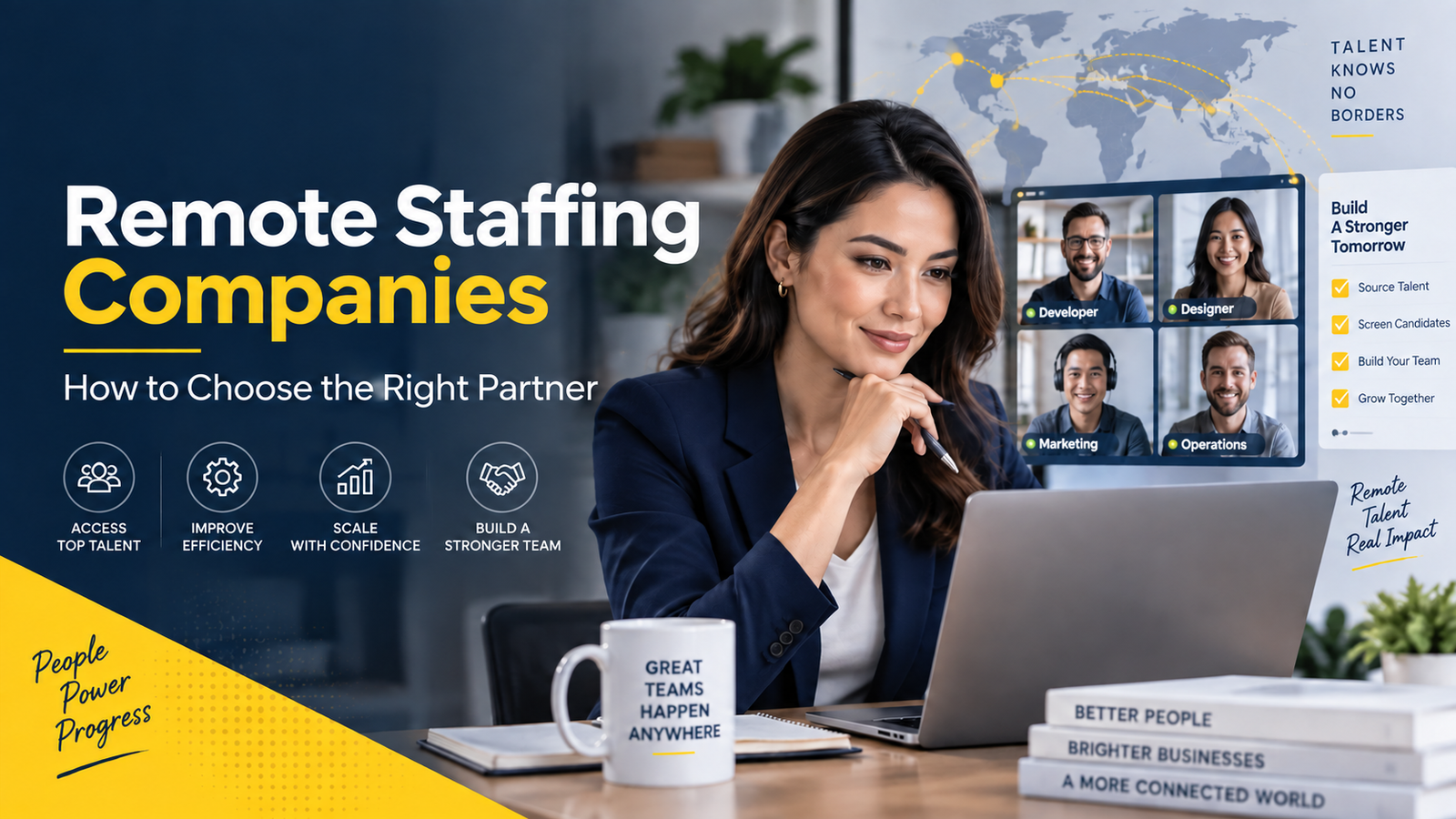
Remote staffing companies give growing businesses a flexible way to access skilled professionals, delegate recurring responsibilities, and strengthen their teams. As workloads increase, the right staffing partner can help improve efficiency. At the same time, business owners and internal employees gain more time to focus on customers, strategy, and growth.
However, choosing the right provider requires more than comparing prices.
A strong staffing partner should understand your business and the type of support you need. In addition, the company should communicate clearly and offer enough flexibility to support future growth.
This guide explains how to compare remote staffing companies, what to consider before hiring, which questions to ask, and how to find a partner that fits your organization.
What Are Remote Staffing Companies?
Remote staffing companies connect businesses with professionals who can perform their responsibilities remotely rather than working from a traditional office.
Depending on the role, these professionals can support areas such as:
- Virtual assistance
- Customer support
- Administrative support
- Lead generation
- Website management
- Social media management
- Research
- E-commerce support
- Executive assistance
- Bookkeeping support
Remote staffing is not simply about finding someone online and assigning random tasks. Instead, a successful staffing relationship begins by understanding what work needs to be completed.
From there, the business can identify the skills and experience required for the position. As a result, candidates can be evaluated according to the actual needs of the organization.
For growing companies, this approach provides another way to increase workforce capacity without limiting recruitment to people who live near a physical office.
Businesses can explore UpSource Media’s remote business support services to learn how remote professionals can support different areas of an organization.
Why Businesses Are Choosing Remote Staffing Solutions
Business growth usually creates more opportunities. However, it also creates additional work.
For example, more customers may lead to additional emails, appointments, support requests, reports, lead follow-ups, website updates, and administrative responsibilities.
Initially, an existing team may absorb the extra workload. Over time, though, owners and senior employees may begin spending too much time on recurring work that does not require their direct involvement.
Consider a business owner who spends several hours each week organizing emails, scheduling appointments, researching prospects, updating records, and preparing documents. Each responsibility is important, but together they can take significant time away from sales, strategy, customer relationships, and long-term planning.
This is where remote staffing solutions can help.
Rather than automatically adding another traditional in-house position, businesses can determine which responsibilities could be delegated to skilled remote professionals. Consequently, internal employees can concentrate on work where their experience creates the greatest value.
The goal is not simply to move work somewhere else. Instead, the goal is to put the right responsibilities in the hands of the right people.
Start With Your Business Needs
Before comparing remote staffing companies, first identify the problem you need to solve.
Do not begin with:
“We need a virtual assistant.”
Instead, ask:
“Which responsibilities are consuming our team’s time?”
For example, your business may need help in several areas.
Administrative Responsibilities
Calendar management, scheduling, inbox organization, data entry, reporting, document preparation, and research can consume valuable internal time.
Therefore, moving appropriate administrative responsibilities to a dedicated professional may create more capacity for your existing team.
Customer Support
As customer volume grows, communication demands often increase as well.
Additional support can help organize inquiries, maintain customer information, and keep routine communication moving. As a result, internal employees can spend more time handling complex customer needs and other priorities.
Lead Support
Prospect research, CRM updates, lead organization, appointment scheduling, and follow-up activities can require consistent attention.
Meanwhile, sales professionals may be more valuable when they are focused on conversations, relationships, and opportunities rather than repetitive administrative work.
Digital Operations
Website updates, e-commerce administration, social media management, and other online responsibilities also require ongoing attention.
Depending on the organization, delegating some of these tasks may help maintain consistency while reducing pressure on internal employees.
Once you understand the work, you can determine the skills, experience, communication ability, availability, and software knowledge required for the position.
If recurring administrative work is becoming a bottleneck, explore UpSource Media’s virtual assistant services.
How to Compare Remote Staffing Companies
Not all remote staffing companies operate the same way.
Some providers focus primarily on recruitment. Others offer broader staffing support designed around ongoing business functions.
Therefore, avoid choosing a company based only on price. Instead, evaluate the complete relationship.
Consider talent quality, communication, recruitment processes, flexibility, security, and long-term business fit.
1. Evaluate How Remote Staffing Companies Select Talent
Different positions require different abilities.
For example, a customer support professional may need strong communication, patience, organization, and problem-solving skills.
By comparison, an administrative professional may need experience with scheduling, document management, research, reporting, and organization.
A lead support role may require CRM familiarity, attention to detail, research skills, and consistent follow-up. Meanwhile, website management requires a different combination of technical abilities.
Before choosing a provider, ask:
- How are candidates sourced?
- How are candidates screened?
- How are professionals matched with businesses?
- Can we participate in candidate selection?
- Can we specify software or industry experience?
- What happens if a candidate is not the right fit?
The best remote staffing companies should be able to explain their process clearly. Furthermore, they should be willing to discuss how your specific requirements influence candidate selection.
2. Choose a Partner That Understands Your Business
Good staffing begins with good questions.
Before recommending someone, a provider should understand what your business does. It should also learn which responsibilities need support and where your existing team is overloaded.
In addition, important considerations include the systems you use, expected working hours, required skills, and desired outcomes.
For instance, an e-commerce business may need customer support and online store assistance. A professional services company, on the other hand, may need executive and administrative support.
Another organization may require research, lead support, website management, or social media assistance.
Because these needs are different, a useful remote staffing solution should reflect the actual responsibilities of the role.
Be cautious if a provider recommends a staffing package before learning about your business.
3. Evaluate Communication
Communication is essential when working with remote professionals.
Before hiring, establish how your team will communicate with the new professional. Additionally, determine who will provide day-to-day direction.
Ask:
- Which communication tools will be used?
- What working hours are expected?
- Who will manage the remote professional?
- How should urgent issues be handled?
- How often will performance be reviewed?
- Who should you contact if there is a staffing concern?
Also, evaluate how the provider communicates during the selection process.
Does the company respond clearly? More importantly, does it listen carefully and understand your requirements?
Strong communication early in the relationship can provide useful insight into what working together may look like later.
4. Look Beyond Geography
One advantage of remote staffing is access to a wider talent pool.
For digitally performed roles, businesses can evaluate professionals according to skills, experience, communication, availability, reliability, technical knowledge, and overall suitability.
However, location can still matter in some situations.
For example, time zones may affect working hours. Likewise, language requirements, customer expectations, and cultural familiarity may influence certain customer-facing positions.
If you are evaluating a remote staffing agency US businesses can work with, make sure the provider understands the expectations of the market your company serves.
Ultimately, the objective is not simply to hire remotely. It is to find the right person for the work.
5. Compare Value, Not Just Price
Cost matters when comparing remote staffing companies. Nevertheless, the lowest rate does not always provide the best overall value.
Imagine two professionals.
One has a lower rate but requires constant supervision, repeated instructions, and frequent corrections.
The other costs more but communicates clearly, understands the workflow, completes responsibilities consistently, and gradually requires less supervision.
In this situation, the second professional may create more business value despite the higher rate.
Therefore, consider factors such as:
- Work quality
- Relevant experience
- Communication
- Reliability
- Productivity
- Management requirements
- Candidate fit
- Flexibility
- Continuity
- Long-term value
A successful staffing relationship should create additional capacity rather than another management problem.
6. Choose Remote Staffing Solutions That Can Scale
Your staffing needs may change as your business grows.
For instance, you may begin with administrative support. Later, growing customer volume may create a need for customer service.
Eventually, you might also require help with website management, social media, research, e-commerce, or another operational function.
Therefore, ask providers what happens when your requirements change.
Can another professional be added? Can responsibilities evolve? Does the provider support several business functions?
Most importantly, determine whether the staffing arrangement can adapt as your workload changes.
Flexible remote staffing solutions give businesses more options as their operational needs evolve.
7. Understand the Recruitment Process
Recruitment can consume significant time.
For example, a traditional hiring process may require businesses to create job descriptions, advertise positions, review applications, screen candidates, schedule interviews, compare applicants, and coordinate onboarding.
For small and growing companies, much of this work may fall on owners or senior managers.
A remote staffing service can potentially reduce some of that burden.
Before choosing a provider, understand exactly what its recruitment process includes. In particular, find out who sources candidates, how screening works, whether you can interview candidates, and what happens after someone is selected.
A transparent recruitment process makes expectations clearer for everyone involved.
8. Protect Your Business Systems
Remote professionals may need access to business systems to perform their responsibilities. Therefore, access should always match the requirements of the role.
For example, someone scheduling social media content does not automatically need access to financial systems. Similarly, a person updating website content may not require unrestricted administrator access across every business platform.
Consider practices such as:
- Role-based permissions
- Secure password management
- Multi-factor authentication
- Regular access reviews
- Documented security procedures
- Removing access when responsibilities change
In addition, the Cybersecurity and Infrastructure Security Agency provides cybersecurity guidance that businesses can use when developing stronger security and access practices.
Security should be part of onboarding from the beginning rather than something considered only after a problem occurs.
9. Define What Success Looks Like
Hiring the right professional is only the first step. Next, your business needs to define what successful performance looks like.
The answer will depend on the position.
For customer support, success may involve accurate and timely handling of customer requests.
In administrative roles, performance may be based on completing recurring responsibilities correctly and on schedule.
Meanwhile, lead support may involve maintaining organized prospect information and completing approved follow-up tasks consistently.
For website management, success could mean completing requested updates accurately and within agreed timelines.
Clear expectations help both the business and remote professional understand what they are working toward.
Questions to Ask Remote Staffing Companies
Before choosing a provider, prepare a consistent set of questions.
Consider asking:
- How do you determine what type of remote professional our business needs?
- How are candidates sourced and screened?
- Can we participate in candidate selection?
- Which roles and business functions do you support?
- How are professionals matched with businesses?
- How does communication work after placement?
- Can we expand our remote team later?
- What happens if a candidate is not the right fit?
- What costs should we understand before starting?
- What should our business prepare before onboarding?
In addition to evaluating the answers, pay attention to the questions the provider asks you.
After all, a serious staffing partner should want to understand your organization before recommending a solution.
Warning Signs When Comparing Remote Staffing Companies
Knowing what to avoid can make your decision easier.
Vague Candidate Screening
If a provider claims to offer excellent professionals but cannot explain how candidates are evaluated, ask additional questions.
In other words, look for a clear process rather than broad promises.
Price Is the Entire Sales Pitch
Cost savings can be useful. However, quality, reliability, communication, and fit should also influence your decision.
Therefore, compare overall value rather than one number.
No Interest in Your Workflow
A provider cannot fully understand a position without learning what the professional will actually do.
For this reason, discovery should be an important part of the staffing process.
Unrealistic Promises
Remote professionals still require onboarding, communication, clear responsibilities, and appropriate management.
Consequently, be cautious of promises suggesting one staffing decision will immediately solve every operational problem.
Unclear Responsibilities
Finally, make sure you understand what the staffing provider manages and what your company remains responsible for.
Clear expectations at the beginning can prevent confusion later.
Remote Staffing Company vs. Freelancer
Businesses sometimes wonder whether they need a remote staffing company or an independent freelancer.
Both options can be useful. However, they often serve different purposes.
Freelancers may work well for clearly defined projects. For example, a company might hire a designer for a branding project, a developer for a website feature, or a writer for a campaign.
Remote staffing, by comparison, is often more appropriate when a business needs recurring operational support.
Examples include:
- Customer communication
- Calendar management
- CRM administration
- Research
- Reporting
- Website management
- E-commerce support
- Administrative work
- Executive assistance
- Social media management
Ultimately, the question is not simply whether someone works remotely.
Instead, determine whether your company needs a defined project completed or ongoing workforce capacity.
How to Prepare Before Hiring a Remote Professional
Even the best remote staffing companies need clear direction from their clients. Fortunately, good preparation can make onboarding much easier.
Document Recurring Processes
First, create simple instructions for responsibilities that happen regularly.
Explain what needs to happen, when it should happen, which tools should be used, what successful completion looks like, and where questions should go.
Your documentation does not need to be perfect. Instead, start with the most important workflows and improve them over time.
Start With Clear Responsibilities
Next, avoid giving a new remote professional dozens of unrelated responsibilities immediately.
Begin with a defined group of tasks. Then, allow the person to learn your systems, communication style, and expectations.
Once consistency develops, additional responsibilities can be introduced.
Establish a Communication Rhythm
Finally, decide how often communication is necessary.
Some positions require daily interaction. Others may work effectively with weekly reviews and a task-management system.
The goal is to maintain visibility and accountability without unnecessary micromanagement.
When a Remote Staffing Service Makes Sense
Remote staffing does not fit every position.
For example, some jobs require physical presence, specialized equipment, in-person interaction, or location-specific qualifications.
However, a remote staffing service may make sense when:
- Your existing team is overloaded
- Administrative work consumes too much leadership time
- Customer inquiries need more consistent attention
- Recurring digital work is slowing employees down
- Local recruitment is limiting your options
- You need greater workforce flexibility
- Growth is creating operational bottlenecks
- You need ongoing support rather than a one-time project
Ultimately, remote staffing works best when it solves a genuine business problem.
How UpSource Media Supports Growing Businesses
UpSource Media helps businesses create additional operational capacity through remote professionals.
Depending on your company’s requirements, support can include virtual assistance, customer support, administrative support, website management, social media management, research, and other digitally managed functions.
Rather than simply adding another person, the objective is to put appropriate responsibilities with skilled professionals. As a result, internal teams can focus more attention on higher-value priorities.
Explore UpSource Media’s services to review available business support options.
Additionally, businesses that need recurring administrative or virtual support can explore UpSource Media’s virtual assistant services.
Choosing Among the Best Remote Staffing Companies
There is no single provider that will automatically fit every organization.
Instead, the best remote staffing companies for your business are those that understand your requirements and provide the right combination of talent, communication, reliability, flexibility, and support.
Rather than asking only:
“Which company costs the least?”
Ask:
“Which partner can help our business operate more effectively?”
Consider talent quality, communication, recruitment processes, security, flexibility, and overall fit.
Most importantly, determine whether the provider understands the business problem you are trying to solve.
Choose a Remote Staffing Partner Built Around Your Business
Choosing among remote staffing companies is ultimately about creating more capacity for your organization.
When appropriate responsibilities are handled by skilled professionals, owners and internal employees can spend more time on customer relationships, strategy, sales, innovation, and growth.
First, identify where your team’s time is going. Next, determine which responsibilities can reasonably be delegated. Then, define the skills required for those responsibilities.
Finally, compare providers based on candidate quality, communication, recruitment processes, security, flexibility, and overall business fit.
The goal is not simply to hire another person. Instead, it is to build a stronger support system around your organization.
If your company is ready to explore flexible remote staffing, contact UpSource Media to discuss your business needs and determine which type of remote support may fit your operation.