
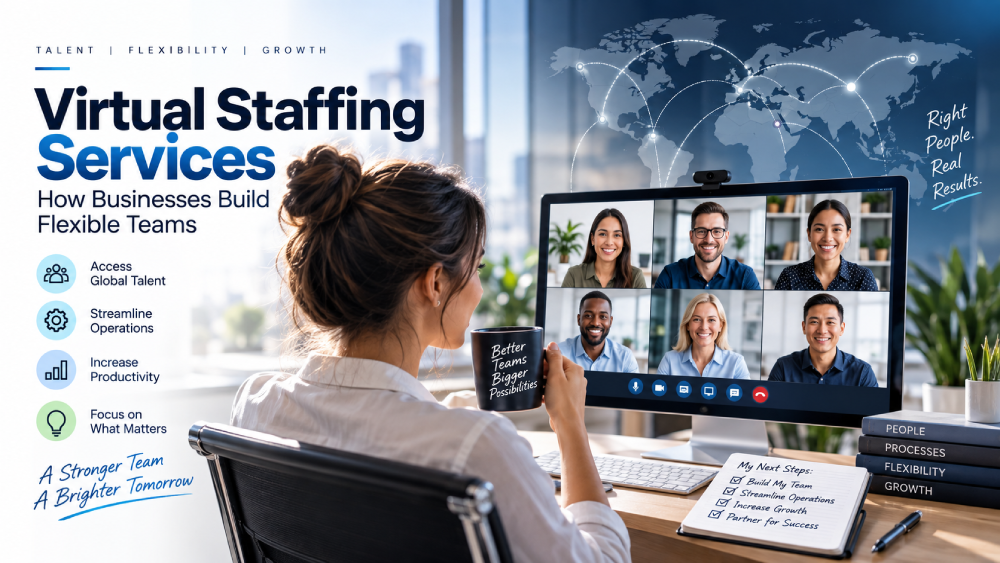
Virtual Staffing Services: How Businesses Build Flexible Teams
Virtual staffing services give businesses a practical way to expand their workforce without limiting recruitment to one office or local talent market. For growing U.S. companies, this approach can provide access to skilled professionals who support daily operations while giving internal teams more time to focus on customers, strategy, and growth.
A flexible team is not simply a group of people working from different locations. Successful remote teams need clear roles, reliable communication, documented processes, appropriate technology, and measurable expectations.
When these elements work together, businesses can build a workforce that adapts more easily as operational needs change.
What Are Virtual Staffing Services?
Virtual staffing services connect businesses with professionals who perform their responsibilities remotely.
Depending on the role, these professionals may work from another city, state, or country. However, they can still operate within the company’s existing systems, workflows, communication channels, and performance standards.
Virtual professionals can support functions such as:
- Administrative assistance
- Executive support
- Customer service
- Research
- Bookkeeping and accounting support
- E-commerce operations
- Website management
- Property management assistance
- Social media management
- Virtual event coordination
UpSource Media currently provides remote assistance across these types of business functions and focuses on connecting companies with skilled professionals from a broader talent pool.
Businesses can explore UpSource Media’s remote staffing services to learn more about the available areas of support.
Why Businesses Are Building More Flexible Teams
Business workloads change constantly.
A new client may create additional administrative work. Growth in online sales can increase customer inquiries and order management. Meanwhile, executives may spend more time scheduling meetings, organizing documents, managing email, and handling routine follow-up.
Hiring locally for every new responsibility is not always the only option.
Instead, businesses can determine which roles require physical presence and which can be performed remotely.
This creates a more flexible workforce model.
A company might keep leadership, sales, and location-dependent positions in-house while using remote professionals for administrative work, customer support, research, e-commerce, bookkeeping support, and other digital functions.
As a result, staffing can be built around actual business requirements rather than geography alone.
Virtual Staffing Services Expand the Talent Pool
Traditional hiring often starts with location.
A business searches for qualified people who live close enough to work at its office. That immediately limits the available talent pool.
Remote hiring changes the starting point.
Instead of asking, “Who is available nearby?” businesses can ask, “Who has the right skills and experience for this position?”
That distinction can provide access to a wider range of professionals.
UpSource Media describes access to a diverse talent pool as a core part of its staffing approach. The company also focuses on recruitment support and workforce flexibility for businesses with changing needs.
However, a larger talent pool does not mean businesses should lower their hiring standards.
Candidates should still be evaluated for:
- Relevant experience
- Communication skills
- Reliability
- Technical knowledge
- Problem-solving ability
- Schedule compatibility
- Professionalism
- Long-term role fit
The objective is not simply to hire remotely. It is to find the right person for the work.
Which Business Roles Can Be Performed Remotely?
Not every position should become virtual.
Roles involving physical equipment, field work, in-person customer interaction, or location-specific responsibilities may still require local employees.
However, many computer-based functions can be performed remotely.
Administrative Support
Administrative work is one of the most practical areas for remote staffing.
Virtual professionals may assist with:
- Email management
- Calendar organization
- Appointment scheduling
- Data entry
- CRM updates
- Travel coordination
- Document organization
- Routine reporting
Delegating these responsibilities can give managers and business owners more time for work that requires their direct attention.
Customer Support
Customer support can also work effectively within a virtual team when processes and expectations are clear.
Remote professionals may help manage:
- Email inquiries
- Live chat
- Phone support
- Customer follow-up
- Complaints and feedback
- Order questions
UpSource Media specifically lists customer support through email, chat, and phone among its current services.
Executive Assistance
Executives frequently spend valuable time managing routine coordination.
A virtual executive assistant may support calendar management, meeting preparation, research, scheduling, travel arrangements, and other recurring responsibilities.
This allows leaders to focus more attention on decisions, clients, partnerships, and business development.
E-Commerce Support
Online businesses already operate through digital systems, which makes many e-commerce responsibilities suitable for remote work.
Virtual professionals may help with product listings, order processing, inventory support, customer inquiries, and other online store operations.
Bookkeeping and Accounting Support
UpSource Media also lists remote support for invoices, expense tracking, account reconciliation, and financial reporting.
Businesses should clearly define responsibilities, system permissions, and oversight when delegating financial support functions.
Website and Social Media Management
Routine website administration and social media management can also be supported remotely.
Tasks may include updating content, managing plugins, scheduling posts, monitoring social channels, responding to engagement, and preparing reports.
Remote and Virtual Staffing Services Should Start With the Role
One of the biggest mistakes businesses can make is hiring before defining what they actually need.
For example, saying “we need a virtual assistant” does not explain the responsibilities of the position.
Instead, start with the work.
Ask:
- Which tasks need to be completed?
- How often do they occur?
- Which skills are required?
- Which systems will the employee use?
- Who will manage the position?
- How will performance be measured?
Then create a clear role around those responsibilities.
For example, instead of requesting general administrative help, a business might need someone responsible for managing appointments, updating CRM records, organizing email, and preparing weekly reports.
A clearly defined position makes recruitment, onboarding, and management easier.
Build Processes Before Expanding the Team
Good people still need good processes.
Before delegating recurring responsibilities, document how the work should be completed.
A useful process should explain:
- What needs to happen
- Who owns the responsibility
- Which tools should be used
- When the work is due
- What quality standards apply
- When an issue should be escalated
For example, a customer support process might explain where inquiries arrive, expected response standards, which questions can be answered directly, and which issues require management involvement.
Documentation reduces uncertainty.
In addition, it becomes easier to train additional team members as the company grows.
Virtual Staffing Services Need Clear Communication
Communication becomes even more important when employees are distributed across different locations.
Remote professionals cannot rely on informal conversations across an office.
Therefore, businesses should establish clear communication practices.
Decide:
- Which platform is used for team communication
- Where tasks are assigned
- Where documents are stored
- How often meetings occur
- When progress reports are expected
- How urgent problems are escalated
For instance, a business might use one platform for everyday messages, project management software for assignments, and scheduled video calls for planning.
Consistency is more important than using a large number of tools.
Everyone should know where information belongs and how communication should happen.
Manage Remote Teams Through Results
Some managers struggle with remote teams because they cannot physically see employees working.
However, visibility should come from clear expectations and measurable outcomes rather than constant monitoring.
Consider the difference between these instructions:
“Keep up with customer emails.”
and:
“Review customer emails during agreed working hours, respond to routine inquiries according to our process, escalate priority issues, and update unresolved cases before the end of the day.”
The second instruction is much clearer.
Managers can evaluate:
- Completed work
- Deadlines
- Accuracy
- Response standards
- Customer outcomes
- Reporting
- Communication
When expectations are measurable, accountability becomes easier regardless of where someone works.
Protect Business Systems When Working Remotely
Remote professionals may need access to company systems, documents, customer information, or other business data.
Therefore, security should be built into the staffing process.
Businesses should consider measures such as:
- Multi-factor authentication
- Strong authentication practices
- Role-based permissions
- Approved software
- Secure remote access
- Regular software updates
- Employee security training
- Periodic access reviews
CISA recommends that organizations establish remote-work security policies, clearly define responsibilities, train remote workers on cybersecurity risks, and secure remote access and devices.
Businesses can review CISA’s remote-work security guidance when developing their own policies.
Most importantly, access should match the responsibilities of each role.
An employee should receive the systems and permissions required to perform the job, rather than unnecessary access to unrelated business information.
Virtual Staffing Services USA Businesses Can Use for Growth
For companies researching virtual staffing services USA, the most important consideration is not simply where a remote professional lives.
Instead, businesses should focus on whether the staffing arrangement works with their operational requirements.
Consider:
- Working hours
- Time-zone compatibility
- Communication requirements
- Language skills
- Software experience
- Role responsibilities
- Data access
- Management structure
A U.S. company may need some remote employees to work during U.S. business hours. Another business may benefit from coverage across different time zones.
The right arrangement depends on the work.
This is why flexible staffing should begin with operational requirements rather than a one-size-fits-all model.
Quality Matters More Than Finding the Lowest Rate
Remote staffing can create access to professionals across different labor markets.
However, businesses should avoid making hiring decisions based only on the lowest available rate.
A poorly matched employee can create additional work through missed deadlines, communication problems, errors, repeated training, or inconsistent performance.
Instead, evaluate overall value.
Consider:
- Skills
- Experience
- Communication
- Reliability
- Work quality
- Management requirements
- Continuity
- Long-term fit
UpSource Media’s published approach emphasizes talent quality, workforce flexibility, recruitment support, and long-term client relationships rather than presenting remote staffing only as a low-cost labor option.
Businesses can learn more through Why UpSource.
How Remote & Virtual Staffing Services Support Scalability
Growth usually creates more operational work.
More customers can mean more emails, appointments, orders, reports, support requests, documents, and administrative responsibilities.
Eventually, existing employees may reach capacity.
Remote & virtual staffing services give businesses another way to add support.
Instead of waiting until employees are overloaded, companies can identify areas where additional capacity will be needed and plan ahead.
For example, a growing company may begin with one administrative professional.
As operations expand, it might add customer support, bookkeeping assistance, e-commerce support, or social media management.
This creates a workforce that can evolve alongside the business.
Avoid Common Virtual Staffing Mistakes
Remote staffing becomes much easier when businesses avoid several common mistakes.
Hiring Without Clear Responsibilities
A vague role usually produces unclear expectations.
Define responsibilities before recruiting.
Choosing Candidates Only by Price
Cost matters, but skills, communication, reliability, and fit also influence the value of a hire.
Skipping Onboarding
Even experienced professionals need to learn your systems, customers, processes, and expectations.
Failing to Document Workflows
Employees cannot consistently follow a process that has never been clearly explained.
Communicating Only When Problems Appear
Regular communication helps identify small issues before they become larger problems.
Micromanaging Every Activity
Focus on results, quality, deadlines, and communication rather than trying to observe every minute of someone’s work.
How to Evaluate Virtual Staffing Services
Not every staffing provider operates the same way.
Before selecting a partner, evaluate several areas.
Talent Quality
How does the provider recruit and evaluate professionals?
Service Fit
Can the provider support the functions your business needs?
Communication
How will your business communicate with the provider and remote professionals?
Flexibility
Can staffing change as your requirements evolve?
Integration
Can remote employees work within your existing systems and processes?
Security
How will company access and sensitive information be managed?
Support
What happens when questions or staffing concerns arise?
UpSource Media states that its model includes access to a broader talent pool, flexible staffing, recruitment support, and ongoing assistance for clients.
Questions to Ask a Virtual Staffing Provider
Before making a decision, ask potential providers practical questions.
These may include:
- What types of roles do you support?
- How are candidates recruited?
- How do you evaluate skills and communication?
- How are professionals matched to businesses?
- Can we interview candidates?
- How does onboarding work?
- How will communication be managed?
- Can the team expand as our business grows?
- What happens if a professional is not the right fit?
- How do you support ongoing staffing relationships?
The answers can help you understand what working with the provider will actually look like.
How UpSource Media Supports Flexible Remote Teams
UpSource Media focuses on virtual employment and remote assistance for businesses seeking additional workforce capacity.
Its current services cover areas such as financial support, real estate and rental operations, e-commerce, executive and personal assistance, professional services, customer support, administration, research, bookkeeping and accounting, website management, virtual events, property management, and social media.
The company also describes its approach as “upsourcing,” with an emphasis on integrating skilled remote professionals into ongoing business operations rather than using remote talent only for isolated tasks.
That distinction matters for businesses seeking long-term operational support.
Rather than asking only, “Which tasks can we outsource?” businesses can also ask, “Which remote professionals could become dependable members of our extended team?”
Companies interested in this approach can contact UpSource Media to discuss their staffing requirements.
Frequently Asked Questions About Virtual Staffing Services
What Are Virtual Staffing Services?
Virtual staffing services help businesses connect with professionals who perform their responsibilities remotely.
These professionals may support administrative work, customer service, executive assistance, research, bookkeeping, e-commerce, website management, and other digital business functions.
What Is the Difference Between Virtual Staffing and Traditional Hiring?
Traditional hiring often focuses on employees located within a specific geographic market.
Virtual staffing allows businesses to recruit for suitable remote roles from a wider talent pool.
However, both approaches still require clear job responsibilities, appropriate hiring standards, onboarding, management, and performance expectations.
What Roles Can Virtual Employees Perform?
Virtual professionals can support many computer-based responsibilities, including administration, customer service, research, e-commerce, executive assistance, bookkeeping support, website management, property management assistance, and social media.
The right roles depend on the company’s operations.
Are Virtual Staffing Services Only for Large Businesses?
No.
Small and growing businesses can also use virtual staffing when they need additional operational capacity or specialized support.
How Do Businesses Manage Virtual Employees?
Effective management begins with clear responsibilities.
Businesses should document processes, establish communication standards, define measurable outcomes, provide appropriate tools, and conduct regular check-ins.
Can Virtual Staffing Help a Business Scale?
Virtual staffing can provide another way to add workforce capacity as business requirements grow.
However, scalability still depends on good hiring, documented processes, effective management, and clear expectations.
Build a Flexible Team Around Your Business
Virtual staffing services can give businesses more options when building their workforce.
Instead of limiting every position to the local hiring market, companies can determine which responsibilities can be performed remotely and search for professionals based on skills, experience, communication, and fit.
The strongest remote teams are built intentionally.
Define the role first. Document the processes. Hire for quality. Establish communication standards. Protect company systems. Measure outcomes.
Most importantly, choose a staffing model that fits the way your business actually operates.
If your company needs additional operational capacity, UpSource Media can help you explore remote professionals across a range of business functions.
Contact UpSource Media to discuss your remote staffing requirements.