
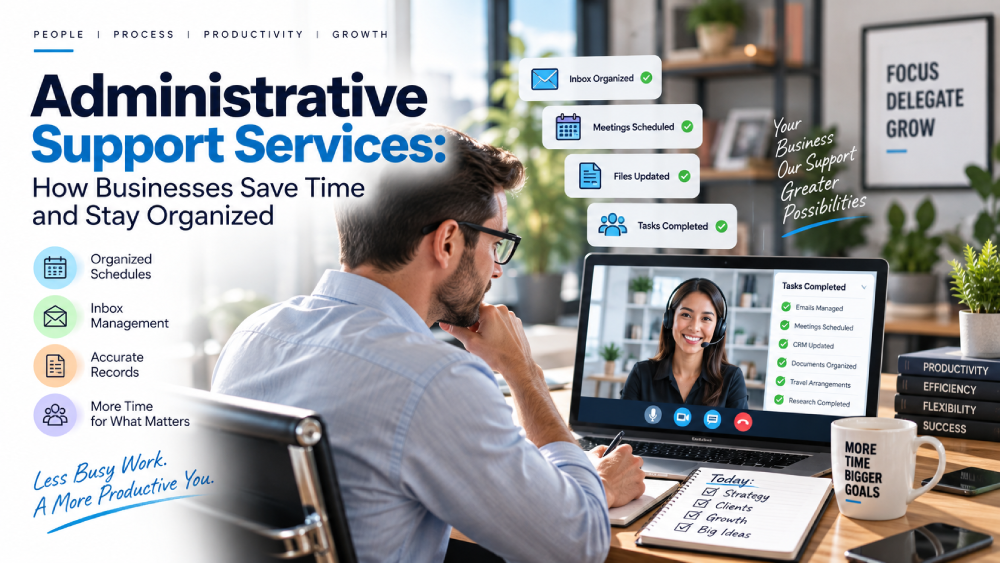
Administrative Support Services: How Businesses Save Time and Stay Organized
Administrative support services help businesses manage the essential day-to-day work that keeps operations moving. Emails need responses, calendars need organization, appointments need scheduling, records need updating, and documents need to stay organized. Individually, these tasks may seem small. Together, however, they can consume valuable working time.
For business owners, executives, and growing teams, the challenge is not whether administrative work matters. It does. The real question is whether the right people are spending their time on it.
By organizing administrative responsibilities and delegating appropriate tasks to skilled support professionals, businesses can create more efficient workflows, reduce unnecessary distractions, and give key employees more time to focus on customers, strategy, revenue, and growth.
What Are Administrative Support Services?
Administrative support services cover recurring organizational and operational tasks that help a business function smoothly.
The exact responsibilities vary by company. However, administrative professionals commonly support areas such as:
- Email management
- Calendar organization
- Appointment scheduling
- Data entry
- Document preparation
- File organization
- CRM updates
- Travel coordination
- Research
- Meeting coordination
- Routine reporting
- Customer follow-up
UpSource Media helps businesses access remote professionals who can support administrative and other operational responsibilities.
Administrative support is not simply about completing a list of small tasks. When managed effectively, it creates structure around the daily activities that allow other employees to perform their jobs.
Why Administrative Work Consumes So Much Business Time
Administrative work often grows gradually.
A business owner may begin by answering every email personally. Then more customers arrive. More meetings need to be scheduled. More documents require organization. CRM records need updating, and reports need preparing.
Eventually, several small responsibilities can become a substantial workload.
The problem becomes more noticeable when senior employees spend significant portions of their day on work that does not require their specific expertise.
For example, an executive may need to approve an important meeting. However, that does not necessarily mean the executive should spend time coordinating schedules, sending invitations, preparing meeting details, and following up with attendees.
Delegation separates the decision from the administrative process surrounding it.
As a result, businesses can use employee time more intentionally.
Administrative Support Services Help Businesses Stay Organized
Organization becomes increasingly important as a company grows.
When a business has only a few employees and customers, informal systems may seem sufficient. However, growth creates more information, conversations, deadlines, appointments, documents, and responsibilities.
Without clear administrative processes, information can become difficult to locate, while important tasks may be delayed.
Administrative professionals can help create consistency around recurring work.
For example, instead of customer information being stored across emails, notes, and spreadsheets, a support professional may be responsible for keeping the company’s approved CRM records current.
Similarly, calendar management can follow an established process instead of every meeting being arranged differently.
The goal is not to add unnecessary procedures. Instead, it is to make routine work predictable and easier to manage.
Which Administrative Tasks Can Businesses Delegate?
Before hiring administrative support, businesses should determine which responsibilities actually need to be delegated.
A useful starting point is to review recurring tasks.
Email and Inbox Management
A busy inbox can quickly become distracting.
Administrative professionals can help organize incoming messages, categorize communications, identify priorities, prepare routine responses where appropriate, and ensure important messages reach the correct person.
However, the business should establish clear rules about which messages can be handled independently and which require management involvement.
Calendar and Appointment Scheduling
Coordinating calendars can take more time than expected.
An administrative professional can manage meeting requests, check availability, coordinate schedules, send invitations, and organize appointment details.
Consequently, managers can spend less time exchanging scheduling messages.
Data Entry and CRM Updates
Business systems are only useful when information remains accurate and current.
Administrative support can help maintain approved records, enter information, update CRM systems, organize contacts, and support routine data management.
Clear processes are particularly important because consistency affects the usefulness of business data.
Document and File Organization
Businesses create large amounts of information.
Contracts, presentations, meeting notes, reports, customer documents, spreadsheets, and internal resources all need logical organization.
Administrative support can help maintain established naming conventions, folder structures, document workflows, and access procedures.
Travel Coordination
Business travel can involve researching schedules, organizing reservations, preparing itineraries, and coordinating details.
Delegating the coordination process can save executives from spending unnecessary time on logistics while allowing them to retain control over final decisions.
Research and Reporting
Administrative professionals may also assist with gathering information, organizing research, compiling reports, and preparing information for review.
This type of support can be especially valuable when decision-makers need organized information but do not need to personally complete every step of the research process.
Virtual Administrative Support Services for Modern Businesses
Virtual administrative support services allow many administrative responsibilities to be performed remotely.
Because tasks such as email management, scheduling, research, data entry, document organization, and CRM administration are primarily digital, the person performing them does not necessarily need to work in the same physical office.
This gives businesses another staffing option.
Instead of limiting recruitment to professionals within commuting distance, companies can consider qualified remote talent when a position does not require a physical presence.
However, remote work does not eliminate the need for structure.
A successful virtual administrative role still requires:
- Clearly defined responsibilities
- Reliable communication
- Documented workflows
- Appropriate technology
- Secure system access
- Defined working hours
- Performance expectations
- Regular feedback
The location changes. The need for good management does not.
Start With Tasks Before Hiring Administrative Support
Businesses sometimes begin the hiring process by saying, “We need an administrative assistant.”
That is a starting point, but it is not yet a job description.
Before hiring, identify the actual work.
Consider tracking repetitive administrative tasks for several days.
Ask:
- Which tasks occur every day?
- Which responsibilities occur weekly?
- What work repeatedly interrupts employees?
- Which activities require management approval?
- Which activities can be completed independently?
- Which systems will the support professional need?
- What information will they access?
- How will success be measured?
Once these questions are answered, the role becomes much clearer.
For example, a business may discover that it does not simply need “administrative help.”
Instead, it needs someone responsible for calendar management, CRM updates, meeting coordination, inbox organization, customer follow-up, and weekly reporting.
That level of clarity improves both hiring and onboarding.
Document Administrative Processes Before Delegating Them
Delegation works best when expectations are documented.
Consider appointment scheduling.
A new administrative professional may need to know:
- Which calendar to use
- Available meeting hours
- How much time to leave between meetings
- Which meetings receive priority
- Whether certain appointments require approval
- Which video platform to use
- What information attendees need
- How cancellations should be handled
Without those instructions, the employee has to guess.
The same principle applies to email, CRM updates, reporting, travel coordination, and document management.
A useful process does not need to be complicated. It simply needs to explain what should happen and what a successful outcome looks like.
How Administrative Support Can Protect High-Value Time
One useful way to evaluate administrative support is to consider where leadership time is being spent.
Imagine a business owner spending part of each morning organizing appointments, updating records, searching for documents, and handling routine email.
Every task may be necessary.
However, the owner may also be responsible for:
- Developing new business
- Meeting important clients
- Improving services
- Managing key employees
- Building partnerships
- Making strategic decisions
Time spent on administrative coordination is time that cannot simultaneously be spent on those responsibilities.
The purpose of delegation is not to suggest that administrative work is unimportant.
In fact, it is important precisely because it needs someone who can take responsibility for completing it consistently.
Remote Administrative Support Services Add Workforce Flexibility
Remote administrative support services can be particularly useful when businesses need additional operational capacity without requiring every role to be based in the same location.
For example, a growing company may need more help managing customer records and appointments. Another may need executive scheduling and research support. An e-commerce company may need administrative assistance alongside order and customer service operations.
Remote staffing allows businesses to build roles around those requirements.
Furthermore, staffing needs may change as a company grows.
A business might initially need support with a limited set of administrative responsibilities. Over time, the role may expand as processes become established and additional work can be delegated.
Therefore, businesses should look for professionals who can learn their systems and adapt to evolving operational requirements.
Administrative Support Should Fit Existing Workflows
Adding another employee does not automatically make a business more organized.
The person needs to understand where their work fits.
Suppose a company uses a CRM for customer information, a project management platform for tasks, cloud storage for documents, and a messaging platform for internal communication.
An administrative professional should understand:
- Which system contains the official information
- Where new tasks are assigned
- Where completed work is reported
- How documents should be stored
- Which communication channel should be used
- When management needs to be notified
Without these standards, adding support can create another layer of confusion.
Therefore, integration should be part of onboarding from the beginning.
Use Clear Communication With Remote Administrative Professionals
Remote teams depend heavily on communication.
However, good communication does not mean scheduling meetings all day.
Instead, establish a predictable communication structure.
For example, businesses can define:
- Primary communication channels
- Expected response times
- Meeting schedules
- Reporting requirements
- Escalation procedures
- Availability expectations
- Emergency communication methods
Routine questions can then follow an established process.
Meanwhile, important issues can reach the appropriate decision-maker quickly.
This reduces unnecessary back-and-forth while keeping everyone informed.
Measure Administrative Support by Outcomes
Administrative roles should have clear expectations just like other business positions.
Instead of measuring whether someone appears busy, evaluate the work being completed.
Depending on the role, useful measures may include:
- Appointments scheduled accurately
- Records updated on time
- Reports delivered by agreed deadlines
- Customer follow-ups completed
- Documents organized correctly
- Inbox workflows maintained
- Tasks completed according to process
- Issues escalated appropriately
The exact measures should match the responsibilities of the position.
When expectations are clear, both the employee and manager understand what successful performance looks like.
Protect Business Information and System Access
Administrative professionals may interact with calendars, emails, customer information, documents, financial records, and internal systems.
Consequently, access should be managed carefully.
Businesses should consider practices such as:
- Individual user accounts
- Multi-factor authentication
- Role-based permissions
- Password management policies
- Approved software
- Secure file-sharing practices
- Access reviews
- Clear offboarding procedures
The Cybersecurity and Infrastructure Security Agency’s Secure Our World resources provide practical cybersecurity guidance that businesses can review when developing their own security practices.
A simple principle is useful: employees should have the access they need to perform their responsibilities, but they do not necessarily need access to every company system.
When Should You Outsource Administrative Support Services?
Businesses may decide to outsource administrative support services when recurring operational work begins consuming too much internal capacity.
Several situations can indicate that additional help may be useful.
Leadership Is Spending Too Much Time on Routine Tasks
Business owners and executives should understand how their operations work.
However, they do not need to personally complete every administrative step.
Administrative Work Is Creating Backlogs
If records remain outdated, emails accumulate, appointments are difficult to coordinate, or documents become disorganized, existing employees may not have enough capacity.
Your Team Is Frequently Interrupted
Constant administrative interruptions can make it difficult for employees to concentrate on responsibilities that require deeper focus.
Growth Is Increasing Operational Work
More customers usually create more communication, documentation, scheduling, reporting, and coordination.
Additional administrative capacity can help a business manage the increased workload.
Local Hiring Options Are Limited
If the work can be performed remotely, businesses can consider professionals outside their immediate geographic area.
How to Outsource Administrative Support Services Effectively
If you decide to outsource administrative support services, avoid beginning with a long list of unrelated tasks.
Start with a defined role.
Step 1: Identify Repetitive Work
List recurring administrative activities that consume internal time.
Step 2: Prioritize Responsibilities
Determine which tasks create the most immediate value when delegated.
Step 3: Document the Process
Write down how each responsibility should be handled.
Step 4: Define Required Skills
Consider software knowledge, communication ability, organizational skills, experience, and schedule requirements.
Step 5: Establish Access
Provide only the tools and permissions required for the role.
Step 6: Create Performance Expectations
Define deadlines, quality standards, reporting requirements, and communication procedures.
Step 7: Review and Improve
After the employee begins working, review the process.
Some workflows will need adjustment. That is normal.
The objective is to develop a working system that becomes more efficient over time.
Choosing an Administrative Support Provider
A staffing provider should do more than simply present available candidates.
Businesses should evaluate how well the provider understands the role and staffing requirements.
Consider asking:
- How are candidates selected?
- What administrative skills are evaluated?
- Can we interview candidates?
- How are professionals matched with businesses?
- What types of administrative responsibilities can they support?
- How does onboarding work?
- How is ongoing support handled?
- Can staffing needs change as our business grows?
- How are communication expectations established?
- What happens if the initial match is not appropriate?
These questions can help reveal whether a provider’s approach fits the company’s requirements.
Administrative Support Services Should Focus on Quality
Price matters when making any staffing decision.
However, choosing administrative support solely because it is inexpensive can create additional problems elsewhere.
Poor communication, missed appointments, inaccurate data, disorganized records, and repeated training can consume management time.
Instead, evaluate total value.
A strong administrative professional should demonstrate:
- Clear communication
- Reliability
- Organization
- Attention to detail
- Relevant technical skills
- Professional judgment
- Accountability
- Ability to learn processes
The right person can become increasingly valuable as they learn how the company operates.
How UpSource Media Supports Administrative Operations
UpSource Media helps businesses build remote teams around operational needs, including administrative support.
Administrative professionals can support recurring responsibilities such as email management, scheduling, data entry, coordination, and other business tasks appropriate for remote work.
The objective is to help businesses create dependable workforce support around clearly defined roles rather than simply moving random tasks outside the company.
For businesses considering a broader remote staffing strategy, learn more about why businesses choose UpSource Media.
Frequently Asked Questions About Administrative Support Services
What Are Administrative Support Services?
Administrative support services include recurring organizational and operational responsibilities that help businesses function efficiently.
Common examples include email management, scheduling, data entry, document organization, CRM updates, research, travel coordination, and reporting.
What Tasks Can an Administrative Support Professional Handle?
Responsibilities depend on the business and role.
Administrative professionals may manage calendars, organize email, schedule appointments, update records, prepare documents, conduct research, coordinate meetings, arrange travel, and assist with routine reporting.
What Are Virtual Administrative Support Services?
Virtual administrative support services provide administrative assistance remotely.
Professionals use digital communication and business systems to complete responsibilities without working from the same physical office as the company.
What Are the Benefits of Remote Administrative Support Services?
Remote administrative support services can give businesses access to a broader talent pool and additional operational capacity for work that does not require physical presence.
Their effectiveness still depends on selecting the right professional, documenting processes, establishing clear communication, and managing performance appropriately.
When Should a Business Consider Administrative Support?
A business may need additional administrative support when managers spend too much time on routine tasks, work begins accumulating, employees are frequently interrupted, or growth creates more administrative responsibilities than the current team can comfortably manage.
Should Businesses Outsource Administrative Support Services?
Businesses can consider outsourcing when administrative responsibilities can be clearly defined and performed effectively by a remote professional.
The decision should depend on the role, processes, security requirements, available internal capacity, and business objectives.
How Do You Manage a Remote Administrative Professional?
Start with clear responsibilities and documented processes.
Establish communication standards, provide appropriate system access, define expected outcomes, and review performance regularly.
Save Time by Building Better Administrative Systems
Administrative support services are most valuable when they create structure rather than simply move tasks from one person to another.
Businesses should begin by identifying where valuable time is being spent.
Then, determine which recurring responsibilities can be delegated, document how the work should be completed, and assign those responsibilities to qualified professionals.
The result is a clearer division of work.
Executives can focus on leadership. Sales teams can focus on customers. Specialists can focus on their expertise. Meanwhile, administrative responsibilities still receive the consistent attention they require.
For growing businesses, that structure can make daily operations easier to manage while creating a stronger foundation for future growth.
Ready to explore a more flexible approach to administrative support? Learn more about UpSource Media and how remote professionals can become part of your extended team.