
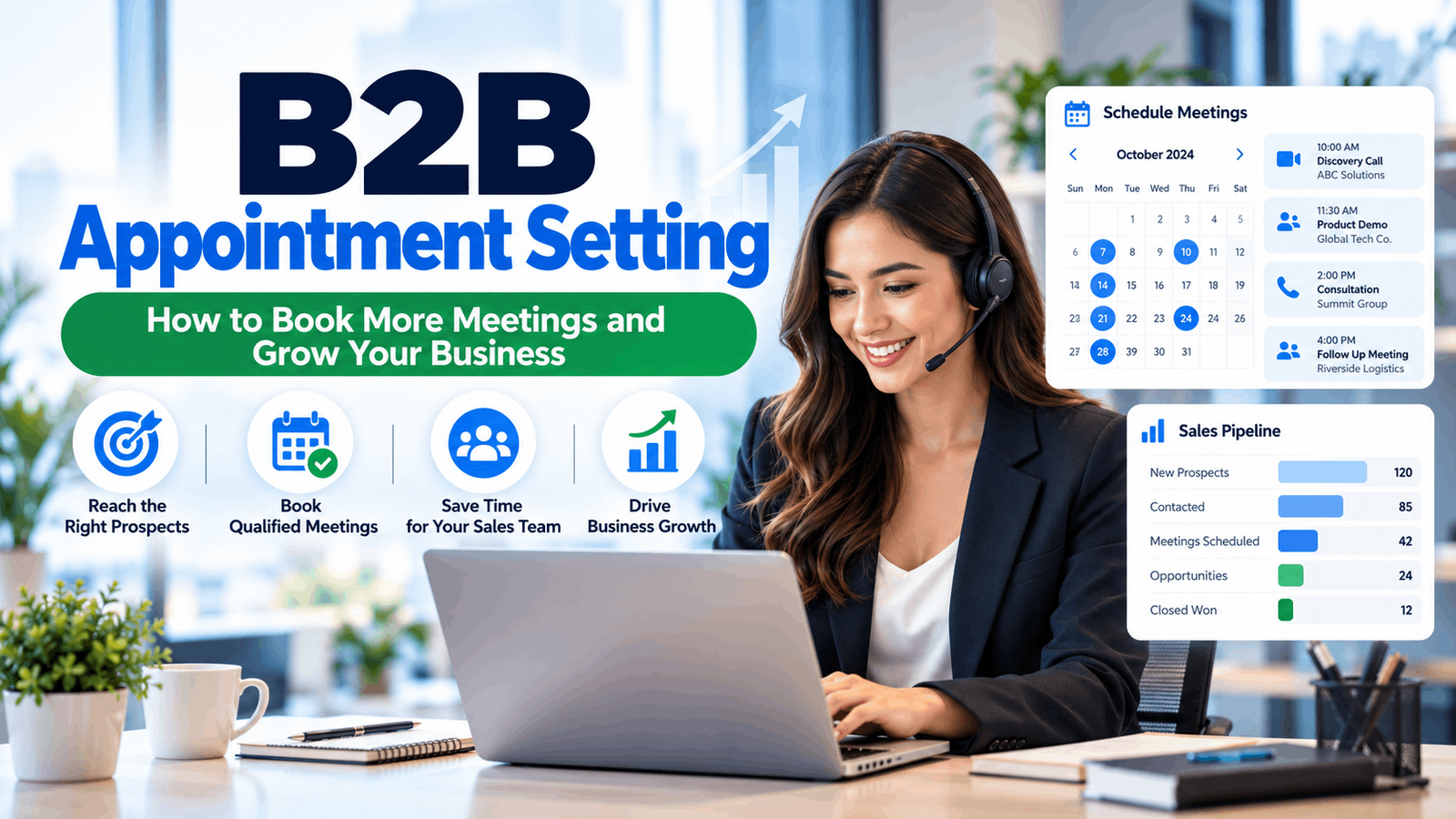
B2B Appointment Setting: How to Book More Meetings and Grow Your Business
B2B appointment setting helps companies turn relevant business conversations into scheduled meetings with potential customers. Yet filling a calendar is not the same as building a healthy sales pipeline. The real goal is to connect the right prospect with the right salesperson at a useful point in the buying process.
For many U.S. businesses, salespeople juggle prospect research, email responses, calendar coordination, CRM updates, and discovery calls. As a result, promising conversations can stall before anyone agrees on a meeting time. A clear appointment-setting process reduces that friction while protecting the sales team’s time.
This guide explains how the process works, what makes a meeting worthwhile, which tasks businesses can delegate, and how to measure results without relying on inflated booking numbers.
What Is B2B Appointment Setting?
If you’re asking what is B2B appointment setting, think of it as the process of arranging a sales conversation between one business and another. The appointment might be a discovery call, product demonstration, consultation, or introductory meeting. Unlike a consumer booking an everyday service, the buyer often represents a company and may need input from several colleagues.
Effective appointment setting combines three activities: identifying relevant contacts, establishing a reason to talk, and coordinating a confirmed time. Therefore, it involves more than sending a calendar link. A meeting should have a clear purpose, an appropriate participant, and enough context for the salesperson to prepare.
For example, a company that supplies commercial cleaning services might target office managers at multi-location businesses. A useful appointment would involve someone who oversees facility needs and wants to discuss a specific service challenge. By contrast, a meeting with a person who has no connection to purchasing decisions may add little value, even if it appears on the calendar.
How B2B Appointment Setting Works
A repeatable workflow makes it easier to identify bottlenecks and improve meeting quality. Although teams use different tools, the core stages usually follow a similar sequence.
1. Define Your Ideal Customer Profile
Start with the types of businesses your offer can genuinely help. For instance, describe the industries, company sizes, service areas, and operational problems that make a prospect relevant. Next, identify the job roles likely to influence the purchase.
Avoid a target list so broad that every company qualifies. Instead, document two or three practical fit criteria and review them with the sales team.
2. Research Relevant Accounts and Contacts
Once the target profile is clear, build a focused list of organizations and appropriate contacts. Research can include company websites, public business information, and existing CRM records. Meanwhile, staff should check for duplicate entries and existing customer relationships before initiating new outreach.
Accuracy matters more than raw list size. Consequently, record where contact information came from and correct obvious errors before starting conversations.
3. Start a Relevant Business Conversation
A strong introduction connects a real business problem with a concise reason to meet. For example, a supplier might mention the prospect’s need to coordinate purchasing across multiple locations, rather than sending a generic pitch about its entire catalog.
Keep the message accurate and respectful. In addition, give recipients a straightforward way to decline further contact and follow the rules that apply to each communication channel.
4. Qualify Interest Without Turning It Into an Interrogation
Not every interested contact needs a full discovery interview before meeting the salesperson. Instead, confirm enough information to judge whether a conversation would be useful. Depending on the offer, that may include business fit, the problem involved, the contact’s role, and the preferred timeline.
For example, ask, “Is this something your team plans to review this quarter?” rather than demanding a detailed budget before the first call. Then capture the answer accurately for the sales representative.
5. Confirm the Appointment and Prepare the Handoff
Offer realistic meeting options, confirm the time zone, and send the correct meeting details. Afterward, update the CRM with the contact’s name, company, stated need, and agreed next step. A brief handoff note helps the salesperson start with context.
Finally, establish a reminder and rescheduling process. A booked meeting becomes more valuable when the prospect actually attends and the sales team knows what to discuss.
Why B2B Appointment Setting Matters for Business Growth
Appointment setting does not create demand on its own. However, it can help businesses respond to existing interest, manage appropriate outreach, and move relevant conversations toward a sales discussion.
Give Salespeople More Time for High-Value Conversations
A sales representative should not spend every morning correcting contact records or exchanging scheduling emails. When a coordinator handles repeatable steps, the representative can focus on discovery, recommendations, and follow-through. As a result, the team can use its available selling time more deliberately.
Make the Pipeline Easier to Understand
A consistent process records who agreed to meet, why they were interested, and what happens next. Therefore, managers can distinguish an unconfirmed calendar invitation from a qualified meeting that took place. That visibility also makes coaching and forecasting discussions more useful.
Create a Better First Experience for Prospects
A clear invitation, accurate time-zone details, and a prepared salesperson show respect for the buyer’s time. Meanwhile, relevant reminders help avoid confusion without overwhelming the contact. Good coordination cannot replace a compelling offer, but it can remove unnecessary obstacles.
B2B Appointment Setting vs. Lead Generation and Sales Support
These activities overlap, yet they solve different problems. Lead generation identifies potential buyers or creates interest. Appointment setting moves suitable conversations toward a scheduled meeting. Sales support covers a broader set of administrative activities, including CRM maintenance, proposal coordination, and customer handoffs.
For example, a marketing campaign might generate an inquiry from a purchasing manager. An appointment setter then confirms the topic and arranges a call. After the meeting, a sales support professional may organize notes and track the proposal deadline.
Some teams combine these roles, while others separate them. The important point is to define ownership so that prospects do not receive duplicate messages or disappear between departments.
Practical B2B Appointment Setting Strategies That Improve Meeting Quality
The strongest approach is not necessarily the one that sends the most messages. Instead, improve the relevance of each interaction and make the next step easy for a prospect to understand.
Focus on a Narrow Audience First
Choose one industry or buyer problem for an initial campaign. For example, a company selling maintenance software could begin with operations managers at regional service businesses. Then review which conversations produce useful meetings before expanding the audience.
Offer a Specific Reason to Meet
A vague request to “connect sometime” gives the buyer little reason to respond. Instead, explain what the discussion will cover and who will attend. A short, accurate agenda can make the invitation easier to evaluate.
Match Outreach to the Buying Context
Some prospects prefer email; others respond to a relevant referral or an inquiry form. However, channel choice should reflect customer preferences, applicable rules, and the team’s ability to respond consistently. Avoid assuming that one channel works for every industry.
Improve B2B Appointment Setting by Reducing Scheduling Friction
Provide a small selection of times and make the time zone explicit. In addition, verify that the right salesperson can attend before sending a confirmation. If a prospect needs to reschedule, keep the original context in the CRM rather than restarting the conversation.
Review Actual Conversations
Managers should examine a sample of accepted meetings and declined invitations. For instance, recurring objections may reveal unclear targeting or a weak meeting proposition. As a result, the team can refine its approach using real feedback rather than increasing outreach volume blindly.
Should You Use B2B Appointment Setting Services?
B2B appointment setting services may help when salespeople have a steady stream of prospects but lack time for research, follow-up coordination, or scheduling. They may also suit businesses testing a new market, provided the company can define its audience and sales message.
However, outside help cannot fix an unclear offer or an unprepared sales team. Before outsourcing, confirm that your representatives can explain the service, handle discovery calls, and follow up after meetings. Otherwise, additional appointments may create more activity without improving outcomes.
A useful starting point is to separate tasks by the judgment they require:
| Task | Potentially Delegable | Keep With the Sales Team |
|---|---|---|
| Researching target accounts | Research and record organization | Approving the target market |
| Contacting prospects | Approved, compliant outreach where agreed | Messaging strategy and sensitive escalations |
| Qualifying inquiries | Recording answers to agreed questions | Deciding whether to pursue complex opportunities |
| Scheduling calls | Invitations, confirmations, and reminders | Running discovery and negotiating terms |
| Updating CRM records | Data entry and meeting notes | Forecasts, deal strategy, and final decisions |
In practice, the right split depends on training, industry requirements, and the support provider’s actual capabilities.
How to Choose a B2B Appointment Setting Company
A B2B appointment setting company should explain what it will do, how it defines a qualified meeting, and how your sales team will supervise the work. Rather than comparing promises about meeting volume alone, examine the process behind those claims.
How B2B Appointment Setting Providers Define a Qualified Meeting
A calendar invitation is not automatically a sales opportunity. Therefore, agree on minimum criteria such as account fit, relevant job role, expressed reason to meet, and confirmed attendance. Also clarify whether rescheduled meetings count toward performance reports.
Confirm Who Owns Messaging and Data
Your business should approve the offer, outreach language, and contact rules. Meanwhile, the provider should explain how it handles CRM access, duplicate contacts, opt-outs, and record updates. Request a sample handoff note to see what information the salesperson will receive.
Check Coverage, Training, and Reporting
For U.S. buyers, time-zone coordination can affect the booking experience. Ask who handles replies during your preferred business hours and how the team manages last-minute changes. In addition, establish a review routine for meeting quality, not just appointment totals.
Evaluate the Full Cost
Pricing may depend on staffing hours, scope, tools, campaign complexity, and whether a provider charges by activity or another agreed model. Therefore, compare the full arrangement, including onboarding and internal management time. Be cautious about guarantees that ignore lead quality or sales readiness.
Consider U.S. Market Fit Without Assuming Location
People searching for B2B appointment setting companies in USA may want familiarity with U.S. business hours, buyer expectations, and applicable outreach requirements. However, a provider’s office location alone does not prove those capabilities. Ask specific questions about coverage, experience, compliance procedures, and supervision.
How to Measure B2B Appointment Setting Performance
Meeting counts are useful, but they do not tell the whole story. Instead, track the steps between a relevant conversation and a productive sales discussion.
| Metric | What It Shows | What to Watch |
|---|---|---|
| Meetings booked | Calendar activity | Does the count include unconfirmed meetings? |
| Meeting attendance rate | How often prospects show up | Are reminders and time zones clear? |
| Qualified meetings held | Conversations meeting agreed criteria | Do salespeople agree the prospects fit? |
| Meeting-to-opportunity rate | Whether meetings progress in the pipeline | Is the offer relevant to the audience? |
| Time to first response | Speed of handling incoming interest | Are inquiries waiting without an owner? |
| CRM handoff completeness | Quality of meeting context | Can the salesperson prepare without extra research? |
For example, a team could book 20 meetings and hold only 10. Another team might book 14 and hold 12 relevant conversations. Although the second calendar looks smaller, it may create a better use of selling time. These figures are illustrative, not industry benchmarks.
Review the numbers alongside call notes and salesperson feedback. Consequently, you can improve targeting, qualification, and reminders without rewarding empty calendar activity.
A 30-Day B2B Appointment Setting Plan
A short pilot helps a business test the workflow before expanding it. The following plan offers a practical structure rather than a promise of a particular booking rate.
Week 1: Define the Offer and Audience
Agree on your ideal customer profile, the meeting’s purpose, and the sales representative who will take the call. Next, document qualification questions, approved messaging, CRM fields, and escalation rules. Establish a baseline for current meetings and attendance.
Week 2: Test the Workflow
Begin with a manageable set of relevant accounts or existing inquiries. Then review sample messages, contact records, and meeting handoffs every day. Correct confusing instructions before increasing activity.
Week 3: Improve Confirmation and Follow-Up
Check which prospects accept invitations, which ones reschedule, and where conversations stall. Meanwhile, refine reminders and meeting briefs. Keep opt-out requests and contact preferences accurate across tools.
Week 4: Review Quality Before Scaling
Compare meetings held, qualification quality, salesperson feedback, and administrative time against your baseline. Finally, decide whether to expand the scope, change the audience, or improve the sales offer first.
Compliance and Data Protection for U.S. Outreach
Business-to-business outreach still carries legal and privacy responsibilities. For commercial email, the Federal Trade Commission’s CAN-SPAM guidance explains requirements such as accurate sender details, nondeceptive subject lines, a valid postal address, and a way to opt out. Importantly, the FTC says the law does not exempt business-to-business commercial email.
Phone calls and text messages can raise additional federal and state requirements, depending on the audience, technology, and circumstances. Therefore, have qualified personnel review your outreach practices before launching a campaign. An external provider does not remove your responsibility to follow applicable rules.
Also, protect contact records and CRM access. The FTC’s cybersecurity guidance for small businesses recommends practices such as multifactor authentication, access limits, and secure remote connections. As a result, companies should give support professionals only the permissions their tasks require and maintain a clear process for reporting issues.
How UpSource Media Can Support the Appointment-Setting Workflow
UpSource Media provides virtual assistance and remote staffing support for businesses. Its published services include appointment coordination, administrative assistance, client communication, research, and customer support. Those activities can support important parts of a B2B appointment-setting workflow, especially scheduling, record organization, and communication follow-through.
However, UpSource Media’s website does not clearly advertise a standalone, fully managed B2B appointment-setting campaign service. Therefore, businesses should confirm whether prospect outreach, qualification calls, CRM work, and meeting targets fall within the proposed role before engaging support.
If your team needs help with the coordination surrounding sales meetings, explore how to hire a virtual assistant and discuss your specific workflow with UpSource Media. A clear task list will help determine which responsibilities fit a remote support arrangement.
Frequently Asked Questions About B2B Appointment Setting
Is B2B Appointment Setting the Same as Cold Calling?
No. Cold calling is one possible outreach method, while appointment setting describes the broader process of arranging relevant business meetings. For example, appointments may also follow inbound inquiries, referrals, or email conversations.
What Makes a B2B Meeting Qualified?
A useful meeting involves an appropriate business, a relevant participant, and a clear reason to talk. However, qualification criteria vary by product and sales cycle. Agree on those criteria before evaluating a campaign.
Can a Virtual Assistant Handle Appointment Setting?
A trained virtual assistant may handle research, scheduling, confirmations, CRM updates, and other agreed tasks. Meanwhile, prospect outreach and qualification require clear training, approved processes, and confirmation that the provider offers those activities.
How Long Does It Take to See Results?
Timelines depend on the audience, offer, contact channels, and existing demand. Therefore, begin with a short pilot and evaluate meeting quality and process reliability before expecting predictable volume.
Should Small Businesses Outsource Appointment Setting?
Sometimes. A small company with repeatable inquiries and limited administrative capacity may benefit from support. However, it should first confirm that the sales team can handle the meetings and that the workload justifies the cost.
Turn Better Meetings Into a Stronger Sales Process
B2B appointment setting works best when the business targets relevant buyers, offers a clear reason to meet, and follows through with a prepared sales conversation. More calendar invitations alone will not grow a company. Instead, focus on qualified meetings, dependable handoffs, and a process that improves with feedback.
If scheduling, customer communication, and CRM administration are slowing your team down, contact UpSource Media to discuss remote support options that match your business needs.