
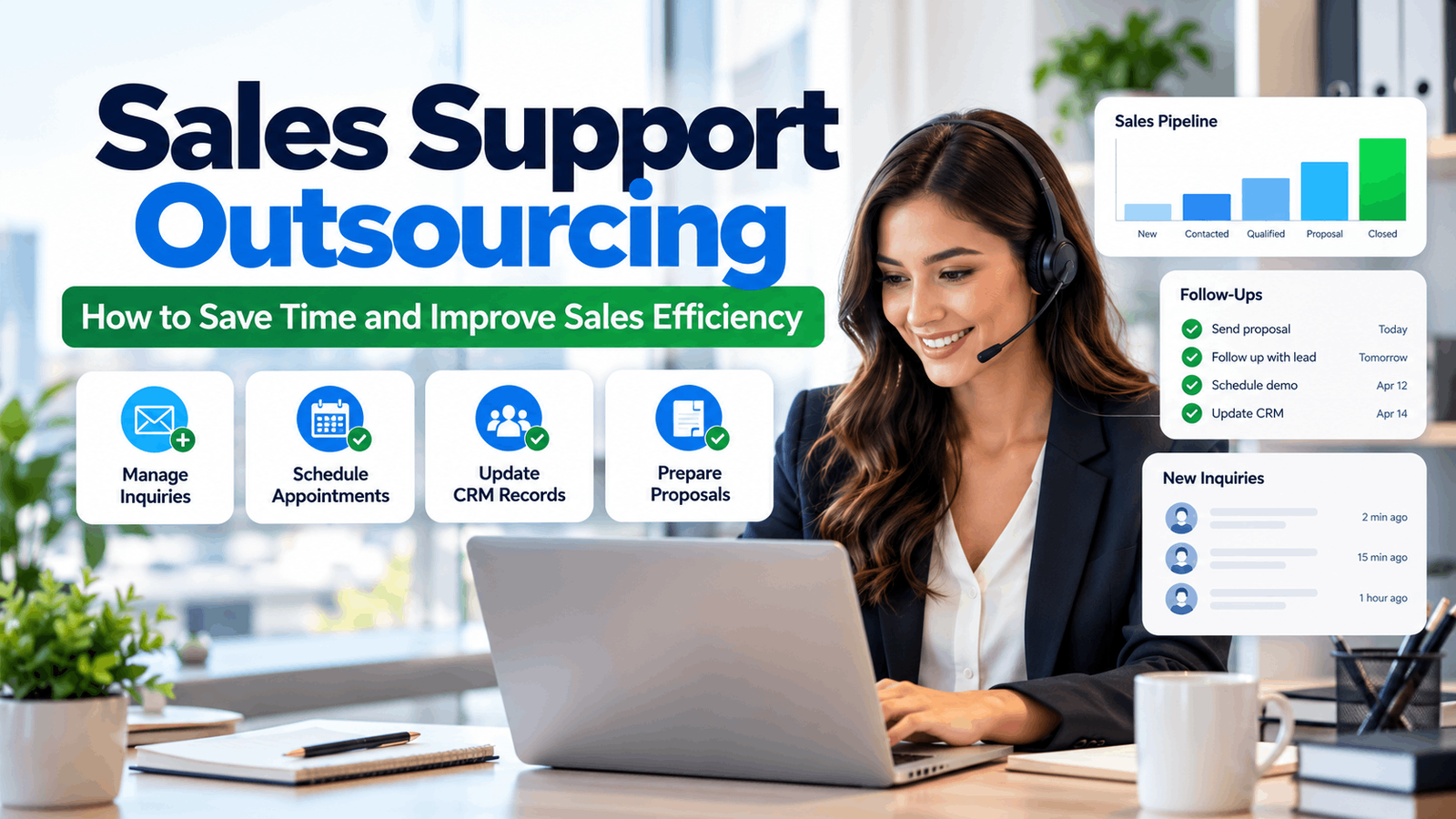
Sales Support Outsourcing: How to Save Time and Improve Sales Efficiency
Sales support outsourcing helps businesses delegate the administrative work that surrounds a sale, so their salespeople can spend more time speaking with customers and moving opportunities forward. For many U.S. companies, the problem is not a shortage of leads. Instead, the team struggles to keep up with inboxes, appointment changes, CRM updates, and the details that follow every conversation.
Consider a growing commercial cleaning company. Its sales manager spends mornings answering service inquiries, afternoons preparing quotes, and evenings updating customer records. Meanwhile, promising prospects wait for callbacks. A remote sales support professional could organize those tasks, flag urgent requests, and keep the next steps visible without taking over pricing decisions or negotiations.
This guide explains what sales support outsourcing includes, how it improves day-to-day efficiency, which tasks to delegate, and how to choose a support arrangement that fits your business.
What Is Sales Support Outsourcing?
Sales support outsourcing means assigning selected sales-related administrative and coordination tasks to an external professional or team. Depending on the arrangement, support may cover incoming inquiries, CRM maintenance, appointment scheduling, proposal preparation, order updates, and internal follow-ups.
The goal is to support the sales process rather than replace the people responsible for selling. Account executives still build relationships, evaluate opportunities, negotiate terms, and make commitments within company policy. Meanwhile, support staff keep information organized and help prevent routine work from interrupting those conversations.
Unlike outsourced sales prospecting, this model does not have to focus on finding new leads. It can improve how a company handles opportunities and customers it already has.
Which Tasks Can Sales Support Outsourcing Services Handle?
The right scope depends on your sales cycle, software, and approval rules. However, several recurring activities lend themselves to clear procedures and measurable outcomes.
Incoming Inquiry Coordination
A support professional can monitor designated inquiry channels, record customer details, and route requests to the appropriate salesperson. For example, a potential customer may ask whether a service covers their location. The assistant can capture the request, check approved information, and arrange a response from the right team member.
As a result, salespeople can prioritize conversations that need their expertise rather than repeatedly sorting the shared inbox.
CRM Data Entry and Pipeline Updates
Incomplete CRM records make handoffs harder. Therefore, a trained assistant can update contact information, log meeting outcomes from approved notes, add next-step reminders, and flag duplicate entries.
The salesperson should still decide whether an opportunity qualifies, how to forecast it, and when to change a deal’s stage. Clear ownership keeps the pipeline useful instead of turning it into a collection of unchecked updates.
Appointment Scheduling and Meeting Preparation
Scheduling a discovery call can involve several messages, calendar checks, and rescheduling requests. A remote assistant can coordinate available times, send confirmations, and prepare a concise meeting brief using existing customer records.
Before the call, the salesperson receives the relevant background and outstanding questions. Consequently, the conversation can start with context instead of a search through emails.
Quote and Proposal Administration
Many sales teams reuse approved templates, product details, and service descriptions. Support staff can assemble draft proposals, check that required fields are complete, and track outstanding approvals.
However, an authorized salesperson or manager should confirm pricing, discounts, contractual terms, and final commitments. That separation protects customers and the business from inaccurate offers.
Follow-Up Tracking and Internal Handoffs
A missed follow-up often starts with an unclear owner or deadline. An assistant can maintain task lists, prepare reminders, and notify the responsible salesperson when a prospect needs attention.
In addition, support can coordinate handoffs to customer service or operations after a sale. The company should define who owns each customer promise and how the receiving team confirms it.
How Sales Support Outsourcing Saves Time
The time benefit comes from moving repeatable tasks into a dependable workflow. Instead of asking a salesperson to stop between calls and clean up records, the business gives those activities a schedule and a clear owner.
Imagine a representative who spends 45 minutes a day updating the CRM and another 30 minutes arranging meetings. In this illustrative example, that totals 75 minutes of administrative work each day. Delegating suitable portions may free time for customer conversations, although training, review, and exceptions will still require attention.
Start by tracking actual time, not by assuming every task should leave the sales team. For one week, record how long staff spend on scheduling, data entry, quote preparation, and status requests. Then identify tasks that follow consistent rules and do not require sales judgment.
Reduce Context Switching
A salesperson who moves repeatedly between customer calls and administrative tasks may lose focus. With dedicated coordination, the representative can handle related conversations together while the support person manages routine updates.
Keep Work Moving Between Sales Conversations
Customers do not always respond during a scheduled call block. Meanwhile, a support professional can monitor agreed channels, maintain reminders, and prepare information for the next available salesperson.
Create a Predictable Review Routine
Rather than reviewing every minor update, managers can receive a short daily exceptions report. For instance, it might highlight overdue quotes, unassigned inquiries, and records missing essential details.
How Sales Support Outsourcing Improves Sales Efficiency
Time savings matter, but sales efficiency also depends on what happens to the work. A useful arrangement makes the next step easier to identify, complete, and measure.
Faster Routing of Customer Requests
When someone owns the intake process, incoming questions have a defined destination. As a result, teams can see which requests need a response and who should provide it.
More Reliable CRM Information
Consistent updates help salespeople prepare for calls and help managers review active opportunities. However, accuracy matters more than the number of fields someone fills in. Set a small group of required fields and review exceptions regularly.
Better Coordination Across Departments
Sales rarely ends when a customer agrees to buy. For example, operations may need a signed scope, a delivery date, or the customer’s preferred contact details. A documented handoff helps both teams work from the same information.
More Time for Relationship Building
When representatives spend less time on repetitive administration, they may have more capacity for discovery calls, proposals, and customer questions. Nevertheless, outsourcing alone cannot guarantee higher close rates or revenue. Results depend on demand, sales skills, service quality, and execution.
Pre-Sales Support Outsourcing: Before the Customer Buys
Pre-sales support outsourcing focuses on the coordination work that helps prospects move toward a decision. Typical tasks include inquiry intake, scheduling, gathering basic requirements, updating CRM records, and preparing approved sales materials.
For example, a commercial equipment supplier might receive requests for product information throughout the day. A support assistant can record each inquiry, request missing details, and route technical questions to the sales specialist. The specialist then handles recommendations and commercial decisions.
This approach works best when the business provides response guidelines and escalation rules. Otherwise, a support person may spend too much time guessing who should answer a question.
Pre and Post Sales Support Outsourcing: After the Agreement
Pre and post sales support outsourcing connects the early sales workflow with the administrative steps that follow a purchase. After a deal closes, support may help confirm customer details, coordinate onboarding appointments, track approved order information, or route service questions.
Consider a business software provider. Before the sale, a coordinator schedules demonstrations and keeps prospect records current. After the customer signs, that same workflow can help transfer contact details and agreed next steps to the onboarding team.
However, customer service, account management, and sales should still have distinct responsibilities. A shared checklist prevents an assistant from making promises about delivery, refunds, or contract changes without approval.
Which Businesses Benefit From Sales Support Outsourcing?
Businesses with a steady flow of inquiries and recurring administrative steps often have the clearest opportunities to delegate. The tasks will differ by industry, so a useful role description should reflect how customers actually buy.
- Professional service firms: Coordinate consultations, collect basic requirements, and maintain proposal status records.
- Home service companies: Organize estimate requests, confirm appointments, and track callbacks.
- B2B suppliers: Maintain quote logs, route product questions, and coordinate order information.
- Ecommerce businesses: Help connect customer inquiries, order questions, and approved sales-related follow-ups.
- Agencies and consultancies: Prepare meeting notes, maintain CRM records, and organize client handoffs.
For a company with very few inquiries, a dedicated role may not make sense yet. Instead, consider whether a broader virtual assistant position could cover sales administration alongside other documented tasks.
When Should You Consider Sales Support Outsourcing?
Look for signs that the sales team spends too much time maintaining the process and too little time working with customers. For instance, staff may repeatedly postpone CRM updates, miss appointment confirmations, or struggle to locate the latest proposal.
Another signal appears when leads reach the correct salesperson only after several internal messages. Likewise, an increase in order-status questions can expose gaps between sales and operations.
Before hiring, ask whether the underlying problem is workload or a broken process. If nobody knows who approves a quote, an extra person will not fix the missing rule. First, define the decision owner; then decide which administrative steps someone else can handle.
How to Choose a Sales Support Outsourcing Company
A sales support outsourcing company should help you define a workable staffing arrangement, not simply promise more sales. Compare providers on role fit, candidate experience, communication, data handling, and the practical details of supervision.
Clarify the Exact Scope
Write down the tasks you want to delegate, the channels involved, and the decisions that must remain internal. Also specify working hours, response expectations, and the tools the person will use.
Ask About Relevant Experience
A candidate who has worked with CRM systems may still need training on your sales cycle. Therefore, ask for examples of scheduling, recordkeeping, handoffs, and handling incomplete information. A short exercise with fictional customer records can reveal useful working habits.
Confirm Communication and Oversight
For U.S. businesses, time-zone overlap may matter when the assistant coordinates live inquiries or same-day appointments. In addition, agree on a reporting cadence and one internal manager who can answer questions promptly.
Review Access and Security Practices
Give each team member an individual account with only the permissions their tasks require. Meanwhile, keep contract approvals, pricing changes, and sensitive customer decisions with authorized employees.
How Much Do Sales Support Outsourcing Services Cost?
Pricing depends on the number of hours, experience level, work complexity, coverage schedule, and staffing model. A role that updates CRM records during business hours may have a different cost structure from one that handles multiple communication channels.
Compare the total arrangement rather than an advertised hourly rate. For example, include onboarding time, software access, management effort, and any provider fees. Also confirm whether the agreement covers replacements, additional hours, and changes in scope.
A lower rate does not automatically mean better value. Instead, evaluate whether the support person can complete the agreed tasks accurately with a reasonable amount of supervision.
A Practical 30-Day Sales Support Outsourcing Plan
A phased rollout reduces confusion and gives the sales team time to refine instructions. Although every company has different needs, this example provides a useful starting point.
Week 1: Map the Sales Workflow
List the main inquiry channels, CRM fields, handoff points, and approval rules. Then choose two or three low-risk tasks for the initial assignment.
Week 2: Train With Realistic Examples
Show the assistant how to record an inquiry, prepare a meeting brief, and flag missing details. Next, review the work daily and adjust unclear instructions.
Week 3: Introduce a Consistent Reporting Rhythm
Let the assistant manage the agreed tasks while an internal owner handles exceptions. For example, a daily summary could list unassigned inquiries, upcoming meetings, and quotes awaiting approval.
Week 4: Review Results and Expand Carefully
Compare the current workflow with your baseline. Finally, add responsibilities only when accuracy, communication, and access controls meet expectations.
How to Measure Sales Support Outsourcing Performance
Choose measures that show whether work moves smoothly through the process. Avoid judging the assistant solely by closed revenue, because sales outcomes depend on many factors beyond administrative support.
| Metric | What to Review | Why It Matters |
|---|---|---|
| Inquiry routing time | Time from arrival to assignment | Reveals intake delays |
| CRM record completeness | Share of active records with required details | Supports better handoffs |
| Follow-up task completion | Tasks completed by their due dates | Reduces overlooked next steps |
| Meeting readiness | Meetings with confirmed details and briefs | Helps salespeople prepare |
| Quote administration time | Time from approved request to prepared draft | Identifies avoidable bottlenecks |
| Salesperson administrative time | Time spent on repeatable support tasks | Shows whether delegation helps |
For example, if CRM completeness improves but salespeople still spend hours fixing entries, the process needs more work. Therefore, review accuracy alongside speed and ask the sales team which interruptions have actually decreased.
Keep Customer Data and Outreach Compliant
Sales support often involves customer contact information and commercial email. Consequently, businesses should define data access, retention, and outreach rules before delegating these activities.
The FTC’s CAN-SPAM compliance guide explains requirements for commercial email, including truthful information and honoring opt-out requests. Importantly, the guidance also covers business-to-business commercial messages. Outsourcing the work does not remove the company’s compliance responsibilities.
For broader protection, the FTC’s small business cybersecurity guidance offers practical steps for safeguarding sensitive information. Use role-based permissions, approved communication tools, and a clear process for reporting mistakes or suspicious activity.
How UpSource Media Can Help With Remote Sales Administration
UpSource Media focuses on virtual assistance and remote staffing for businesses, including those in the United States. Its published services cover customer inquiries through email, chat, and phone, along with administrative assistance, client communication, and ecommerce support.
Those capabilities are relevant to sales-related coordination, although the website does not present a separately defined sales support outsourcing package. Therefore, businesses should confirm the precise duties, required experience, coverage hours, and reporting expectations before engaging a remote professional.
If your salespeople spend too much time scheduling calls, maintaining records, or coordinating customer requests, explore UpSource Media’s virtual assistant hiring process. You can also review why businesses choose UpSource and discuss your requirements with the team.
Frequently Asked Questions About Sales Support Outsourcing
Does Sales Support Outsourcing Replace a Sales Team?
No. The arrangement typically supports administrative and coordination tasks while sales professionals handle relationship building, negotiations, and decisions that require their expertise.
Can Small Businesses Use Outsourced Sales Support?
Yes, if they have repeatable tasks and enough work to justify outside help. However, a small company may prefer a broader remote assistant role rather than a dedicated sales support position.
What Is the Difference Between Pre-Sales and Post-Sales Support?
Pre-sales support helps coordinate inquiries, meetings, and sales materials before a purchase. Afterward, post-sales coordination helps transfer approved information and next steps to customer service or operations.
Can an Outsourced Assistant Work in Our CRM?
Potentially, yes, if the person has the right experience and your systems support suitable access controls. Start with limited permissions and review the accuracy of early updates.
How Soon Can a Business See Time Savings?
The answer depends on the workload, training, and existing procedures. First, establish a baseline for administrative time and task completion; then compare results after the new workflow stabilizes.
Make Your Sales Process Easier to Manage
Sales support outsourcing can save time and improve sales efficiency when a business delegates repeatable work, keeps decisions with the right people, and measures the quality of each handoff. The strongest results come from clear instructions and steady oversight, not from simply adding another person to the workflow.
Start with the tasks that interrupt your salespeople most often. Then contact UpSource Media to discuss remote staffing support that fits your sales administration needs.